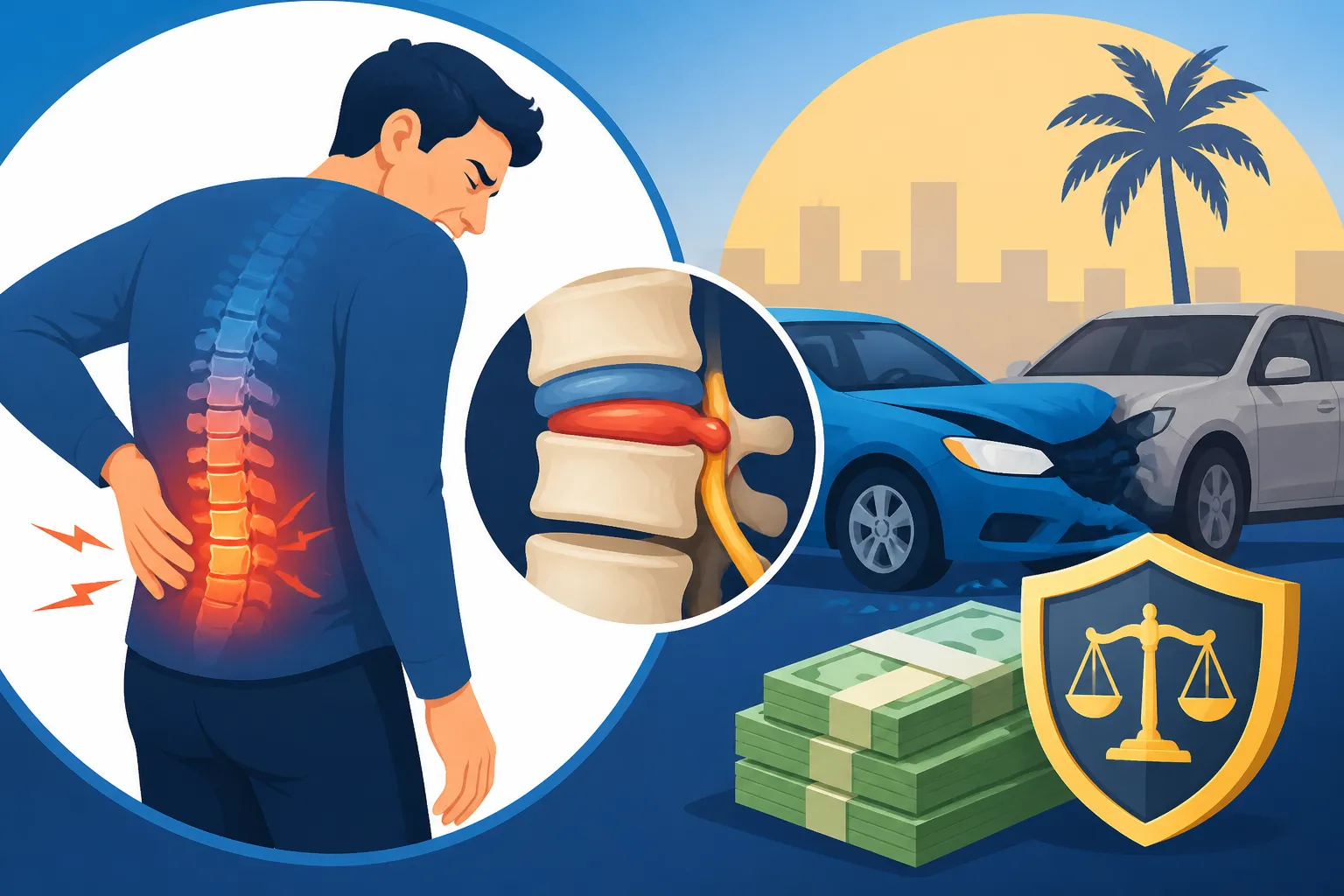
How Much Is a Herniated Disc Settlement Worth in California?
Dealing with a car accident is stressful enough, but discovering you have a herniated disc afterward can turn your world upside down. The pain, the doctor visits, the worry about missing work, and the sheer uncertainty of it all can be overwhelming. If you're wondering how much a herniated disc settlement is worth in California, you're looking for clarity amidst chaos, and this guide is here to walk you through the complexities of valuing such a claim in the Golden State.
Understanding Herniated Discs and Their Impact
A herniated disc, often colloquially referred to as a "slipped disc," occurs when the soft, jelly-like center of a spinal disc pushes through a tear in the tougher outer layer. In the context of a car accident, this usually happens due to the sudden, violent forces of impact, which can twist, compress, or jerk the spine beyond its normal range of motion. The result can be excruciating pain, numbness, weakness, or tingling in the affected area, often radiating down an arm or leg, depending on where the herniation is located in your spine.
How Car Accidents Cause Herniated Discs
The physics of a car crash are brutal on the human body, especially the delicate structures of the spine. During an impact, your body can be thrown forward or backward with immense force, even in a seemingly minor fender bender. This sudden acceleration and deceleration can cause the vertebrae to compress or twist sharply, leading to excessive pressure on the spinal discs. For instance, in a rear-end collision, the head and torso are violently whipped back and forth (whiplash motion), which can rupture a disc in the cervical (neck) or thoracic (upper back) spine. Similarly, side-impact collisions or T-bone accidents can cause severe lateral forces that lead to lumbar (lower back) herniations.
It's not just the immediate jolt; sometimes, the injury isn't apparent right away. Many people experience delayed injury symptoms after a car accident, where the initial adrenaline masks the pain, and symptoms of a herniated disc only emerge days or even weeks later. This delay often leads to people thinking they're fine, only for serious symptoms to develop, making it crucial to seek medical attention promptly after any accident, regardless of how minor it seems.
Common Symptoms and Medical Treatments
The symptoms of a herniated disc can vary widely depending on its location and severity. If the herniation is in your neck (cervical spine), you might experience pain that shoots into your arm or hand, along with numbness, tingling, or weakness. A herniated disc in the lower back (lumbar spine) might cause sciatica – a sharp, shooting pain that travels down your leg and into your foot. You might also struggle with everyday activities like sitting, standing, or walking, and even coughing or sneezing can exacerbate the pain.
Treatment for a herniated disc usually starts conservatively. Doctors might recommend rest, anti-inflammatory medications, physical therapy to strengthen surrounding muscles, or epidural steroid injections to reduce inflammation and pain around the nerve root. For some, chiropractic care might be helpful. However, if conservative treatments don't provide relief, or if there's significant nerve compression causing progressive weakness, surgery might become necessary. Surgical options range from a microdiscectomy, which removes the herniated portion of the disc, to a spinal fusion, which involves joining two or more vertebrae together to stabilize the spine. Each of these treatments carries significant costs, recovery times, and impacts on your daily life, all of which factor into a potential settlement.
Factors Influencing Your Herniated Disc Settlement in California
Determining the "worth" of a herniated disc settlement in California isn't like looking up a price tag. It's a complex calculation influenced by a multitude of factors unique to your specific situation and the nuances of California law. There's no one-size-fits-all answer, but understanding these key elements will give you a clearer picture of what to expect.
Severity of the Injury and Medical Prognosis
The most significant factor influencing your settlement is the actual severity of your herniated disc and your medical prognosis. Was it a small bulge, or a full herniation with nerve impingement? Did it require extensive physical therapy, injections, or did you need surgery? A minor herniation that resolves with a few weeks of physical therapy will naturally result in a lower settlement than a severe herniation requiring spinal fusion surgery, prolonged rehabilitation, and potentially leading to permanent limitations.
Insurance companies will scrutinize your medical records to assess the extent of your injury and treatment. They'll look at the type of doctors you saw (orthopedists, neurologists, pain management specialists), the diagnostic tests performed (MRIs, X-rays, EMGs), and the prescribed treatments. Your long-term prognosis, including whether you've reached Maximum Medical Improvement (MMI) and if you have any permanent impairment or restrictions, will heavily impact the valuation. If your injury is expected to cause chronic pain after a car accident or require ongoing medical care for years to come, that will significantly increase the value of your claim.
Economic vs. Non-Economic Damages
California law allows you to seek compensation for both economic and non-economic damages resulting from your herniated disc injury. Understanding the distinction between these two categories is crucial for grasping how your settlement is calculated.
Economic Damages
Economic damages are the tangible, quantifiable financial losses you've incurred or will incur because of your injury. These are often easier to calculate because they come with receipts, bills, or clear wage statements. They include:
- Medical Expenses: This covers everything from ambulance rides and emergency room visits to specialist consultations, diagnostic tests (MRIs, CT scans), prescription medications, physical therapy, chiropractic care, injections, and any surgical procedures. It also includes future medical expenses you're expected to need, like ongoing therapy or future surgeries.
- Lost Wages: If your herniated disc injury prevented you from working, or forced you to take time off for appointments and recovery, you can claim compensation for these lost earnings. This includes both past lost wages and any future lost earning capacity if your injury impacts your ability to work at your previous level or in your chosen profession.
- Property Damage: While not directly related to your physical injury, any damage to your vehicle or other personal property from the accident is also part of your economic damages claim.
- Out-of-Pocket Expenses: This covers costs like transportation to medical appointments, adaptive equipment, or even household services you had to pay for because you couldn't perform them due to your injury.
Non-Economic Damages
Non-economic damages are far more subjective and represent the intangible losses associated with your injury. These are often the most significant component of a personal injury settlement, especially for severe injuries like a herniated disc. They include:
- Pain and Suffering: This is compensation for the physical pain and discomfort you've endured, both acutely after the accident and potentially long-term. It also covers mental anguish, emotional distress, and the overall disruption to your life.
- Loss of Enjoyment of Life: If your herniated disc prevents you from engaging in hobbies, recreational activities, or even simple daily tasks you once enjoyed, this factor comes into play. For example, if you can no longer play with your children, participate in sports, or engage in your favorite outdoor activities, that's a significant loss.
- Disfigurement or Impairment: While less common for a herniated disc itself, if surgical scars or permanent physical limitations result from the injury, these can be compensated.
The value of non-economic damages is often calculated using a multiplier method, where your total economic damages are multiplied by a certain factor (often between 1.5 and 5, or even higher for very severe cases) to arrive at a figure for pain and suffering. The higher the multiplier, the more severe and long-lasting the pain and disruption. For a deeper dive, you might find our guide on how the pain and suffering multiplier works useful.
Liability and Comparative Negligence in California
California operates under a system of "pure comparative negligence." This means that even if you are partially at fault for the car accident, you can still recover damages from the other driver, but your compensation will be reduced by your percentage of fault. For example, if your total damages are $100,000, but you were found to be 20% at fault, your recoverable settlement would be $80,000.
Establishing clear liability is paramount. If the other driver was 100% at fault, your ability to recover maximum compensation is much stronger. However, if there's any dispute over who is at fault in a car accident, the insurance companies will rigorously investigate, and they might try to assign some percentage of fault to you to reduce their payout. This is where evidence like police reports and car accident fault, eyewitness statements, dashcam footage, and expert accident reconstruction can be critical. Your claim's value hinges significantly on how convincingly you can prove the other driver's negligence was the sole cause, or at least the primary cause, of the accident and your subsequent herniated disc.
Calculating Damages for a Herniated Disc Claim
When it comes to putting a dollar figure on your herniated disc injury, we're really talking about a process of meticulously documenting and valuing all the ways this injury has impacted your life. It's more than just adding up medical bills; it's about projecting future costs and assigning a fair value to your suffering.
Documenting Your Medical Journey
The foundation of any strong car accident claim, especially one involving a complex injury like a herniated disc, is thorough medical documentation. Every doctor's visit, every diagnostic test, every therapy session, and every prescription needs to be recorded.
Think of it as building a story of your injury, told through medical records. This includes initial emergency room reports, MRI results showing the herniation, reports from orthopedic specialists or neurosurgeons, physical therapy notes, and any documentation of injections or surgeries. These records not only prove the existence and severity of your injury but also demonstrate the necessity of the treatments you've received. They also help establish the link between the car accident and your herniated disc, which insurance companies will always try to dispute. Keep track of all your medical bills and statements, even if your health insurance is covering some of them, because you're seeking compensation for the total cost incurred.
Estimating Future Costs and Losses
One of the trickiest but most crucial parts of valuing a herniated disc claim is estimating future costs. Your injury might not be fully healed when you settle your claim, or it might leave you with long-term complications. This is why it's vital to consider all potential future expenses and losses.
This could include ongoing physical therapy, future pain management treatments, potential future surgeries, and prescription medications. If your injury has left you with a permanent disability or limitation, you might also need to account for future lost earning capacity, assistive devices, or even modifications to your home. Medical and vocational experts often play a key role here, providing projections and reports that detail the long-term financial and personal impact of your injury. These expert opinions lend significant weight to your claim, helping to paint a comprehensive picture for the insurance company of what your future holds.
The Role of Pain and Suffering
Pain and suffering are often the largest component of a herniated disc settlement, particularly because these injuries can be incredibly debilitating and long-lasting. Unlike a broken bone that typically heals, a herniated disc can lead to chronic pain, nerve damage, and a significantly reduced quality of life for years, if not permanently.
Insurance adjusters typically calculate pain and suffering by taking your total economic damages (medical bills, lost wages, etc.) and multiplying them by a factor that reflects the severity and duration of your non-economic losses. For a herniated disc that requires extensive treatment, surgery, or causes ongoing limitations, this multiplier could be anywhere from 3 to 5, or even higher in severe cases. For example, if your economic damages total $50,000, and a multiplier of 4 is applied, your pain and suffering could be valued at $200,000. It's not just about the physical pain; it's also about the emotional toll, the anxiety, the depression, and the frustration that comes with a life-altering injury. Documenting pain and suffering through personal journals, witness statements, and psychological evaluations can significantly strengthen this aspect of your claim.
Here's a simplified table illustrating potential settlement ranges based on severity:
| Herniated Disc Severity | Economic Damages (Estimated) | Pain & Suffering Multiplier | Non-Economic Damages (Estimated) | Total Settlement Range (Estimated) |
|---|---|---|---|---|
| Minor (Bulge, no surgery) | $10,000 – $30,000 | 1.5 – 2.5 | $15,000 – $75,000 | $25,000 – $105,000 |
| Moderate (Herniation, injections/therapy) | $30,000 – $70,000 | 2.5 – 4 | $75,000 – $280,000 | $105,000 – $350,000 |
| Severe (Herniation, surgery required) | $70,000 – $200,000+ | 4 – 6+ | $280,000 – $1,200,000+ | $350,000 – $1,400,000+ |
Disclaimer: These figures are highly generalized estimates for informational purposes only and do not represent a guarantee of actual settlement amounts. Every case is unique.
Navigating the Settlement Process in California
The journey from car accident to a final settlement for a herniated disc can be a long and winding road, fraught with negotiations and potential roadblocks. Knowing what to expect in California can help you feel more prepared and in control.
The Initial Claim and Investigation
Once you've sought medical attention and have some initial documentation of your herniated disc injury, the first formal step is to file a car accident insurance claim. This typically involves notifying both your own insurance company and the at-fault driver's insurance company. In California, which is an "at-fault" state, you'll generally be pursuing a third-party claim against the other driver's insurer.
The insurance company will then launch its own investigation. This often includes reviewing the police report, speaking with their insured driver, and potentially contacting you for a recorded statement. While it's important to cooperate, be very cautious about what you say, as anything can be used to minimize your claim. Avoid admitting fault or speculating about your injuries. This is also a critical time to be working on how to prove the other driver was at fault. The insurance company will also typically request a release for your medical records related to the accident. They're looking for anything that might suggest a pre-existing condition or that your injuries aren't as severe as you claim.
Negotiation and Potential Lowball Offers
After their investigation, the insurance adjuster will eventually come back with a settlement offer. This initial offer, especially when dealing with injuries like a herniated disc, is often a lowball insurance offer. It's a common tactic designed to see if you'll accept a quick, cheap payout before you fully understand the extent of your damages or hire legal representation.
It's crucial not to accept the first settlement offer. Your response should typically be a counter-offer, backed by solid evidence of all your damages – medical bills, lost wages, and a detailed explanation of your pain and suffering. This is a negotiation process, and it can go back and forth several times. The adjuster might try to argue that your injuries aren't severe, that your treatment was excessive, or even that your own actions contributed to the accident. They might also pressure you, stating that your claim is taking too long or that they can't offer more. Remaining firm, and having comprehensive documentation, is key to how to counter a low settlement offer effectively.
When a Lawyer Becomes Indispensable
While you can try to handle a minor car accident claim on your own, a herniated disc injury is far from minor, and dealing with it without experienced legal representation can significantly compromise your outcome. An attorney who specializes in car accident cases, especially those involving serious injuries, understands the nuances of California's laws, the tactics insurance companies employ, and how to accurately value all your damages, including future medical costs and pain and suffering.
A lawyer will gather all necessary evidence, from medical records and bills to expert witness testimony (medical, vocational, accident reconstruction). They will handle all communications and negotiations with the insurance companies, protecting you from common pitfalls like providing damaging recorded statements or inadvertently admitting fault. They can also ensure that all relevant legal deadlines, such as California's statute of limitations for car accidents, are met. Most car accident lawyers work on a contingency fee basis, meaning they only get paid if you win your case, making quality legal representation accessible regardless of your current financial situation. If negotiations fail, a lawyer is also prepared to take your case to court, though most car accident cases do settle out of court. They are invaluable for maximizing your car accident settlement and ensuring you receive fair compensation for the long-term impact of a herniated disc.
Disclaimer
Please remember that the information provided in this article is for general informational purposes only and does not constitute legal advice. Every car accident claim is unique, and the value of a herniated disc settlement can vary significantly based on individual circumstances, jurisdiction, and the specific facts of the case. It is highly recommended to consult with a qualified personal injury attorney in California to discuss your specific situation and receive personalized legal guidance.