Who Is at Fault in a Distracted Driving Accident in Texas?
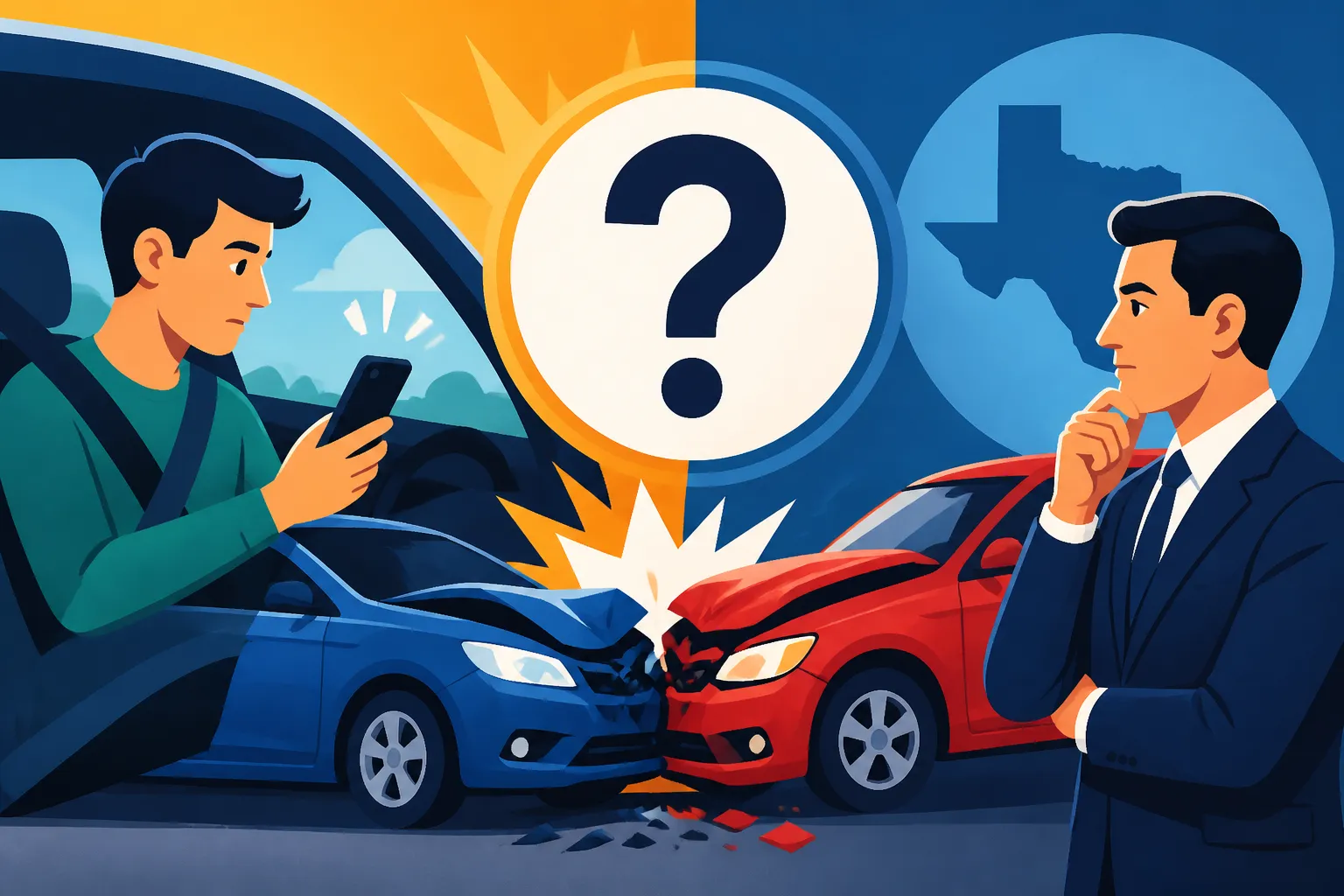
Experiencing a car accident is jarring enough, but when you suspect the other driver was fiddling with their phone or distracted by something else entirely, it adds a whole new layer of frustration and injustice. It feels like such a preventable crash, doesn't it? Figuring out who is at fault in a distracted driving accident in Texas can be a complex puzzle, but this guide will walk you through everything you need to know, from understanding the laws to collecting crucial evidence and navigating the legal landscape.
Understanding Distracted Driving in Texas
Distracted driving isn't just a nuisance; it's a dangerous behavior that puts everyone on the road at risk, and it’s a significant cause of accidents across the Lone Star State. When you're dealing with the aftermath of a collision, especially one where you suspect the other driver wasn't paying attention, the details matter immensely. Texas has specific laws designed to combat this issue, and knowing them is the first step in understanding your rights and building your claim.
Texas Distracted Driving Laws and Penalties
Texas has taken significant steps to address distracted driving, primarily focusing on the use of wireless communication devices. Since September 1, 2017, there has been a statewide ban on texting while driving. This means if a driver is caught sending or reading an electronic message while their vehicle is in motion, they can face fines. It's not just about texting, though; anything that diverts a driver's attention from the primary task of operating a vehicle falls under the umbrella of distracted driving.
Beyond the statewide ban, many Texas cities have implemented their own, often stricter, ordinances regarding cell phone use. For example, cities like Austin, San Antonio, and Dallas have hands-free ordinances, meaning drivers cannot use a handheld cell phone for any purpose—talking, texting, navigating—while driving. This applies even if they are stopped at a red light. Violations can lead to tickets and fines, which are typically civil infractions but can have implications in a personal injury claim if they point to negligence. These local laws create a patchwork of rules, making it crucial to understand the specific regulations in the area where your accident occurred. While these laws provide a legal framework, demonstrating a violation after an accident often requires diligent evidence gathering.
Common Types of Distracted Driving
When we think of distracted driving, our minds often jump straight to cell phones – texting, calling, or endlessly scrolling. And yes, cell phones are a huge culprit. However, distracted driving encompasses a much broader range of behaviors that pull a driver's attention away from the road. Imagine you're on a busy street in Houston, and the car in front of you suddenly swerves. Was the driver checking their GPS, reaching for a dropped item, or trying to settle a squabble in the back seat?
Here are some of the most common forms of distracted driving, which can all lead to severe accidents:
- Manual Distractions: These are actions that cause a driver to take their hands off the steering wheel. This could be anything from eating or drinking, adjusting the radio or climate controls, grooming (applying makeup, brushing hair), or reaching for something on the floor or in the back seat.
- Visual Distractions: These involve taking a driver's eyes off the road. Examples include looking at a GPS device, staring at an accident scene, watching videos, or even focusing on roadside billboards for too long. A moment's glance away at 60 mph means covering a significant distance blind.
- Cognitive Distractions: These are perhaps the trickiest to spot but equally dangerous. They involve taking a driver's mind off the task of driving. This might include deep conversations with passengers, daydreaming, being preoccupied with personal problems, or even listening to an engaging podcast or audiobook that requires too much mental processing.
It’s important to remember that all these types of distractions, individually or in combination, can severely impair a driver's ability to react safely to changing road conditions, leading directly to collisions. Identifying the specific type of distraction is key when you're trying to figure out who is at fault in a car accident.
Proving Fault in a Texas Distracted Driving Accident
Proving fault after any car accident can feel like an uphill battle, especially when you're dealing with injuries and property damage. But when distracted driving is involved, it adds a layer of complexity because the evidence isn't always obvious. Insurance companies and opposing drivers might try to shift the blame. However, with the right approach and meticulous collection of evidence, you can build a strong case to show that the other driver's inattention caused the crash.
Gathering Evidence at the Scene
The moments immediately following an accident are often chaotic and stressful, but they are also crucial for gathering initial evidence that can support your claim. What you do right there and then can make a world of difference later on. Remember, your safety and the safety of others is always the priority, so only proceed with these steps if it's safe to do so.
First and foremost, call 911 to report the accident. Requesting law enforcement to the scene, even for seemingly minor collisions, is always a good idea. The responding officers will typically create a police report, which serves as an official record of the incident. This report will include vital information such as the time and location of the crash, a description of the vehicles involved, and often, an initial assessment of how the accident occurred. While a police report doesn't solely determine fault, it's a critical starting point and can significantly influence how insurance companies determine who is at fault.
Next, if you are physically able, start documenting everything with your phone. Take photos and videos of the accident scene from various angles. Focus on:
- Vehicle Damage: Capture close-ups of damage to all vehicles involved, as well as broader shots showing their final resting positions.
- Road Conditions: Photograph skid marks, debris, traffic signs, signals, and any relevant road hazards.
- Surroundings: Include landmarks, street names, and even the weather conditions.
- The Other Driver: If you suspect distracted driving, try to capture the other driver's behavior or their immediate surroundings. Did you see a phone in their hand? Was there an open fast-food container on their lap? These small details can be surprisingly insightful.
Also, exchange information with the other driver. Get their name, contact information, insurance details, and driver's license number. Be polite but avoid discussing fault or apologizing, as an admission of fault, even unintentional, can be used against you later.
Finally, look for witnesses. If anyone saw the accident happen, ask for their names and contact information. An objective third-party account can be incredibly powerful in corroborating your version of events and strengthening your case. They might have seen the other driver distracted, which you might not have caught in the heat of the moment.
Post-Accident Investigation
While the scene evidence is invaluable, the investigation doesn't stop there. After you've left the accident site and sought any necessary medical attention, there's more to be done to solidify your claim, especially if you believe distracted driving was the cause. This often involves a deeper dive into records and professional analyses.
One of the most compelling pieces of evidence in a distracted driving case is the other driver's cell phone records. If you believe they were texting, talking, or using an app at the time of the crash, these records could prove it. Obtaining these isn't always straightforward; it often requires a legal request or subpoena, as phone records are protected by privacy laws. However, if granted, these records can show call logs, text message activity, and even data usage during the exact time of the accident. This can be a smoking gun, clearly demonstrating that the driver's attention was elsewhere.
Beyond phone records, look for surveillance footage. Many businesses, traffic intersections, and even private homes in urban areas like Fort Worth, Dallas, or Houston have security cameras that might have captured the accident. Dashcam footage from your vehicle or another vehicle passing by could also be invaluable. This visual evidence can objectively show the events leading up to and including the collision, often revealing clear signs of distraction that might not be apparent from static photos.
Another often overlooked source of evidence is social media. While it might seem like a long shot, sometimes individuals will post about their activities or even about the accident itself on platforms like Facebook, Instagram, or X (formerly Twitter). These posts could inadvertently reveal that they were distracted just before the crash or provide information that contradicts their official statement.
Finally, consider the role of expert testimony. Accident reconstruction specialists can analyze physical evidence from the scene – such as vehicle damage, skid marks, and impact points – to determine speed, direction, and even the likely actions of the drivers leading up to the crash. In cases where distracted driving is suspected, these experts can often deduce if a driver's reaction time was unusually slow or if their steering inputs were erratic, consistent with someone who wasn't paying full attention.
The Role of the Police Report
After a car accident in Texas, the police report is often the first official document detailing the incident, and it plays a significant role in the initial stages of a claim. It’s compiled by law enforcement officers who respond to the scene, and it contains a wealth of information that can be incredibly helpful for your case. However, it's crucial to understand that while the police report is highly influential, it isn't the final word on who is at fault.
A well-detailed police report will typically include:
- Officer's Observations: The responding officer will note down their observations about the accident scene, including vehicle positions, damage, road conditions, and any visible evidence of traffic violations.
- Driver and Witness Statements: The report usually summarizes what each driver and any independent witnesses told the officer about how the accident occurred. This is where you might find mention of the other driver admitting they were "just looking at their GPS" or "checking a notification."
- Citations Issued: If the officer observed a traffic law violation, they might issue a citation. A ticket for texting while driving, for instance, can be strong circumstantial evidence of distracted driving. Even if no citation is issued, the officer might note behaviors or conditions that suggest distraction.
- Diagram of the Accident: Many reports include a diagram illustrating the accident, which can visually represent the officers' understanding of the sequence of events.
For a distracted driving accident, the police report can be particularly helpful if the officer included any details about visible cell phone use, erratic driving patterns, or witness statements confirming distraction. Even if the report doesn't explicitly state "distracted driving," notes about the other driver's demeanor, apparent lack of awareness, or even an admission from them that they were looking down can be powerful.
Insurance companies frequently use the police report as a foundational document when they begin their own investigation into an accident. It helps them piece together the initial narrative and can guide their subsequent inquiries. While it doesn't officially declare one party "at fault" in a legally binding sense, it often strongly sways their initial determination. If the report points to distracted driving on the other driver's part, it can set a positive tone for your claim. Conversely, if it contains inaccuracies or overlooks details crucial to your case, it highlights the need for you to gather additional evidence to supplement or even challenge its findings.
How Texas Law Assigns Fault
When you're dealing with the aftermath of a car accident, especially one involving distracted driving, understanding how fault is assigned under Texas law is absolutely critical. It’s not always a straightforward "one person is 100% to blame" scenario. Texas operates under what's called a modified comparative fault system, which can significantly impact your ability to recover damages and the amount of compensation you might receive.
Texas Comparative Fault Law
Texas follows a "modified comparative negligence" rule, often referred to as the 51% bar rule. This means that you can still recover damages even if you were partially at fault for the accident, but only if your percentage of fault is 50% or less. If a jury or insurance company determines that you were 51% or more responsible for the crash, you are legally barred from recovering any compensation from the other party.
Let's break down how this works:
When an accident occurs, particularly one where distracted driving is a factor, both insurance companies and, if necessary, a court, will assess the actions of all drivers involved. They'll look at all the evidence—police reports, witness statements, cell phone records, accident reconstruction, and even your own actions—to assign a percentage of fault to each party.
For example, imagine you were in a collision with a driver who was texting. If the evidence overwhelmingly shows the other driver was 100% at fault due to their distraction, then you would be eligible to recover 100% of your damages. This is the ideal scenario for a victim of distracted driving. However, what if you were also speeding slightly, even though the primary cause was the other driver's distraction? A jury might determine the distracted driver was 80% at fault, but you were 20% at fault for speeding. In this case, under Texas law, you would still be able to recover 80% of your total damages. This is why it's so important to have strong evidence proving the other driver's distraction, as it helps minimize any potential fault assigned to you.
The 51% bar rule can be a major hurdle. If, for instance, a distracted driver swerved into your lane, but you failed to apply your brakes in time, and the jury finds you 60% at fault while the distracted driver is 40% at fault, you would get nothing. This is why thorough evidence collection, accurate representation of events, and often, legal guidance are indispensable when dealing with distracted driving claims in Texas. Knowing that even a small percentage of fault can reduce your settlement or bar it entirely emphasizes the need to present a clear and compelling case. When considering your legal options, understanding the nuances of comparative fault is key to protecting your financial recovery.
Impact on Your Claim
The modified comparative negligence rule in Texas profoundly impacts your car accident claim, especially when a distracted driver is involved. It’s not just an academic legal concept; it directly affects the amount of money you might receive for your medical bills, lost wages, and pain and suffering.
Let's say you've been in a crash on I-35 in Austin, and you firmly believe the other driver was looking at their phone. You've gathered evidence like a police report mentioning a potential texting violation and a witness who saw the other driver looking down. Your total damages—including vehicle repairs, medical treatment for whiplash, and time missed from work—come out to $50,000.
Here’s how the comparative fault rule could play out:
- Scenario 1: You are found 0% at fault. If the insurance adjuster or a jury determines the other driver was entirely responsible because of their distracted driving, you would be eligible to recover the full $50,000 in damages. This is the best-case scenario and what you aim for when you can clearly prove the other driver's sole negligence.
- Scenario 2: You are found 20% at fault. Perhaps during the investigation, it's discovered that you were also driving a few miles over the speed limit. Even though the primary cause of the accident was the other driver's distraction, your speeding contributed slightly to the severity of the crash. If your fault is assessed at 20%, your $50,000 settlement would be reduced by 20% ($10,000). You would then receive $40,000. This still represents a significant recovery, but it shows how your own actions can influence the outcome. Learning about how comparative fault reduces your settlement can be an eye-opener.
- Scenario 3: You are found 51% or more at fault. This is the critical threshold in Texas. Let's say the other driver's attorney argues that while their client was distracted, you made an illegal lane change without signaling, which was a more significant contributing factor to the collision. If a jury agrees and assigns you 55% of the fault, you would recover absolutely nothing, even if the other driver was also negligent. This "51% bar" is why it's so important to not only prove the other driver's fault but also to minimize any blame that could be assigned to you.
Understanding these scenarios highlights why documentation and strong legal representation are so vital in a Texas distracted driving accident. Every piece of evidence you collect to show the other driver's inattention helps reduce your perceived share of the blame and, consequently, maximize your potential settlement. Don't underestimate the power of a solid case that clearly illustrates How to Prove the Other Driver Was at Fault.
| Factor to Determine Fault | Relevance in Distracted Driving Cases | Impact on Claim |
|---|---|---|
| Police Report | Official account, may note citations or officer observations of distraction. | Strong initial evidence, but not definitive. |
| Witness Statements | Direct accounts of driver behavior (e.g., "saw them on their phone"). | Highly persuasive, especially from impartial third parties. |
| Cell Phone Records | Shows call/text/data activity at the time of the crash. | Potentially a "smoking gun" if obtained legally. |
| Surveillance Footage | Visual proof of driver behavior before/during impact. | Objective, irrefutable evidence. |
| Driver's Admissions | Other driver admitting they were distracted (e.g., "I didn't see you, I was looking at my GPS"). | Very strong evidence, but hard to get after the fact. |
| Vehicle Damage/Skid Marks | Expert analysis can infer erratic driving or delayed reactions consistent with distraction. | Supports professional accident reconstruction. |
| Traffic Laws Violated | Citation for texting while driving or local hands-free ordinance. | Legal proof of negligence. |
Navigating a car accident claim when a distracted driver is involved can be incredibly challenging. The legal framework of comparative negligence in Texas means that every detail matters. By thoroughly documenting the scene, collecting robust evidence, and understanding how fault is assessed, you significantly improve your chances of a fair recovery. Remember that filing a claim is a complex process, and knowing What to Do After a Car Accident: Step-by-Step (2027) can help you protect your rights from the very beginning. If you've suffered injuries, don't hesitate to consider if you need a lawyer for a car accident (2026) to help you through the process, especially given the complexities of proving fault against a distracted driver and understanding how much your car accident settlement is worth (2026).
Disclaimer
Please remember that this information is intended for general guidance and informational purposes only, and does not constitute legal advice. Car accident claims are highly specific to individual circumstances and the laws of the jurisdiction where the accident occurred. It is strongly recommended to consult with a qualified legal professional for advice tailored to your specific situation.