Who Is at Fault in a Chain-Reaction Accident in Texas?
Finding yourself caught in a chain-reaction car accident in Texas can feel like a chaotic, bewildering nightmare. You're trying to figure out what just happened, if anyone is hurt, and then the sinking feeling hits you: how on earth is fault determined when so many cars are involved? This guide is here to walk you through the complexities of assigning responsibility in these multi-vehicle pile-ups specifically under Texas law, helping you understand your rights and the next steps.
Understanding Chain-Reaction Accidents in Texas
Let's be real, a car accident is stressful enough, but when it’s not just two cars, but three, four, or even more, it can feel overwhelming. Texas, like many states, has specific rules that apply to these kinds of crashes, and understanding them is your first step toward navigating the aftermath.
What Defines a Chain-Reaction Crash?
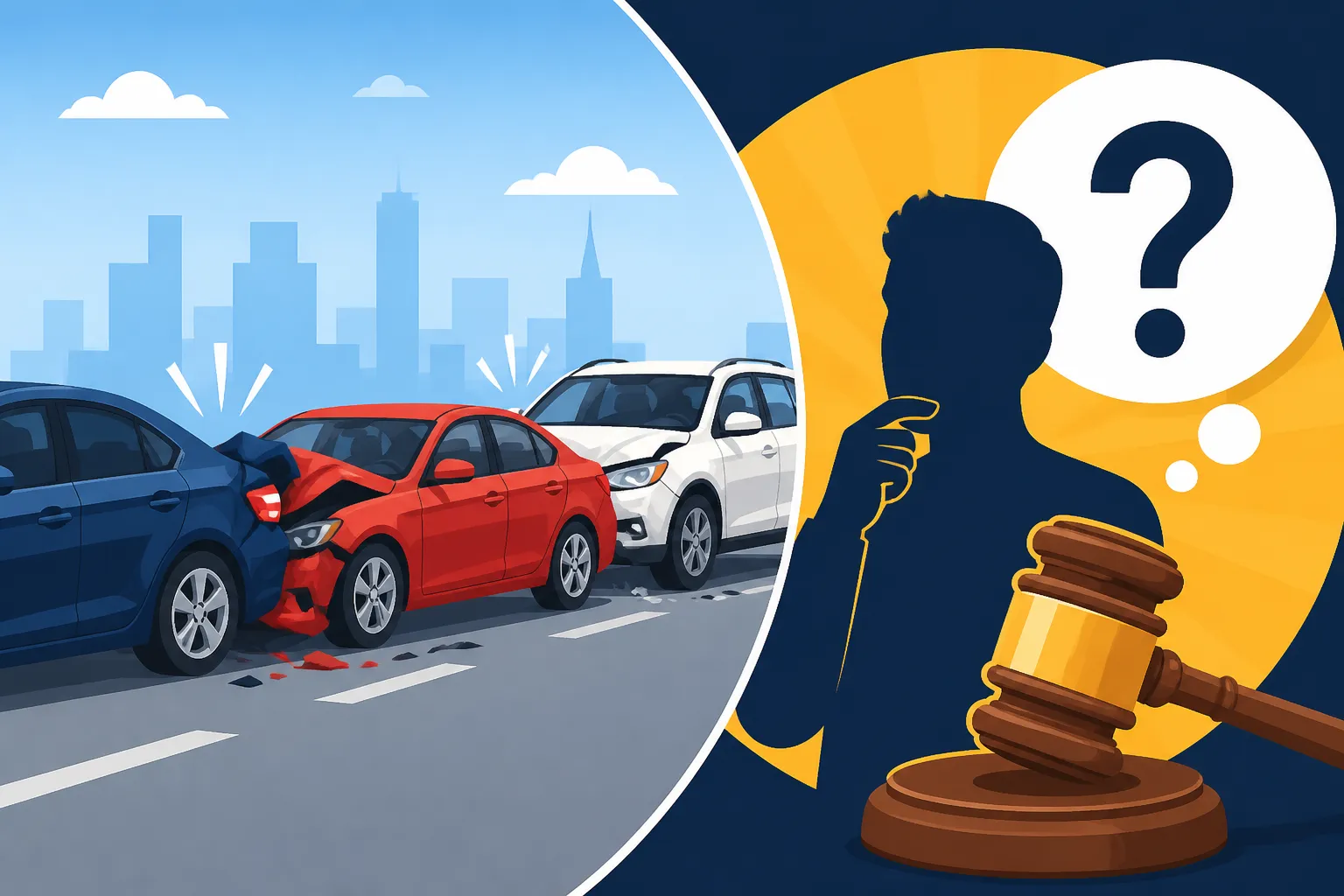
When we talk about a chain-reaction accident, we're usually picturing that classic "domino effect" scenario. Imagine you're stopped at a red light, and suddenly, the car behind you slams into you, pushing your vehicle forward into the car in front of you, which then might get pushed into the one ahead of it. That’s a chain reaction in its purest form. It's characterized by a series of rear-end collisions that happen in quick succession, often stemming from an initial impact that propels subsequent collisions. It's not just a multi-car accident where several cars happen to collide in different ways; it's typically one event triggering the next down the line.
The force of the initial impact can vary wildly, from a gentle tap that nudges cars together to a violent collision that causes significant damage and serious injuries across several vehicles. These incidents are particularly complex because the damage isn't always linear, and the sequence of events can be difficult to piece together without thorough investigation.
Texas's Fault System Explained
Texas operates under a "fault" system for car accidents, which means that the person (or people) responsible for causing the accident are liable for the damages. This is a crucial distinction, especially when you're caught in a chain-reaction scenario. It's not a "no-fault" state where your own insurance simply pays for your injuries regardless of who caused it. Here, establishing blame is paramount.
What makes Texas's system even more nuanced is its adherence to modified comparative negligence, specifically the 51% bar rule. In simple terms, this means that if you are found to be 51% or more at fault for an accident, you cannot recover any damages from the other drivers involved. If you are found to be less than 51% at fault, you can still recover damages, but your compensation will be reduced by your percentage of fault. For example, if you are deemed 20% at fault for a chain-reaction crash and your total damages are $10,000, you would only be able to recover $8,000. This rule is a major factor in how claims are settled and why determining fault is so aggressively contested. Understanding Modified Comparative Negligence (50% vs 51% Bar) is essential when dealing with any car accident claim in Texas.
Determining Initial Fault in a Chain-Reaction Accident
The primary challenge in chain-reaction accidents is untangling the sequence of events and identifying the primary cause. While it might seem like everyone is at fault, Texas law usually tries to pinpoint the driver who started the whole mess.
The "Push" vs. "Pile-Up" Scenario
The most common scenario in a chain-reaction crash involves what we call the "push." This is where a vehicle, often the very last one in the line, initiates the collision by hitting the car directly in front of it with enough force to propel that car into the one ahead, and so on. In such cases, the driver of the initial striking vehicle is usually considered primarily responsible for the entire chain of events. Their negligence—perhaps distracted driving, speeding, or following too closely—is seen as the proximate cause of all subsequent impacts.
However, not all multi-vehicle accidents are pure "push" scenarios. Sometimes, a "pile-up" might occur due to hazardous conditions like dense fog on I-35 outside Waco, black ice on Highway 287 near Amarillo, or sudden heavy rainfall across the Dallas-Fort Worth metroplex. In these situations, drivers might hit each other because they couldn't stop in time, even if they weren't directly "pushed" into another vehicle. Here, fault can become much more distributed, with multiple drivers sharing a percentage of responsibility for failing to drive safely for the conditions or to maintain a safe following distance. The specific force of impact on each vehicle can tell investigators a lot about whether it was a push or a more independent, but related, series of collisions.
Evidence Gathering at the Scene
Collecting thorough evidence at the scene is absolutely critical, especially in a complex chain-reaction accident. The police report, while not always the final word on fault, is an incredibly important piece of evidence. It documents the positions of the vehicles, statements from drivers and witnesses, road conditions, and often includes an initial assessment of how the accident occurred. While a police officer cannot definitively assign legal fault, their observations and diagrams can be highly persuasive to insurance companies and, if necessary, in court. For more information, you can read about Police Reports and Car Accident Fault.
Beyond the police report, eyewitness statements are gold. Did anyone see who hit whom first? Did anyone notice a driver distracted, speeding, or driving erratically before the crash? Dashcam footage, if available from any of the vehicles involved, can provide irrefutable evidence of the collision's sequence. Even photographs and videos you take on your phone showing vehicle damage, road conditions, and traffic signs can be invaluable. Documentation of property damage versus bodily injury claims helps separate the costs associated with vehicles from the costs of physical harm. Remember, the goal is to piece together a clear narrative of how the accident unfolded, which is essential for How Fault Is Determined in a Car Accident.
When Multiple Drivers Share Fault
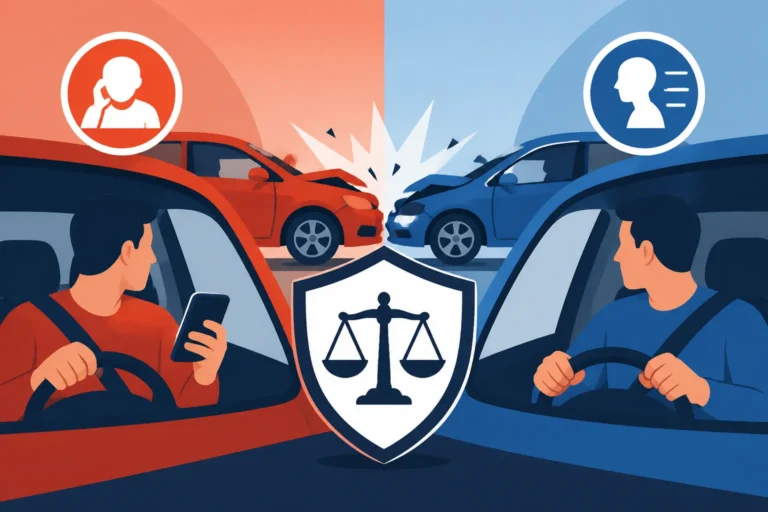
While often one driver initiates a chain reaction, it's not uncommon for multiple drivers to share some degree of fault, especially in complex scenarios. This is where Texas's modified comparative negligence system really comes into play.
Contributing Factors Beyond the Initial Impact
Even if a driver at the very back of the line started the whole chain, other drivers might have contributed to the severity or even the occurrence of subsequent collisions. For instance, if you were following the car in front of you too closely (often referred to as "tailgating"), and that car suddenly stopped due to an impact from behind, your inability to stop in time could be seen as a contributing factor. This is why maintaining a safe following distance is so important, especially on busy Texas highways like Loop 1604 in San Antonio or US-59 entering Houston.
Other factors that could assign partial fault include:
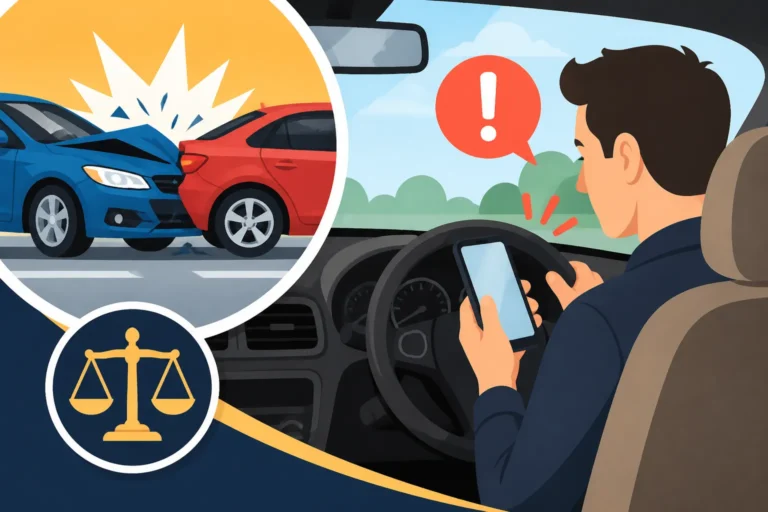
- Distracted Driving: If a driver was texting, talking on the phone, or otherwise not paying attention.
- Speeding: Driving too fast for conditions, even if not over the posted limit, can reduce reaction time.
- Aggressive Driving: Sudden lane changes or braking without warning.
- Vehicle Malfunctions: While less common, issues like faulty brakes could contribute, though this usually shifts liability to the manufacturer or maintenance provider rather than the driver directly.
Insurance companies will scrutinize these details to determine if any other driver's actions contributed to the overall incident. This is why you must avoid any Admission of Fault (and How to Avoid It) at the scene.
The Role of Comparative Negligence in Texas
As mentioned, Texas uses a 51% modified comparative negligence rule. In a multi-car accident, this means that each driver's actions are assessed to determine their percentage of fault. Imagine a four-car chain reaction:
- Car A (front)
- Car B (middle)
- Car C (middle)
- Car D (rear)
Let's say Car D hits Car C, pushing C into B, and B into A. Typically, Car D would bear a significant portion of the fault. However, if investigation reveals Car C was tailgating Car B, and Car B had malfunctioning brake lights that prevented Car C from reacting even if Car D hadn't hit it as hard, the fault might be distributed.
- Car D: 60% at fault
- Car C: 30% at fault (for tailgating)
- Car B: 10% at fault (for faulty brake lights)
- Car A: 0% at fault
In this hypothetical scenario, Car D could recover 40% of their damages from the other parties (assuming they also suffered injuries or property damage, though typically the at-fault driver pays others), Car C could recover 70% of their damages from D and B, and Car B could recover 90% of their damages from D and C. Car A, being 0% at fault, would recover 100% of their damages from the at-fault parties.
It's a complex dance of percentages, and sometimes, Who Is at Fault When Both Drivers Are to Blame? becomes a significant question. If your assigned fault percentage pushes you over that 50% mark, you're out of luck for recovery. This system underscores why meticulous investigation and strong advocacy are essential to protect your claim.
Navigating Insurance Claims and Legal Challenges
Once the immediate dust settles after a chain-reaction accident in Texas, the real work begins: dealing with insurance companies and, potentially, legal proceedings. This phase can be just as challenging, if not more so, than the accident itself.
Dealing with Multiple Insurance Companies
In a multi-vehicle pile-up, you're not just dealing with one other driver's insurance; you could be interacting with several. Each insurance company will naturally try to minimize their own client's liability and shift blame to others. They might contact you for recorded statements, which you should approach with caution. It’s their job to find reasons to reduce payouts, and they'll be looking for inconsistencies or any statements that could imply fault on your part.
You might receive calls from different adjusters representing different drivers. It's crucial to be polite but firm, providing only the facts of the accident without speculating on fault or the extent of your injuries. This is where having your ducks in a row with all your documentation, from the accident scene to medical reports, becomes invaluable. Understanding How Insurance Companies Determine Who Is at Fault can help you anticipate their strategies. You can also learn about How to File a Car Accident Insurance Claim to ensure you're taking the right steps.
Proving Your Case
To successfully pursue a claim, you need to clearly and convincingly prove who was at fault and the extent of your damages. This involves more than just a police report. You'll need:
- Medical Records: Documenting all injuries, treatments, and prognosis. This is essential for understanding Common Car Accident Injuries: Complete Guide (2027).
- Repair Estimates: For vehicle damage.
- Witness Testimonies: Detailed accounts from anyone who saw the accident.
- Traffic Camera/Dashcam Footage: If available, this can be definitive.
- Accident Reconstruction: For highly complex cases, experts can recreate the accident using physics and engineering principles to determine speed, impact points, and fault. This can be particularly useful when you need to How to Prove the Other Driver Was at Fault.
Remember that what happens if you're partially at fault can significantly impact your recovery. The burden of proof rests on you to demonstrate the other party's negligence. If you find yourself in a situation where What Happens If the Other Driver Blames You?, strong evidence and clear communication are your best defenses. Don't forget that What to Do After a Car Accident: Step-by-Step (2027) can guide you through those crucial first moments.
Ultimately, navigating the aftermath of a chain-reaction accident in Texas is a marathon, not a sprint. With multiple parties, competing interests, and the complexities of comparative negligence, it’s a demanding process that often benefits from professional guidance. If you're wondering Do You Need a Lawyer for a Car Accident? (2027), a complex case like a chain-reaction crash is often when legal assistance proves invaluable. This is also a factor in determining How Much Is My Car Accident Settlement Worth? (2026).
Here's a quick overview of common scenarios and typical fault assignments in Texas chain-reaction accidents:
| Scenario Description | Common Cause | Typical Fault Assignment in Texas (General) | Key Considerations for Fault Determination |
|---|---|---|---|
| Rear-End Push | Driver at rear fails to stop, impacts car ahead, pushing it into others. | Primarily the fault of the rearmost driver. | Speed of initial impact, safe following distance of other drivers, working brake lights. |
| Multi-Vehicle Pile-Up (Low Visibility) | Dense fog, heavy rain, or smoke obscures vision, leading to multiple independent but related collisions. | Fault can be distributed among multiple drivers for failing to adjust speed/distance to conditions. | Driver testimonies, weather reports, vehicle inspection for functioning lights. |
| Sudden Stop/Brake Check Initiated | Front car intentionally brakes suddenly, causing rear cars to collide. | Front car driver could be partially or primarily at fault for reckless driving. | Dashcam footage, witness accounts of aggressive driving, traffic flow analysis. |
| Following Too Closely | A driver fails to maintain a safe distance and hits the car in front after an initial impact from behind. | Initial striking driver primarily at fault, but tailgating driver may bear partial comparative fault. | Skid marks, damage analysis, statements on following distance, Texas Transportation Code violations. |
| Distracted Driving Involvement | A distracted driver causes an initial impact or contributes to subsequent collisions. | Fault assigned heavily to the distracted driver. | Cell phone records, witness statements, driver admission (avoid this if possible!), police report observations. |
| Merging/Lane Change Gone Wrong | A driver attempts to merge or change lanes unsafely, causing a multi-car incident. | Fault primarily with the driver making the unsafe maneuver. | Point of impact, traffic laws for merging/lane changing, witness accounts, road markings. |
Dealing with a chain-reaction accident is a serious challenge, and understanding who is at fault is the cornerstone of your recovery process. In Texas, with its unique comparative negligence laws, thoroughly investigating the accident and meticulously documenting every detail are paramount. Don't underestimate the complexity of these situations; what might seem straightforward to you could be a hotly contested point between multiple insurance companies. Protecting your rights and ensuring you receive fair compensation often hinges on a deep understanding of these rules and a robust approach to your claim.
Disclaimer
Please remember that this article provides general information and insights into car accident claims in Texas. It is not intended as legal advice. Every accident is unique, and the specific facts and circumstances of your case will determine the outcome. For personalized legal guidance regarding your situation, it is always recommended to consult with a qualified car accident attorney in Texas.