Who Is at Fault in a Left-Turn Accident in California?
It's a moment many of us dread: you're waiting to make a left turn, the light changes, you think you have a clear shot, and then bam – you're involved in an accident with an oncoming vehicle. Figuring out who is at fault in a left-turn accident in California can feel like navigating a maze, especially when both drivers are pointing fingers. This guide is here to untangle that knot, helping you understand the rules of the road and how fault is typically determined in these confusing collisions.
Understanding Left-Turn Accidents in California
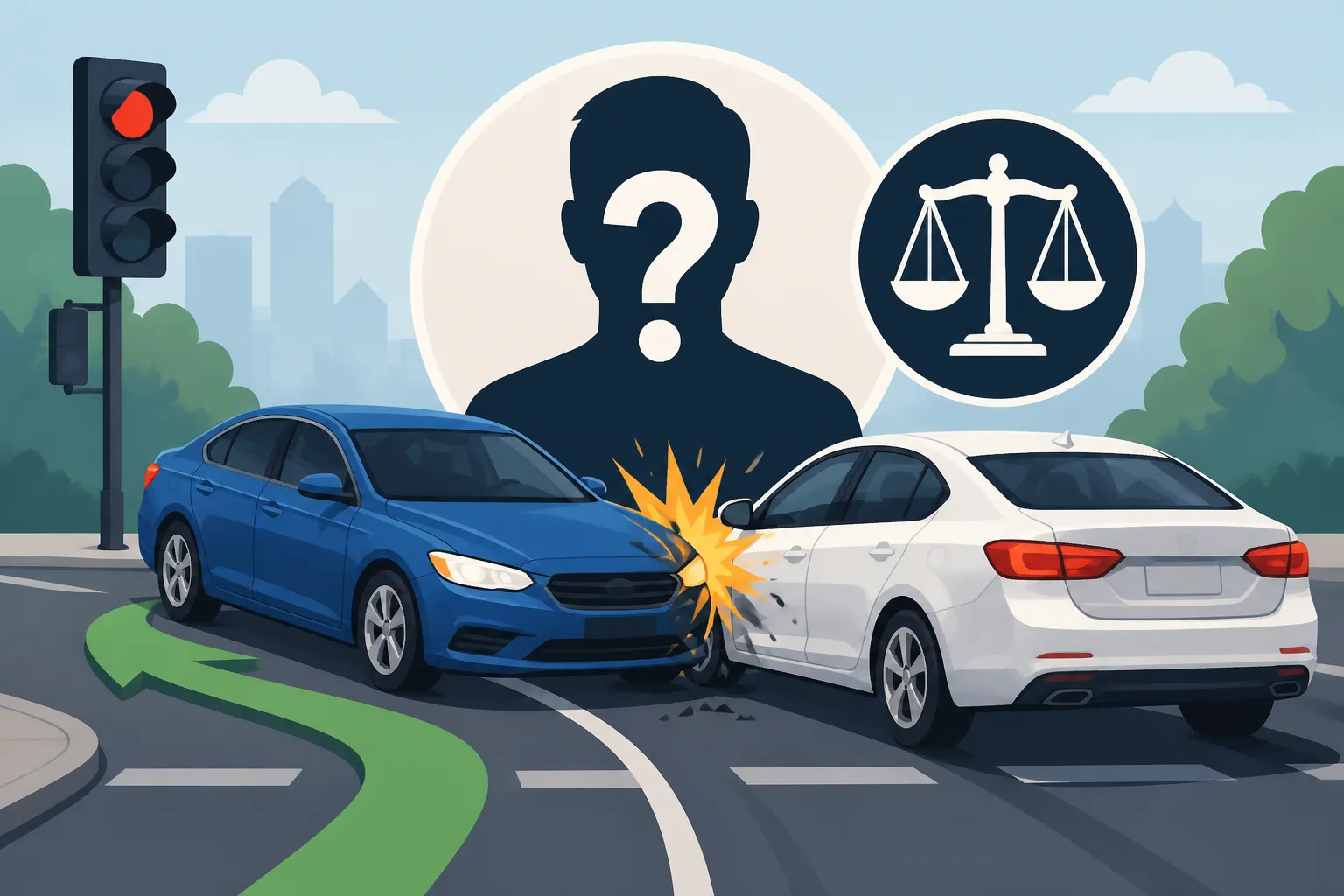
Left-turn accidents are notoriously tricky, often leading to significant damage and injuries because they usually involve one vehicle directly hitting the side of another. In the bustling intersections across California, from the crowded streets of Los Angeles to the busy avenues of San Francisco, understanding the fundamental rules of right-of-way for left turns is crucial for every driver.
The Presumption of Fault for Left-Turning Drivers
When it comes to left-turn accidents in California, there's a strong legal presumption that the driver making the left turn is primarily at fault. Why? Because the law places a high duty of care on the turning driver to ensure the intersection is clear and it's safe to proceed. California Vehicle Code 21801(a) is the key here, stating that a driver intending to turn left "shall yield the right-of-way to all vehicles approaching from the opposite direction which are so close as to constitute a hazard at any time during the turning movement."
Imagine you're at an intersection on a busy street like El Camino Real in Santa Clara. You have a green light, but no green arrow. You're waiting for oncoming traffic to clear, and you spot what you think is a sufficient gap. You start your turn, but then a car coming straight through suddenly seems to accelerate, or you simply misjudged their speed, leading to a collision. In such a scenario, the police, and subsequently the insurance companies, will most likely find you, the left-turning driver, responsible because you failed to yield the right-of-way. This principle applies whether you're dealing with a slow roll into the intersection or a quick dash. It’s all about the reasonable expectation of safety.
California Vehicle Code and Left Turns
Beyond the general duty to yield, specific sections of the California Vehicle Code (CVC) directly address left turns and help solidify who is responsible when an accident occurs. These aren't just dry legal statutes; they are the very foundation upon which fault is assigned in these types of crashes.
CVC 21801(a), as mentioned, is paramount. It emphasizes that the left-turning vehicle must yield to all oncoming traffic, not just some of it. This includes vehicles that might not seem immediately hazardous but could become so during the turn. Then there's CVC 21801(b), which adds another layer of responsibility, stating that a driver having yielded and given a signal may then proceed, and oncoming vehicles must yield to them. However, getting to that point of "having yielded" is often the contested part.
For instance, consider an intersection in downtown San Diego. You’re making a left turn on a green light without an arrow, and an oncoming car hits you. If that oncoming car had plenty of time and space to pass safely before you started your turn, but you proceeded anyway, the CVC puts the onus on you. The law essentially states that you cannot begin your turn until it is truly safe, which means not interfering with the path of any approaching vehicle. The expectation is that you have evaluated the speed and distance of all oncoming vehicles before you commit to the turn. This makes it challenging for a left-turning driver to claim they weren't at fault, but as we'll explore, it's not impossible.
When the Straight-Through Driver Might Be at Fault (or Share Fault)
While the default assumption often leans towards the left-turning driver being at fault, it’s not always a black-and-white situation. There are specific circumstances where the straight-through driver can be held partially or even entirely responsible for a left-turn accident in California. It’s important to remember that every accident is unique, and the full picture needs to be considered.
Speeding or Reckless Driving
One of the most common ways for a straight-through driver to share or assume fault in a left-turn collision is by speeding or driving recklessly. If a vehicle approaches an intersection at an excessive speed, far exceeding the posted limit, it can make it impossible for a turning driver to accurately judge their distance and closing speed. This dramatically alters the safety calculus.
Imagine you're trying to turn left onto Highway 1 in Santa Cruz, waiting for a break in traffic. You see a car a good distance away, judge that you have ample time to turn, and begin to proceed. Suddenly, that car, which was going 70 mph in a 45 mph zone, is on top of you, crashing into your vehicle. In this scenario, while you still had a duty to yield, the excessive speed of the oncoming driver could be deemed a direct cause of the accident, making them substantially, if not entirely, at fault. The fact that their speed made it impossible for you to safely complete your turn shifts the dynamic of responsibility. This is where How Fault Is Determined in a Car Accident gets nuanced.
Running a Red Light or Yellow Light Issues
A critical factor that can completely swing the pendulum of fault is if the straight-through driver ran a red light. If the oncoming vehicle blew through a clearly red signal, they are almost certainly the one at fault, regardless of your left-turn maneuver. In this case, your duty to yield to lawful traffic would be superseded by their clear violation of traffic laws.
However, the "yellow light" scenario can be much trickier. If you, the left-turning driver, started your turn on a stale green or just as the light turned yellow, and the straight-through driver sped up to make it through the yellow light, both parties could potentially share some blame. A common dispute arises when a left-turner alleges they were "clearing the intersection" after the light changed, while the straight-through driver claims they were lawfully proceeding through a yellow light. If the straight-through driver entered the intersection when their light was already red, or even after it had been red for a noticeable period, then the fault would definitively fall on them. This often requires witness testimony, traffic camera footage, or the assessment of a police officer.
Other Contributing Factors
Beyond speeding and red light violations, other actions by the straight-through driver can contribute to or cause a left-turn accident. Distracted driving is a huge concern in California, and if the straight-through driver was texting, talking on the phone, or otherwise not paying attention, their inattention could easily shift fault. They might not have seen your signal or reacted appropriately to your turning movement.
For example, if a driver coming straight through an intersection in Sacramento was looking down at their phone and swerved at the last minute, causing a collision with your left-turning vehicle, their distraction would be a significant factor. Similarly, driving under the influence of alcohol or drugs immediately places a driver at a severe disadvantage in any fault determination. Aggressive driving, such as weaving through traffic or an unsafe lane change just before entering the intersection, could also contribute to the accident. If there was a mechanical failure in the straight-through vehicle that contributed to their inability to stop or maneuver, that could also be a factor, though typically this points to maintenance negligence rather than a spontaneous event. Gathering evidence such as dashcam footage or witness statements, as discussed in How to Document a Car Accident Scene, becomes crucial in these situations to prove the other driver's contributing negligence.
The Role of Comparative Negligence in California
Understanding fault in a left-turn accident in California requires a deep dive into the state’s comparative negligence laws. Unlike some other states where even slight fault can bar you from recovery, California operates under a system designed to ensure that accident victims can still receive compensation, even if they share some responsibility for the crash. This can be a huge relief for drivers feeling unfairly blamed.
California's Pure Comparative Negligence System
California follows a "pure comparative negligence" rule. This means that even if you are found partially at fault for a left-turn accident, you can still recover damages from the other driver. The amount of compensation you receive will simply be reduced by your percentage of fault. There's no cutoff point; you could theoretically be 99% at fault and still recover 1% of your damages. This is a crucial distinction, as some states, like Maryland, follow "contributory negligence" which would bar recovery if you are even 1% at fault.
Let's illustrate this with an example. Suppose you were making a left turn in Oakland, and an oncoming car hit you. After investigating, the insurance companies and perhaps the courts determine that you, the left-turning driver, were 70% at fault for failing to yield, but the straight-through driver was 30% at fault because they were slightly speeding through the intersection. If your total damages (medical bills, lost wages, vehicle repair, pain and suffering) are $100,000, you would still be eligible to recover $30,000 from the other driver's insurance. Conversely, if the straight-through driver's damages were $50,000, they would only recover $35,000 from your insurance. This system ensures that liability is fairly distributed based on each party's contribution to the accident, as explained in What Happens If You're Partially at Fault?. It really puts the emphasis on assigning percentages.
Collecting Evidence to Support Your Claim
In a pure comparative negligence state like California, the more evidence you have, the better your chances of accurately establishing fault and maximizing your potential recovery. Collecting comprehensive evidence immediately after a left-turn accident can make all the difference when dealing with insurance companies and, if necessary, the courts.
Key pieces of evidence include:
- Police Report: While not always definitive, a police report can offer an initial assessment of fault and contain crucial details like witness information, diagrams, and citations issued. It can significantly influence How Insurance Companies Determine Who Is at Fault.
- Witness Statements: Independent witnesses who saw the accident unfold can provide unbiased accounts of what happened, especially regarding traffic light colors, vehicle speeds, and driving behaviors.
- Photos and Videos: Take pictures of the accident scene from various angles, showing vehicle positions, damage, road conditions, traffic signals, and any skid marks. If you have a dashcam, the footage can be invaluable.
- Medical Records: Document all your injuries, medical treatments, and expenses. This substantiates your claims for bodily injury and pain and suffering. Keeping meticulous records is vital for your Car Accident Claim Timeline What to Expect.
- Traffic Camera Footage: Many intersections in California have traffic cameras. While often difficult to obtain directly, your attorney or the police might be able to access relevant footage.
Without strong evidence, it's often your word against theirs, and given the general presumption of fault against left-turning drivers, you might find yourself at a disadvantage. Thorough documentation helps present a clear picture of how the straight-through driver's actions contributed to the collision, thus solidifying your claim under California's comparative negligence rules. This is how you How to Prove the Other Driver Was at Fault.
| Left-Turn Accident Scenario | Typical Fault Assignment in California | Key Factors for Determination |
|---|---|---|
| Left-turn on green vs. straight on green | Left-turning driver (high likelihood) | Failure to yield right-of-way (CVC 21801a). Straight-through driver had lawful right-of-way. |
| Left-turn on green arrow vs. straight on red | Straight-through driver | Straight-through driver ran a red light. Left-turning driver had protected right-of-way. |
| Left-turn on green vs. speeding straight-through | Shared fault (e.g., 70% left-turn, 30% straight) | Left-turner failed to yield; Straight-through driver's excessive speed contributed to collision. |
| Left-turn on green vs. distracted straight-through | Shared fault (proportions vary) | Left-turner failed to yield; Straight-through driver's inattention contributed. |
| Left-turn began on yellow vs. straight entered on red | Straight-through driver | Straight-through driver ran a red light. Left-turner may have been clearing intersection. |
| Left-turner already in intersection vs. straight-through | Shared fault (proportions vary) | Left-turner entered unsafely; Straight-through driver may have had opportunity to avoid. |
Navigating the Claims Process After a Left-Turn Accident
Being involved in any car accident is incredibly stressful, but a left-turn accident in California comes with its own set of challenges, especially when fault is being disputed. Knowing the steps to take immediately after the crash and understanding how to deal with insurance companies can significantly impact the outcome of your claim.
Initial Steps and Information Exchange
The moments right after a collision can be chaotic, but taking a few critical steps can lay a strong foundation for your claim. First and foremost, ensure everyone's safety. Check for injuries and, if anyone is hurt, call 911 immediately. Move your vehicles out of traffic if it's safe to do so, especially on busy California roadways where secondary accidents are a real risk.
Next, it's essential to contact the police, even if the accident seems minor. A police report, as we discussed, provides an official account of the incident and can be incredibly helpful in fault determination. When the police arrive, be factual and avoid admitting fault. Just state what happened from your perspective. After ensuring safety and contacting law enforcement, exchange information with the other driver. This should include:
- Names and contact information
- Insurance company names and policy numbers
- Driver’s license numbers
- Vehicle make, model, year, and license plate numbers
Also, remember to gather evidence at the scene, as outlined above. Take photos and videos of everything – vehicle damage, road conditions, traffic signals, skid marks, and anything else relevant. Look for potential witnesses and get their contact information if they are willing to provide a statement. These immediate actions are crucial for filing a comprehensive insurance claim later on. For a more detailed walkthrough, refer to What to Do After a Car Accident Step-by-Step.
Dealing with Insurance Companies
Once the dust settles, you'll need to report the accident to your insurance company. Even if you believe the other driver is entirely at fault, it's often advisable to inform your insurer. Remember, in California's comparative negligence system, there's always a chance some fault might be assigned to you. When speaking with insurance adjusters, whether from your own company or the other driver's, be polite but guarded.
Insurance companies are in the business of minimizing payouts, and their adjusters are skilled at gathering information that might undermine your claim. This is why giving a recorded statement directly to the other driver's insurance company without consulting an attorney is generally not recommended. Anything you say could be used against you, especially if you accidentally make an admission of fault. Stick to the facts, provide the information you gathered, and let your insurance company handle the bulk of the communication.
Your insurance company will investigate the accident, review the police report, witness statements, and photos to determine fault. This process can take time. If their initial assessment of fault places too much blame on you, or if the settlement offer for your damages feels too low, you have the right to dispute it. This is often where having a knowledgeable car accident attorney can be invaluable. They can negotiate on your behalf, present additional evidence, and ensure your rights are protected, making sure you don't get a lowball insurance offer. Remember, the goal is to secure fair compensation for your injuries and damages, and understanding the nuances of California's fault laws is key to achieving that.
Disclaimer
Please remember that this article provides general information and should not be considered legal advice. Car accident laws are complex and vary by jurisdiction. If you have been involved in a car accident, especially a left-turn accident where fault is disputed, it is highly recommended to consult with a qualified attorney in your area to discuss the specifics of your case.