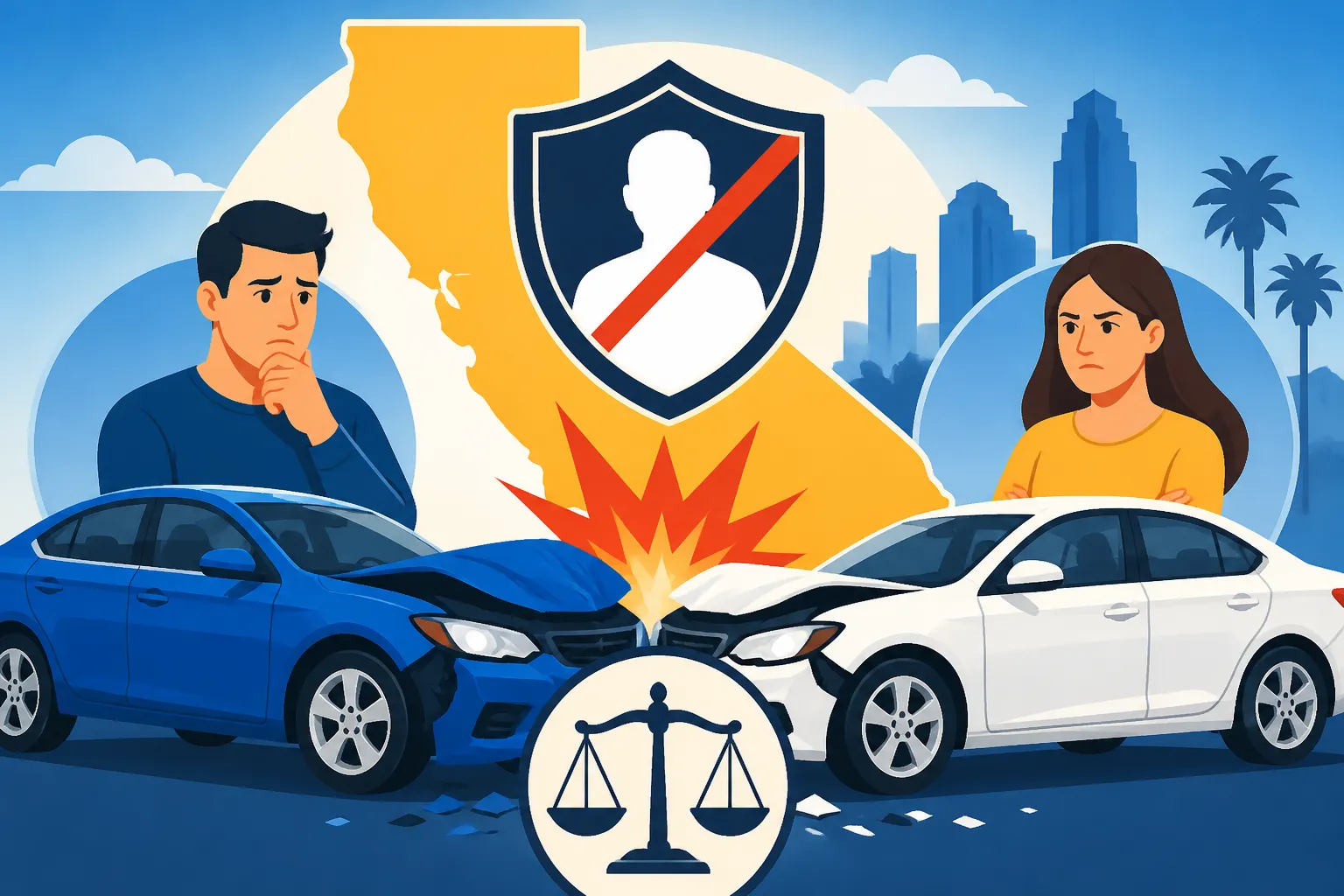
Who Is at Fault in a Uninsured Driver Accident in California?
Getting into a car accident is a jarring, stressful experience for anyone, but discovering the other driver doesn't have insurance can quickly turn that stress into outright panic and confusion. You're left wondering not only about your immediate safety and vehicle damage but also how on earth you're going to get things sorted out when the at-fault party lacks the basic financial responsibility. This guide is here to walk you through how fault is determined in an uninsured driver accident specifically in California and what steps you can take to protect yourself and your claim.
Understanding Fault in California Car Accidents
When two vehicles collide, one of the first and most critical steps is figuring out who caused the accident. This determination of fault is foundational to any car accident claim, as it dictates whose insurance (or lack thereof) will be responsible for damages. California has specific rules that govern this process, and they apply even when an uninsured driver is involved.
California's Comparative Negligence Rule
California operates under a "pure comparative negligence" system. Now, that might sound like a fancy legal term, but what it essentially means is that responsibility for an accident can be divided among all parties involved. Unlike some states where even a tiny percentage of fault might bar you from recovering anything, California allows you to recover damages even if you are mostly to blame. However, your total compensation will be reduced by your percentage of fault.
Let's imagine a scenario: You're driving down a busy street in Los Angeles, perhaps on Wilshire Boulevard. An uninsured driver suddenly pulls out from a side street, causing a collision. Initially, it seems clear they are 100% at fault. However, investigations might reveal that you were slightly speeding, or perhaps you could have taken evasive action to avoid the collision but didn't react quickly enough. In such a case, a jury or an insurance adjuster might determine the uninsured driver was 90% at fault, but you were 10% at fault due to your speed. If your total damages were, say, $10,000, you would only be able to recover $9,000 (100% – 10% = 90% of $10,000). This concept of shared responsibility is a cornerstone of how fault is determined in a car accident in California. It ensures that while the primary at-fault party bears the brunt, all contributing factors are considered. This is a critical distinction, especially compared to states with stricter contributory negligence laws.
General Principles of Fault Determination
Regardless of insurance status, the process of assigning fault in a car accident relies on a collection of evidence and adherence to traffic laws. Law enforcement, insurance adjusters, and sometimes even courts, will look at several key factors to piece together what happened. The goal is to establish negligence, which means demonstrating that a driver failed to act with reasonable care, causing the accident.
This often starts with the scene itself. A police report, for instance, provides an objective account of the officer's observations, diagrams, and initial assessment of violations. While a police report doesn't definitively determine who pays, it carries significant weight and can heavily influence insurance company decisions. Beyond that, physical evidence like skid marks, vehicle damage, and debris scatter can paint a picture of impact points and speeds. Witness statements from bystanders who saw the accident unfold offer valuable third-party perspectives. Even traffic camera footage, if available, can be crucial. For a deeper dive, check out our guide on How Fault Is Determined in a Car Accident. Ultimately, every piece of information helps build a comprehensive understanding of the sequence of events and the actions (or inactions) of each driver involved.
The Uninsured Driver Factor: What Changes in California?
While the general principles of fault remain the same, the fact that a driver is uninsured introduces a significant hurdle, particularly for the uninsured driver themselves. California has a specific rule designed to deter people from driving without the legally required liability insurance.
The "No Pay, No Play" Rule in California
This is where things get really interesting – and often frustrating – for uninsured drivers, even if they're not at fault. California's Proposition 213, often referred to as the "No Pay, No Play" rule, severely limits the ability of uninsured drivers to recover certain types of damages in an accident, even if another insured driver is 100% at fault.
Specifically, an uninsured driver in California can generally still recover economic damages, such as medical expenses (hospital bills, doctor visits, physical therapy), lost wages (time missed from work due to injury), and property damage costs (vehicle repairs or replacement). However, they are barred from recovering non-economic damages. Non-economic damages include things like pain and suffering, emotional distress, loss of enjoyment of life, and other intangible losses that can form a significant portion of a car accident settlement.
Consider our earlier example on Wilshire Boulevard. If the uninsured driver was the one who was 90% at fault, the "No Pay, No Play" rule applies to them. If they were the insured driver who was only 10% at fault, they would still be able to claim non-economic damages, but their compensation would be reduced by their 10% fault. This rule acts as a strong incentive for all drivers to carry adequate insurance, as the consequences of being caught without it can be financially devastating, even if you’re the victim of someone else’s negligence.
Proving Fault Against an Uninsured Driver
Successfully navigating a claim when the other driver is uninsured requires diligent evidence collection. Since there isn't a third-party insurance company for the at-fault driver to immediately step in and assess the claim, the burden of proof often falls more heavily on you and your own insurer, especially if you're filing an uninsured motorist claim.
The first step is always to ensure your immediate safety and seek any necessary medical attention. Once that's handled, document everything you possibly can at the scene. Take clear, well-lit photographs or videos of both vehicles from multiple angles, showing the damage, license plates, and the surrounding environment (road conditions, traffic signs, debris). Get contact information for any witnesses, as their unbiased account can be invaluable. If the police respond, make sure you get the police report number and the officer's name and badge number. This report will be a critical piece of evidence in determining who is at fault in a car accident. Without an insurance company on the other side to do their own investigation, your detailed records become even more crucial for proving the other driver was at fault.
Your Options When an Uninsured Driver is at Fault
Discovering the at-fault driver doesn't have insurance can feel like hitting a brick wall. But rest assured, you still have options to pursue compensation for your damages in California. These options primarily revolve around your own insurance policy or, in some cases, direct action against the uninsured driver.
Utilizing Your Uninsured Motorist UM Coverage
For many Californians, uninsured motorist (UM) coverage is your best friend in this difficult situation. This is a type of coverage that you purchase as part of your own car insurance policy, and it's specifically designed to protect you if you're involved in an accident with an at-fault driver who either has no insurance or not enough insurance. It’s also important to differentiate between Uninsured Motorist Bodily Injury (UMBI) and Uninsured Motorist Property Damage (UMPD).
UMBI covers your medical expenses, lost wages, and pain and suffering if you or your passengers are injured by an uninsured driver. UMPD, on the other hand, covers the cost of repairing or replacing your vehicle if it's damaged by an uninsured driver. California law mandates that insurance companies offer UM coverage, though you have the option to reject it in writing. However, given the high number of uninsured drivers on the road, rejecting this coverage is a risky move. If you have UM coverage, you would file a claim directly with your own insurance company, which would then step into the shoes of the uninsured driver's insurer to cover your damages up to your policy limits. This process can significantly streamline your recovery, though your insurer will still need to investigate and verify fault, much like any other third-party claim. This is essentially how Fault in an Uninsured Motorist Accident claims are processed, offering a vital safety net.
Pursuing a Personal Lawsuit Against the Uninsured Driver
While utilizing your UM coverage is often the most practical route, you do have the legal right to sue an uninsured driver directly for your damages. This means taking them to small claims court (for damages below a certain threshold, currently $12,500 for individuals in California) or superior court for larger claims.
The major challenge here is collecting any judgment you might win. An uninsured driver often lacks the financial resources or significant assets to pay for your damages. Even if a court orders them to pay, actually getting that money can be incredibly difficult, if not impossible. You might find yourself with a judgment but no means to enforce it, leaving you in the same financial predicament you started in. This is why a personal lawsuit is often considered a last resort, particularly for substantial damages, unless the uninsured driver demonstrably has significant assets (like a home or substantial income that can be garnished). It’s a harsh reality, but pursuing an individual who is "judgment proof" can involve significant time, legal fees, and emotional energy with little to no financial return. This is a situation where you might find yourself saying, "What Happens If You Can't Agree on a Settlement?" with the at-fault driver, as they likely have no means to settle.
Navigating the Claims Process After an Uninsured Driver Accident
An accident with an uninsured driver adds layers of complexity to an already confusing situation. Knowing the right steps to take immediately after the incident and throughout the claims process can make a significant difference in your ability to recover.
Immediate Steps After the Accident
The moments immediately following a car accident are critical, even more so when an uninsured driver is involved. Your first priority should always be safety. Move your vehicle to a safe location if possible, and check for injuries. If anyone is hurt, or if there's significant property damage, call 911 immediately to report the accident. It's crucial to have law enforcement respond to create an official record. Even if the accident seems minor, a police report from the California Highway Patrol (CHP) or local police department can be invaluable later on, especially if the uninsured driver later tries to dispute fault or the extent of damage.
While waiting for the police, collect as much information as you can. Get the uninsured driver's name, contact information, driver's license number, and vehicle information (make, model, license plate number). Take photos or videos of the accident scene, including vehicle damage, road conditions, and any relevant traffic signs. Look for witnesses and get their contact information. Lastly, even if you don't feel injured, it's always wise to seek medical attention promptly. Some injuries, like whiplash or concussions, have delayed symptoms after a car accident and might not manifest for hours or even days. Documenting these initial steps is vital for any subsequent claim, whether it's with your own insurer or through legal action. For a full breakdown of what to do, refer to our guide on What to Do After a Car Accident: Step-by-Step (2027).
Working with Your Own Insurance Company
Once you've handled the immediate aftermath, your next call should be to your own insurance company. Even if the accident wasn't your fault, it's usually in your best interest to notify them, especially if you have uninsured motorist coverage. They need to be aware of the incident, and they can guide you through the process of filing a claim under your UM policy. This is particularly relevant if you are wondering, "Should You Call Your Insurance If It Wasn't Your Fault?" The answer, in the case of an uninsured driver, is a resounding yes.
Your insurance company will open a claim and assign an adjuster. This adjuster will investigate the accident, just as they would if the other driver had insurance. They'll review the police report, photos, witness statements, and any medical records you provide to determine fault and assess your damages. If you have UM coverage, your insurer will essentially act as the other driver's insurance, covering your expenses up to your policy limits. They may also attempt to pursue the uninsured driver directly to recover the money they pay out, a process known as subrogation. Be prepared to provide them with all the documentation you collected at the scene. Cooperating fully with your insurer is key to a smooth claims process and helps ensure you receive the compensation you're entitled to under your policy. This is How Car Accident Insurance Claims Work in these specific circumstances, providing a pathway to recovery even without the at-fault driver's insurance.
| Type of Damages | Insured At-Fault Driver | Uninsured At-Fault Driver (claiming against their own UM policy) | Uninsured Driver (at fault, claiming against your policy if they were injured) |
|---|---|---|---|
| Economic | Recoverable | Recoverable | Recoverable (e.g., medical bills, lost wages, property damage) |
| Non-Economic | Recoverable | Recoverable (if you have UMBI coverage) | Not Recoverable (due to California's "No Pay, No Play" rule) |
| Example | Medical bills, lost wages, pain & suffering | Medical bills, lost wages, pain & suffering up to UM limits | Medical bills, lost wages ONLY (no compensation for pain & suffering) |
Disclaimer
Please remember that this article provides general information and is not a substitute for professional legal advice. Car accident laws are complex and vary by jurisdiction. For advice tailored to your specific situation, it is always recommended to consult with a qualified attorney.