Car Accident Reporting Requirements in Arizona
Getting into a car accident is never a pleasant experience. In the immediate aftermath, you’re often reeling from shock, perhaps dealing with injuries, and certainly concerned about your vehicle. On top of all that, a wave of confusion can hit: what exactly are you supposed to do? One of the most critical steps, and often misunderstood, involves fulfilling the car accident reporting requirements in Arizona. This guide will walk you through exactly what Arizona law dictates, when and how you need to report an accident, and why getting it right is so important for your peace of mind and any potential claims.
Understanding Arizona's Accident Reporting Mandates
Arizona has clear laws about when and how you must report a car accident. These aren't just suggestions; they are legal obligations designed to ensure public safety, facilitate insurance claims, and maintain accurate records of incidents on the roads. Navigating these requirements can feel like walking through a maze, especially when you're already stressed, but knowing them upfront can save you a lot of grief down the line. It's not just about the police showing up; there's often another layer of reporting to consider, which many drivers overlook.
When a Police Report Is Required
In Arizona, law enforcement must be called to the scene of a car accident under specific circumstances. Generally, if the accident involves injuries, fatalities, or significant property damage, a police presence is mandatory. This means if anyone involved is hurt, even if it seems minor at the time, or if the collision resulted in a death, you must contact the police. Likewise, if there's substantial damage to any vehicle or property, the police need to be involved. The threshold for what constitutes "significant" property damage can sometimes be a gray area, but generally, if it's more than a fender-bender, it's safer to err on the side of caution and call. For instance, if your car can't be driven away from the scene, or if there's visible structural damage, that definitely qualifies.
It's important to remember that even if you think the damage is minimal and no one is visibly injured, adrenaline can mask pain, and what looks like a small dent could hide significant underlying structural damage. This is why many experts advise calling the police for anything beyond the most trivial scrape. A police report serves as an official, unbiased record of the incident, documenting details like the time, location, parties involved, vehicle information, and often a preliminary determination of fault. This documentation becomes invaluable later on when dealing with insurance companies. If you're wondering, "Do You Have to Call the Police After a Minor Accident?", the answer often depends on these thresholds.
MVD Reporting Requirements for Drivers
Beyond the initial police involvement, Arizona law also requires drivers to file a written accident report with the Arizona Department of Transportation (ADOT) Motor Vehicle Division (MVD) under certain conditions. This is a separate, distinct requirement from any police report filed at the scene, and it's something many drivers unfortunately miss. Arizona Revised Statutes (ARS) §28-667 states that any driver involved in an accident resulting in injury or death, or property damage exceeding $2,000, must submit an accident report. This report is commonly known as the Driver's Crash Report, or form SR-1.
The crucial part here is the $2,000 property damage threshold. If you're in a minor collision where the police weren't called because no one seemed injured and the damage appeared minimal, but then you get an estimate for repairs that exceeds $2,000, you are legally obligated to file this report with the MVD. You have 15 days from the date of the accident to submit this form. Failing to do so can lead to serious consequences, including the suspension of your driver's license, even if you weren't at fault for the accident itself. This is a common pitfall, so always keep that MVD report in mind.
The Process of Reporting a Car Accident in Arizona
Once an accident happens, the immediate aftermath can feel chaotic. However, having a clear, step-by-step process in mind can help you stay calm and ensure you meet all legal requirements. The reporting process typically involves actions at the scene, followed by potential follow-up steps with both law enforcement and the MVD. Remember, your actions in these initial hours and days are critical for both your safety and your future car accident claim. If you're looking for a general guide, consider reviewing What to Do After a Car Accident: Step-by-Step (2027).
Actions at the Scene of the Accident
Your priority at the scene is always safety. First, move your vehicle to a safe location if possible, and turn on your hazard lights. Check on yourself and any passengers, then check on the occupants of the other vehicle(s) involved. If anyone is injured, call 911 immediately. Even if injuries seem minor, medical attention is crucial, and it’s a trigger for police involvement in Arizona. Once emergency services are contacted, focus on gathering information.
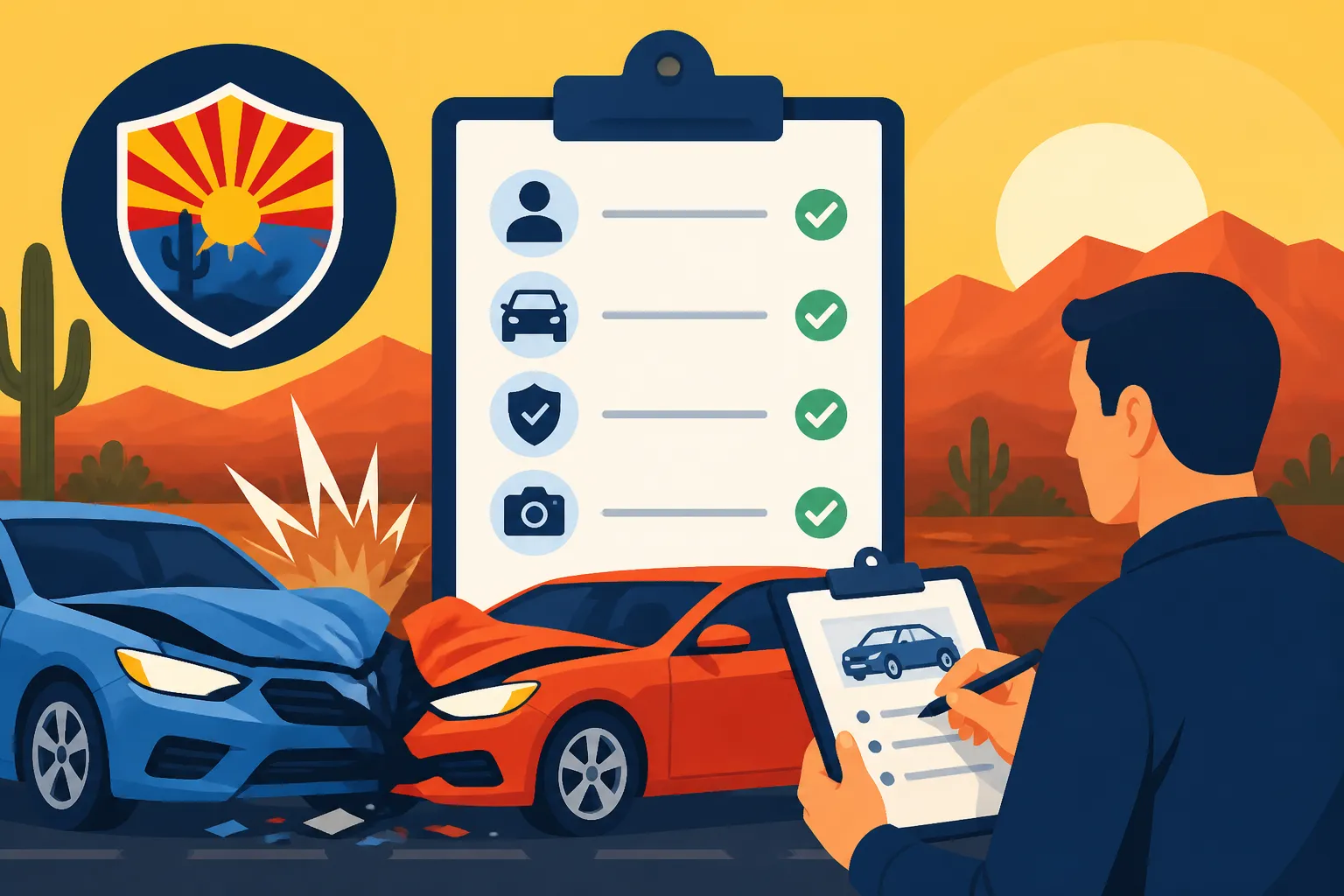
This involves exchanging contact and insurance information with all other drivers involved. Get their full name, phone number, address, driver's license number, license plate number, and insurance company details, including policy number. It's also vital to document the scene as thoroughly as possible. Take photos and videos of the vehicles from multiple angles, showing the damage, the surrounding area, road conditions, traffic signs, and any skid marks. If there are any witnesses, politely ask for their contact information. All this documentation helps paint a clear picture for insurance companies and authorities. Remember, if police respond, they will typically handle much of this information gathering, but it's still wise to collect your own evidence. For more detailed steps on this, see How to Document a Car Accident Scene and What Information to Exchange After a Car Accident.
Filing a Driver's Crash Report (SR-1)
If your accident meets the MVD reporting criteria (injury, death, or property damage exceeding $2,000), you must file a Driver's Crash Report (SR-1). This report is submitted directly to the Arizona MVD. You can usually find the SR-1 form on the ADOT website. It requires detailed information about the accident, including dates, times, locations, details of all vehicles and drivers involved, and a description of the accident itself. You'll need to indicate if there were any injuries or fatalities and provide an estimate of property damage.
It's absolutely critical to complete this form accurately and submit it within the 15-day deadline. Even if the police filed their own report, your obligation to file the SR-1 remains. The police report goes into a law enforcement database, but the SR-1 ensures the MVD has a record and that you've fulfilled your legal requirement as a driver. If you're unsure about the total damage, you should still file the report if you suspect it could exceed $2,000, or if anyone was injured. Better safe than sorry when it comes to keeping your driver's license valid.
Here's a quick summary of the reporting requirements in Arizona:
| Accident Type/Severity | Police Report Required? | MVD SR-1 Form Required by Driver? | Reporting Deadline |
|---|---|---|---|
| Injury or Death | Yes | Yes | Immediately (Police), 15 days (MVD) |
| Property Damage > $2,000 | Yes (Often) | Yes | Immediately (Police if called), 15 days (MVD) |
| Property Damage < $2,000 & No Injury | No (Typically) | No | N/A |
| Hit-and-Run | Yes | Yes (if damage/injury meets threshold) | Immediately (Police), 15 days (MVD) |
Consequences of Not Reporting an Accident
Ignoring Arizona's accident reporting requirements can lead to a host of problems, far beyond a simple slap on the wrist. Many people, especially after minor accidents, might think it's easier to just exchange information and move on, or they might not realize the dual reporting requirements. However, neglecting these duties can have serious legal and financial ramifications that can significantly complicate your life.
Legal Penalties and Driver's License Suspension
Failing to comply with ARS §28-667 by not filing the Driver's Crash Report (SR-1) when required can result in legal penalties. The most immediate and impactful consequence is often the suspension of your driver's license. This can happen even if you weren't at fault for the accident itself. The MVD doesn't care about fault when it comes to reporting; they care about compliance with the law. Imagine being unable to drive to work or pick up your kids, all because you missed a filing deadline for a form you didn't even know existed.
Beyond license suspension, you could face fines or other administrative actions. For example, if you were involved in a hit-and-run and didn't report it, the penalties escalate significantly, potentially involving criminal charges. Even if it's not a hit-and-run, simply failing to report an accident that causes the requisite damage or injury is a violation of traffic law. This could be viewed negatively by a judge or prosecutor, adding unnecessary stress and cost to an already difficult situation.
Impact on Insurance Claims and Liability
One of the biggest reasons to adhere strictly to reporting requirements is the profound impact it has on your insurance claim. Without a police report or a properly filed SR-1, proving the details of your accident becomes much harder. Insurance companies rely heavily on official documentation to process claims, determine fault, and ultimately decide on payouts. If you didn't report the accident to the police or MVD, the insurance company might deny your claim, argue that the damage wasn't from the accident, or dispute the extent of injuries.
A missing police report can also complicate How Fault Is Determined in a Car Accident. If there's no official record from law enforcement, it can become a "he said, she said" scenario, making it harder for your insurance to advocate on your behalf, especially if the other driver is uncooperative or provides a different version of events. In Arizona, which follows a modified comparative negligence rule, your percentage of fault can significantly impact your settlement. A lack of official documentation could hinder your ability to prove the other driver's full responsibility or defend yourself if the other party tries to assign you more blame than you deserve. This is why addressing What If There Was No Police Report? can be so challenging.
The Critical Role of Accident Reports in Your Claim
Accident reports, whether from law enforcement or filed with the MVD, are more than just bureaucratic paperwork. They are foundational documents that can make or break your ability to recover damages and receive fair compensation after a car accident. Understanding their importance from the outset can help you prioritize these steps even amidst the stress of a collision. These reports provide an objective, third-party account that can cut through disputes and misunderstandings.
Proving Fault and Damages
An official accident report is often the first piece of evidence an insurance company will look at. It provides key details like the date, time, and location of the crash, the names and contact information of all involved parties, vehicle details, and most importantly, a description of how the accident occurred. In many cases, the police officer's report will also include observations about road conditions, traffic control devices, and even a preliminary assessment of fault, sometimes issuing citations. While a police officer's fault determination isn't legally binding, it carries significant weight with insurance adjusters.
This documentation is essential for proving not only Who Is at Fault in a Car Accident? but also the extent of the damages. The report can describe vehicle damage and initial reports of injuries, linking them directly to the accident. Without this initial record, it becomes much easier for insurance companies to question the validity of your claims, suggesting that damages or injuries might have occurred elsewhere or were pre-existing. It's truly a cornerstone for any future discussions about compensation for medical bills, lost wages, and property repairs. When you consider How Car Accident Insurance Claims Work, the report is a critical starting point.
Supporting Personal Injury Claims
If you or your passengers sustained injuries in the accident, the official accident report takes on even greater significance. Even seemingly minor injuries like whiplash can have long-term effects. The report serves as early documentation that injuries were sustained at the time of the accident. This helps establish the necessary link between the collision and your need for medical treatment. Without a police report or a timely filed SR-1, proving this causal connection can become a considerable hurdle, making it easier for insurance companies to deny or minimize your claim.
Furthermore, if your injuries are severe, leading to significant medical expenses, lost income, or long-term care, a robust official report provides undeniable evidence that the incident occurred and was reported according to Arizona law. This evidence will be crucial as you pursue a How to File a Car Accident Insurance Claim and negotiate for a fair settlement. Always remember that insurance companies are businesses, and they will look for any reason to reduce their payout. Providing them with official, complete documentation from the beginning helps protect your interests and strengthen your position. If you can't file a claim for days after an accident, the official report can still anchor your narrative.
Navigating Specific Scenarios
Every car accident is unique, and sometimes the circumstances can make reporting feel even more confusing. What if the other driver left? What if you were on private property? Arizona law tries to cover many of these scenarios, but knowing the nuances can make a big difference in how you respond and report.
Hit-and-Run Accidents in Arizona
Hit-and-run accidents are particularly distressing. You're left with damage, potentially injuries, and no information about the at-fault driver. In Arizona, if you are involved in a hit-and-run, you must report it to the police immediately. The law requires you to report any accident involving damage or injury, and a hit-and-run is no exception. Contacting law enforcement as soon as possible gives them the best chance to investigate, potentially locate the other driver, and create an official report.
Even if the other driver isn't found, the police report is still critical for your insurance claim. It serves as proof that the accident occurred and that the other party fled the scene. This documentation allows you to file a claim under your uninsured motorist coverage (if you have it) for bodily injury and sometimes property damage, or under your collision coverage. Without a police report, your insurance company might be hesitant to cover the damages, suspecting fraud or a non-accident related incident. So, when dealing with a hit-and-run, your first call after ensuring safety should be to the police.
Accidents on Private Property
Many drivers mistakenly believe that accident reporting requirements don't apply if the crash happens on private property, like in a parking lot. While the immediate police response might differ depending on the specific jurisdiction's policies for private property accidents, the MVD reporting requirements in Arizona still apply if the damage or injury thresholds are met. If there's an injury or property damage exceeding $2,000, you are still legally obligated to file the SR-1 form with the MVD within 15 days.
Even if the police don't come to the scene on private property, it's highly recommended to at least try and get an incident report from the local police department. Some departments will send an officer, especially if there's significant damage or injury. Regardless, gather as much information as possible from the other driver and document the scene extensively. Who Is at Fault in a Parking Lot Accident? can sometimes be tricky to determine without clear traffic laws, making your own documentation even more vital. This thoroughness will be essential when you approach your insurance provider.
The Impact of Fault on Reporting
While fault plays a huge role in How Fault Affects Your Insurance Claim and ultimate liability, it generally does not exempt you from reporting requirements in Arizona. Whether you believe you were 100% at fault, 0% at fault, or somewhere in between, if the accident meets the reporting thresholds (injury, death, or $2,000+ in property damage), you still have a legal duty to report it to the MVD by filing the SR-1.
The reporting requirements are about the occurrence of the accident itself, not about who caused it. Even if you're certain the other driver was entirely to blame, failing to submit your SR-1 could lead to your license suspension. This is a common misconception that can catch drivers off guard. Always separate the act of reporting from the question of fault. Address your legal reporting obligations first, then focus on building your case regarding fault with your insurance company.
Disclaimer
Please remember that this information is for educational purposes only and should not be considered legal advice. Car accident laws and reporting requirements can be complex and may change. It is always recommended to consult with a qualified legal professional for advice tailored to your specific situation.