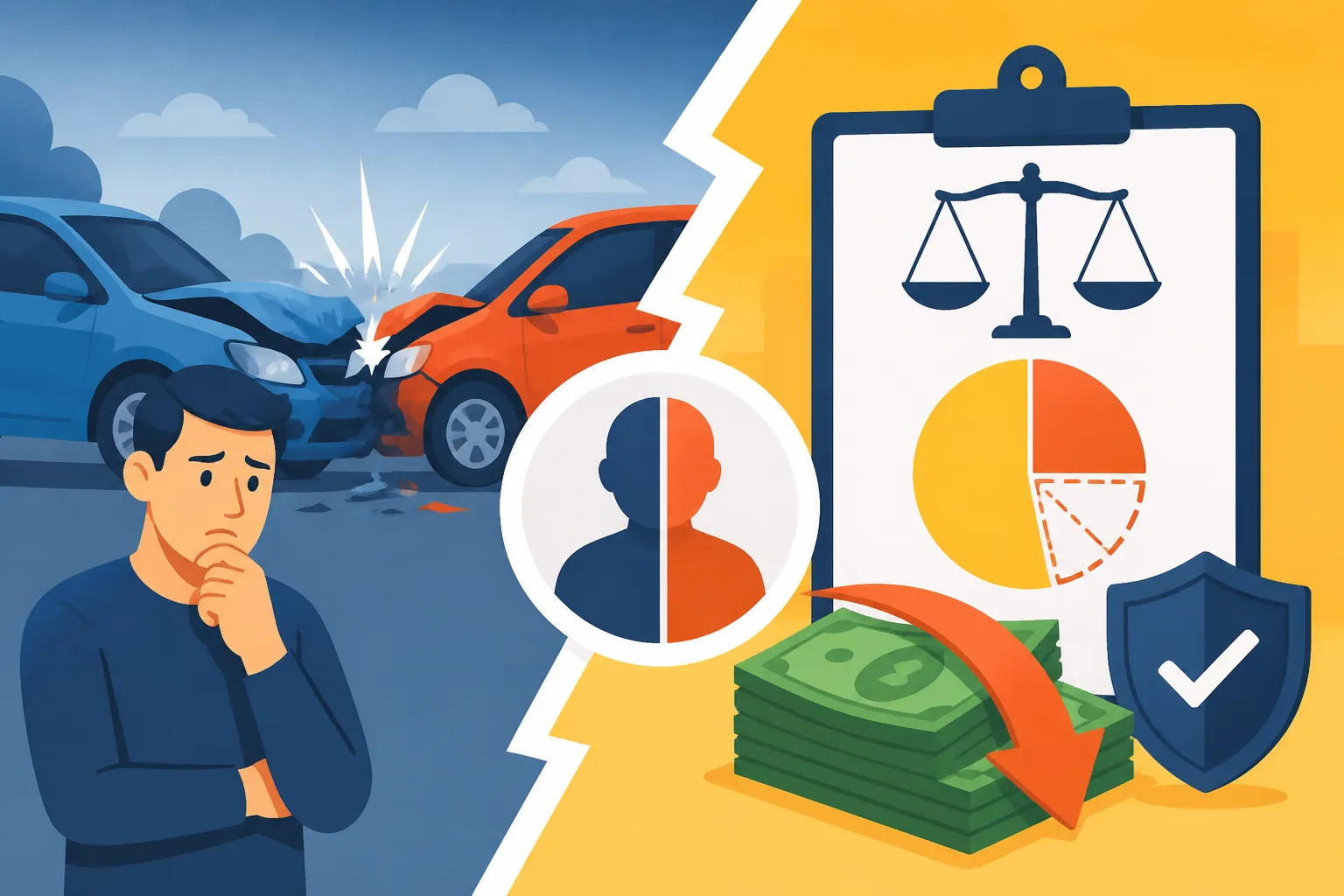
How a Settlement Changes If You’re Partly at Fault
It's a truly unsettling experience to be involved in a car accident, but what happens when you suspect, or are outright told, that you might share some of the blame? That nagging question, "How does a settlement change if you're partly at fault?" can keep you up at night, creating immense anxiety about your recovery and financial future. This guide aims to clear up that confusion, diving deep into how partial fault impacts your car accident settlement and what you can do to navigate this complex situation.
Understanding the Legal Landscape of Partial Fault
When you're involved in a car accident, the legal system needs a way to figure out who's responsible for the damage and injuries. It's rarely black and white, and often, more than one person could have contributed to the crash. This is where the concept of "partial fault" comes into play, and it's absolutely crucial to grasp because it dictates how much compensation you can expect – or owe.
The Core Concepts: Negligence and Causation
At its heart, any car accident claim revolves around the legal concept of negligence. In simple terms, negligence means that someone failed to act with the reasonable care that a prudent person would have exercised in a similar situation, and this failure caused harm. For instance, if a driver was texting and swerved, hitting your vehicle, their texting is a negligent act. But what if you were also speeding slightly, even if they swerved into you? That's where things get complicated.
The court or insurance company will look at all the circumstances surrounding the collision to determine who, if anyone, was negligent and to what degree their negligence caused the accident. This isn't about assigning moral blame; it's about allocating legal responsibility. If multiple parties contributed to the crash, they all might share some percentage of the fault. For example, if one driver ran a stop sign but the other driver was also excessively speeding through the intersection, both actions contributed to the severity, or even occurrence, of the crash. The challenge lies in accurately assessing these contributions, which can feel incredibly subjective when you're in the thick of it. Understanding Who Is at Fault in a Car Accident? Complete Guide can give you a broader perspective on how these determinations are made.
Comparative vs. Contributory Negligence Explained
The way your settlement is affected by partial fault depends almost entirely on the specific laws of the state where the accident occurred. There are two primary legal frameworks that states use to handle situations where both parties are found to be at fault: contributory negligence and comparative negligence. These aren't just legal terms; they are literally the difference between recovering compensation and getting nothing at all, even if the other driver was mostly to blame. It's a huge source of frustration for many accident victims, as they assume logic will prevail, but state laws can be quite rigid.
Let's break down the critical differences between Comparative vs Contributory Negligence Explained. In a pure contributory negligence state, if you are found to be even 1% at fault for the accident, you are completely barred from recovering any damages from the other party. Imagine the frustration: the other driver blew a stop sign, but because you were technically one mile over the speed limit, you get nothing. It feels incredibly unfair, and indeed, very few states still operate under this strict rule.
Most states, however, follow some form of comparative negligence. This system is generally seen as more equitable because it allows you to recover damages even if you were partly at fault, but your recovery will be reduced by your percentage of blame. So, if you're found to be 20% at fault for an accident and your total damages are $100,000, you would only be able to recover $80,000. It still stings to lose a portion of your compensation, but it's a far cry from receiving nothing. These distinctions are absolutely vital when you're trying to figure out if you Can You Still Get Paid If You're Partly at Fault?
How Different States Handle Partial Fault
The specific rules governing partial fault vary significantly from state to state, making it a potential minefield if you're not aware of the local laws. It's not enough to know you were "partly at fault"; you need to understand precisely what that means in your jurisdiction. This patchwork of laws is one of the biggest challenges for individuals trying to navigate the aftermath of an accident on their own.
Pure Comparative Negligence States
In states that practice pure comparative negligence, you can recover damages from the other at-fault driver no matter how much fault you carry, even if you are mostly to blame for the accident. The only catch is that your compensation will be reduced by your percentage of fault. For example, if an accident occurred in California, which is a Pure Comparative Negligence States Explained, and you were found to be 70% at fault, but your total damages amounted to $100,000, you could still recover $30,000 (100% – 70% = 30%).
This system aims to ensure that everyone pays for the portion of the damages they caused, even if one party's fault is substantially higher than the other's. While it might seem generous, insurance companies in these states will fight tooth and nail to assign a higher percentage of fault to you, knowing that every percentage point directly reduces their payout. It means that while you can theoretically recover, the battle over fault percentage can be intense. States like California, Florida, and New York operate under this pure comparative negligence rule.
Modified Comparative Negligence States
The majority of states fall under the modified comparative negligence rule, which adds a crucial threshold to the recovery process. This rule comes in two main forms: the 50% bar rule and the 51% bar rule. This is where the intricacies really start to impact potential settlements.
50% Bar Rule: In states adhering to the 50% bar rule, you can only recover damages if your percentage of fault is 49% or less. If you are found to be 50% or more at fault, you are completely barred from recovering any compensation. This is a significant cut-off point. Imagine being deemed 50% at fault; you would receive nothing, even if the other driver was equally negligent. This rule pushes insurance companies and legal teams to try and shift just enough blame to you to cross that 50% threshold.
51% Bar Rule: More common than the 50% bar, states with the 51% bar rule allow you to recover damages as long as your fault is 50% or less. If your fault is determined to be 51% or more, you cannot recover. This means if you are 50% at fault, you can still collect half of your damages, but if you're deemed 51% at fault, your claim becomes worthless. This one percent difference can mean hundreds of thousands of dollars in a severe injury claim. Understanding the nuances of Modified Comparative Negligence (50% vs 51% Bar) is absolutely essential to manage expectations for your claim. States like Texas, Ohio, and Illinois are examples of those that use a modified comparative negligence system, often with the 51% bar.
Strict Contributory Negligence States
While rare, a handful of states still follow the incredibly strict Contributory Negligence States (Where 1% Fault Bars Recovery) rule. In these states, if you are found to be at fault for any percentage, even just 1%, you cannot recover any damages from the other party. Period. This is the harshest rule and can be devastating for accident victims.
For instance, if you're in Maryland, Virginia, North Carolina, or Alabama, and the insurance company or court determines you contributed to the accident in any way, your claim is essentially over. This draconian rule puts immense pressure on accident victims to prove they were entirely blameless, which is often an uphill battle against aggressive insurance adjusters. If you find yourself in an accident in one of these states, seeking immediate legal advice is not just recommended, it's absolutely critical, as the burden of proof for zero fault is exceptionally high.
Here’s a simplified table to help visualize how your recoverable damages change based on different state negligence laws, assuming your total damages are $10,000 and the other driver's damages are also $10,000:
| State Negligence Rule | Your Fault Percentage | Other Driver's Recoverable Damages (from you) | Your Recoverable Damages (from other driver) |
|---|---|---|---|
| Pure Comparative | 20% | $8,000 | $8,000 |
| Pure Comparative | 50% | $5,000 | $5,000 |
| Pure Comparative | 80% | $2,000 | $2,000 |
| Modified (50% Bar) | 49% | $5,100 | $5,100 |
| Modified (50% Bar) | 50% | $5,000 | $0 (Cannot recover) |
| Modified (51% Bar) | 50% | $5,000 | $5,000 |
| Modified (51% Bar) | 51% | $4,900 | $0 (Cannot recover) |
| Contributory | 1% | $9,900 | $0 (Cannot recover) |
Note: In this table, "Other Driver's Recoverable Damages (from you)" assumes the other driver is also filing a claim and recovering damages from you based on their fault percentage, illustrating a scenario where both parties sustain damages and share fault.
The Impact of Partial Fault on Your Settlement
So, you've been in an accident, and the question of fault is now on the table. This isn't just an academic discussion; it directly translates into dollars and cents, affecting everything from your medical bill coverage to compensation for your pain and suffering. The realization that your own actions might reduce your payout can be incredibly frustrating, especially when you feel the other driver was primarily to blame.
How Your Percentage of Fault Reduces Payouts
In any comparative negligence state, the more fault that is assigned to you, the less money you will ultimately receive in a settlement. This is the fundamental way How Comparative Fault Reduces Your Settlement. The reduction is a direct percentage. If your total damages are calculated at $50,000, and you are found to be 25% at fault, your settlement will be reduced by 25%. This means you would receive $37,500 ($50,000 – 25% = $37,500).
This calculation applies to all forms of damages: medical expenses, lost wages, vehicle repair costs, and even non-economic damages like pain and suffering. Insurance adjusters are keenly aware of these rules and will often try to inflate your percentage of fault to minimize their company's payout. They might scrutinize every detail of the accident, looking for any minor infraction or even perceived delay in your actions to assign a higher percentage of blame. This can feel like they're trying to nickel-and-dime you, and that feeling isn't entirely unfounded.
Economic vs. Non-Economic Damages and Partial Fault
When you make a claim after a car accident, you're generally seeking two types of damages: economic and non-economic. Both are subject to reduction based on your assigned percentage of fault.
- Economic Damages: These are quantifiable financial losses, such as medical bills, lost wages, property damage (car repair or replacement), and future medical expenses. If you incurred $10,000 in medical bills and $5,000 in lost wages, your total economic damages are $15,000. If you are 30% at fault, you would only recover $10,500 of those economic damages. The figures are concrete, but the reduction is equally concrete.
- Non-Economic Damages: These are more subjective losses that don't have a direct monetary value, such as pain and suffering, emotional distress, loss of enjoyment of life, and disfigurement. Calculating these can be complex, often involving multipliers of economic damages. If your pain and suffering was valued at $30,000 (after applying a multiplier), and you are 30% at fault, your recovery for non-economic damages would also be reduced by 30%, meaning you'd receive $21,000 for that portion of your claim.
It's common for insurance adjusters to dispute the value of non-economic damages even in clear-cut fault cases. When partial fault is involved, they have an additional lever to pull, arguing that because you bear some responsibility, your suffering or emotional distress is somehow less deserving of full compensation. This approach can be particularly frustrating for accident victims who are genuinely struggling with long-term pain or emotional trauma.
The Role of Insurance Adjusters in Assigning Fault
Insurance adjusters play a pivotal role in determining fault, and their assessment directly impacts your settlement. They are not neutral parties; their primary goal is to protect the insurance company's bottom line. Their process for How Insurance Companies Determine Who Is at Fault involves reviewing police reports, witness statements, photographs, video footage, and sometimes even accident reconstruction reports.
When partial fault is a factor, adjusters become even more meticulous, looking for any piece of evidence that can increase your percentage of blame. They might point to your speed, a slightly worn tire, a momentary lapse of attention, or even how you responded immediately after the crash. They might even try to get you to admit fault or give a recorded statement that could be used against you. It's a high-stakes game of assigning percentages, and the adjuster's initial determination is often just that – an initial determination, not the final word. This is often where disputes arise, and victims feel like they are being blamed unfairly for something that wasn't primarily their fault.
Strategies for Maximizing Your Claim Even When Partly at Fault
Feeling partly at fault for an accident doesn't mean you should just give up on your claim. While it's true that your settlement might be reduced, there are still crucial steps you can take to protect your rights and maximize the compensation you receive. It requires diligence, swift action, and often, expert help.
Gathering Evidence to Dispute Fault
One of the most powerful things you can do is to meticulously gather and preserve evidence immediately after the accident. This documentation can be your strongest weapon against an unfair fault assessment by an insurance company. Don't assume the police report tells the whole story, or that the other driver's insurance will be objective.
- Photographs and Videos: Use your phone to take as many photos and videos as possible at the scene. Capture damage to all vehicles, skid marks, road conditions, traffic signs, debris, relevant intersections, and any visible injuries. The more visual evidence you have, the harder it is for an adjuster to paint a different picture of the accident.
- Witness Statements: If there are any witnesses, get their contact information. A third-party account can be incredibly valuable in corroborating your version of events and refuting claims of higher fault. Even if they didn't see the entire sequence, their perspective on specific elements (like weather, traffic flow, or post-impact positions) can be crucial.
- Police Reports: While not always the definitive word on fault, a police report provides an official account and often contains crucial details like diagrams, citations issued, and statements from drivers and witnesses. Get a copy of the Police Reports and Car Accident Fault as soon as it's available.
- Medical Records: Document all your injuries and treatments, no matter how minor they seem initially. Seeing a doctor immediately after the accident creates a clear link between the crash and your injuries, which is vital for proving damages and refuting arguments that your injuries are unrelated or exaggerated.
The goal here is to build a robust narrative that supports your lower percentage of fault, or at least challenges an inflated fault assignment by the other side.
The Importance of Legal Counsel
When fault is disputed, or you're assigned even a small percentage of blame, the value of an experienced car accident attorney becomes immeasurable. This isn't just about fighting; it's about navigating a system designed to protect insurance companies.
An attorney can:
- Investigate Independently: They can conduct their own investigation, gathering evidence you might miss, such as traffic camera footage, cell phone records, or expert accident reconstruction analysis. This can be critical in challenging an initial fault assessment.
- Understand State-Specific Laws: Your attorney knows the nuances of your state's comparative or contributory negligence laws and how they apply to your specific case. They can explain exactly What Happens If You're Partially at Fault? and your options.
- Negotiate with Insurance Companies: Insurance adjusters are less likely to employ aggressive tactics or lowball offers when dealing with a lawyer. Your attorney will handle all communication, ensuring you don't accidentally say something that could jeopardize your claim. They know how to counter offers and present your case effectively.
- Protect Your Rights: If the insurance company unfairly blames you or offers an inadequate settlement, your attorney can advise you on whether to file a lawsuit and represent you in court if necessary. They ensure you aren't taken advantage of simply because you might share some minor blame. For complex cases involving significant injuries or disputed fault, getting a lawyer is often the difference between a fair settlement and walking away with nothing.
Negotiating with Insurers
Even with partial fault, negotiation is key. Never accept the first offer, especially if you feel the fault assessment is unfair. Insurance companies start low, and they expect you to negotiate.
- Understand Your Claim's Value: Before negotiating, have a clear idea of your total damages, including current and future medical expenses, lost wages, property damage, and a reasonable estimate for pain and suffering. This allows you to negotiate from an informed position.
- Present Your Evidence: Systematically present all the evidence you've gathered that minimizes your fault. This could include witness statements, photos that show the other driver's primary negligence, or expert opinions. Your attorney will be crucial in compiling and presenting this effectively.
- Be Patient but Firm: Negotiations can take time. Don't feel pressured to accept a quick settlement. Be firm in your position, especially if you believe the fault assessment is disproportionate. Your attorney can provide a buffer, allowing you to focus on recovery while they handle the back-and-forth. If you receive a lowball offer, knowing How to Deal With a Lowball Insurance Offer can empower you to push for more. Remember, your percentage of fault directly affects How Comparative Fault Reduces Your Settlement, so fighting for a lower percentage can significantly increase your take-home amount.
Common Scenarios Where Partial Fault Arises
Understanding how partial fault works in theory is one thing, but seeing it in real-world scenarios makes it much clearer. It's often not about a single, obvious mistake, but a combination of factors that contribute to an accident. Many drivers are surprised to learn they might be partially at fault in situations they initially thought were entirely someone else's responsibility.
Rear-End Accidents with Shared Blame
You might think that in a rear-end collision, the rear driver is always at fault. While this is often true, there are specific situations where the lead driver can share some blame. This can be a source of significant confusion and frustration for the person who was hit from behind.
For instance, if you stop suddenly without warning (e.g., slamming on your brakes for no apparent reason, rather than reacting to an emergency), or if your brake lights were not functioning properly, you might be assigned a percentage of fault. While the trailing driver still has a responsibility to maintain a safe following distance, your actions could have contributed to their inability to avoid the collision. Similarly, if you were making an unsafe lane change and then had to brake abruptly, the scenario shifts. Even a broken taillight could become a point of contention for an insurance adjuster trying to assign you some fault. This is why thorough documentation of your vehicle's condition and the accident scene is so important for a Rear-End Collision Fault: Who Is Responsible?.
Left-Turn Accidents and Fault Allocation
Left-turn accidents are notoriously complex when it comes to fault, and it's quite common for both drivers to share some degree of responsibility, even if one party clearly violated a right-of-way. The driver making a left turn typically has the burden of yielding to oncoming traffic. However, this doesn't automatically mean they are 100% at fault in every instance.
Consider a scenario where the left-turning driver initiated their turn, but the oncoming vehicle was speeding excessively or ran a red light. In such a case, the oncoming driver's negligence could contribute to the crash, assigning them a percentage of fault despite the left-turner’s initial responsibility. An insurance adjuster might argue that even if the oncoming car was speeding, the left-turning driver still had a duty to ensure the turn was safe. Conversely, if the oncoming driver had a green light but was distracted by their phone, their distraction could be a factor. Figuring out Left-Turn Accident Fault Rules often requires careful examination of traffic signals, vehicle speeds, and witness testimonies.
Multi-Car Pileups
Multi-car pileups, often seen on highways or in adverse weather conditions, are perhaps the most complicated scenarios for fault allocation. When several vehicles are involved, it becomes incredibly difficult to determine exactly who hit whom, in what order, and whose negligence contributed to the overall chain reaction. Everyone involved might be pointing fingers, and insurance companies are often eager to spread the blame as widely as possible.
For example, in a chain-reaction rear-end crash, the initial rear-ending driver might be primarily at fault. However, if a driver in the middle of the chain failed to brake or maintain a safe distance, or if another driver initiated an unsafe lane change that exacerbated the situation, they could also be assigned a percentage of blame. Factors like heavy fog, icy roads, or distracted driving by multiple parties can make fault incredibly murky. This is where expert accident reconstruction can become critical, as simply looking at the final resting positions of the vehicles often doesn't tell the full story. Understanding Who Is at Fault in a Multi-Car Pileup often requires an extensive investigation, and it’s a situation where having legal counsel is almost always beneficial.
Working with Insurance Companies When You're Partly at Fault
Dealing with insurance companies after any car accident can be stressful, but when you're partly at fault, that stress amplifies significantly. You might feel like you're already on the defensive, and knowing how to navigate these interactions can mean the difference between a fair outcome and a frustrating battle that leaves you short-changed.
Reporting the Accident When You're Potentially at Fault
It's natural to hesitate when reporting an accident if you think you might be partly to blame. You might worry about your insurance rates going up or facing legal repercussions. However, you generally have a contractual obligation to report accidents to your own insurance company, regardless of fault. Delaying or avoiding reporting can actually cause more problems, potentially violating your policy terms.
When you do report, be factual and stick to what you know. Avoid speculating about fault or making admissions like, "It was probably my fault because I wasn't looking." Let the investigators determine fault. Simply state what happened: where and when the accident occurred, the vehicles involved, and any immediate observable damage or injuries. Your insurer will conduct their own investigation, and having accurate information from the start is crucial. Remember, your own insurance company is there to defend you, even if you are partially at fault, up to your policy limits.
Dealing with Your Own Insurance vs. the Other Driver's
This is a critical distinction, especially when partial fault is involved. You will likely be dealing with two insurance companies: your own (first-party) and the other driver's (third-party).
- Your Own Insurance (First-Party Claim): Your insurance company will process your claim for damages to your vehicle (if you have collision coverage) and medical expenses (if you have MedPay or PIP, depending on your state). They will also defend you if the other driver makes a claim against you. While they will investigate to determine fault, their primary interest is to protect you, their policyholder. It's usually safe to be open and honest with your own insurer, as they are contractually obligated to work on your behalf.
- The Other Driver's Insurance (Third-Party Claim): This is where you need to be much more cautious. The other driver's insurance company represents their client, not you. Their goal is to pay out as little as possible, and they will likely try to assign as much fault as possible to you to reduce their payout. You are generally not obligated to give them a recorded statement, and it's often advisable not to do so without consulting an attorney. Any information you provide can and will be used against you to increase your percentage of fault and diminish your claim. If you're wondering Should You Call Your Insurance If It Wasn't Your Fault?, the answer is generally yes, but be careful with the other party's insurer.
What to Do If Insurance Blames You Unfairly
It's a common and incredibly frustrating experience to feel like the insurance company is unfairly blaming you for an accident. When they assign you a higher percentage of fault than you believe is accurate, it directly impacts your recoverable settlement. Don't just accept their initial assessment.
First, revisit all your evidence. Do your photos, witness statements, or police report details contradict their claims? Compile everything that supports your lower fault percentage. Next, calmly and factually dispute their assessment. Write a letter or email outlining why you believe their fault determination is incorrect, citing specific evidence. If they base their fault assignment on an inaccurate police report, understand that Police Reports and Car Accident Fault can be challenged, and an attorney can help you do this.
If the insurance company remains unyielding, this is a strong indicator that you need to consult with a car accident attorney. An attorney can present your case in a more compelling way, often negotiating a more favorable fault assignment or even pursuing legal action if necessary. They know What to Do If Insurance Blames You Unfairly and have the experience to challenge adjusters who are trying to shift blame to protect their bottom line. Don't let the insurance company's initial opinion be the final word on your case; you have the right to dispute their findings and fight for a fairer outcome.
Disclaimer
Please note that this article is intended for informational purposes only and does not constitute legal advice. Car accident laws are complex and vary significantly by state. You should consult with a qualified attorney for advice regarding your individual situation.