How Fault Affects Your Insurance Claim
Getting into a car accident is jarring enough, but the real headache often begins when you try to sort out the aftermath, especially when it comes to insurance. One of the biggest stressors is figuring out who is actually responsible, and perhaps more importantly, how that determination of fault is going to impact your ability to get your car fixed, cover your medical bills, and ultimately receive compensation. This guide is here to walk you through the complex world of fault in car accidents, explaining exactly how it can make or break your insurance claim, and what you can do to protect yourself.
Understanding Fault: The Foundation of Your Claim
When a car accident happens, the first thing insurance companies (and often the police) try to figure out is who caused it. This isn't just about pointing fingers; it's about assigning legal responsibility, which directly translates into financial liability. Without a clear understanding of fault, you're essentially walking into a negotiation blind, and that's a position no one wants to be in when dealing with car repairs, medical costs, and lost wages.
The Basic Principle of Negligence
At its core, fault in a car accident claim usually comes down to a legal concept called "negligence." This means someone failed to exercise reasonable care while driving, and that failure directly led to the accident and your injuries or damages. Think about it: every time you get behind the wheel, you have a duty to drive safely and follow traffic laws to protect yourself and others. When someone breaches that duty – maybe by speeding, texting, or running a red light – they are considered negligent.
For example, if a driver blows through a stop sign because they were distracted by their phone and T-bones your vehicle, their actions clearly show a breach of their duty to drive safely. This negligence would establish them as the at-fault party. Insurance companies will look at every detail, from traffic laws to witness statements, to build a picture of who acted negligently and to what degree. It's not always a cut-and-dry situation, which is why it can feel so frustrating when you're trying to prove your side.
Immediate Aftermath: Why Initial Actions Matter
What you do (or don't do) in the moments and days following an accident can significantly affect how fault is determined later on. It’s a chaotic time, full of adrenaline, and it’s easy to overlook crucial steps. However, gathering the right information, or failing to do so, can either solidify your claim or leave you scrambling to prove your innocence.
One of the most critical steps is to properly What to Do After a Car Accident: Step-by-Step (2027). This includes exchanging information with the other driver, taking photos of the accident scene, vehicle damage, and any visible injuries, and getting contact information from witnesses. If possible, call the police to the scene, even for minor accidents. A police report, while not always the final word on fault, provides an objective account of the scene and the officers' initial assessment. This official documentation can be a powerful piece of evidence when the insurance companies start their investigations. Without this immediate documentation, it often becomes a "he said, she said" scenario, which can be incredibly difficult to untangle.
Types of Fault Systems: How Your State Matters
It would be a lot simpler if every state handled car accident fault the same way, but unfortunately, that's not the case. The rules vary wildly, and understanding your state's specific system is absolutely crucial. These differences can mean the difference between recovering full compensation, partial compensation, or nothing at all.
Pure Contributory Negligence
This is the toughest system for accident victims, and thankfully, it's rare, only used in a handful of states like Alabama, Maryland, North Carolina, and Virginia, as well as the District of Columbia. In a pure contributory negligence state, if you are found to be even 1% at fault for the accident, you are completely barred from recovering any damages from the other driver. Yes, you read that right – 1%.
Imagine you're driving slightly over the speed limit (let's say 5 mph over), and another driver blows a stop sign and T-bones you. In a pure contributory negligence state, if the court or insurance company determines that your minor speeding contributed to the accident in any way, even minimally, you might not be able to recover a dime for your medical bills, lost wages, or vehicle damage. This system can be incredibly harsh and disproportionate, leaving seriously injured victims with no recourse. This is why it's vital to understand Contributory Negligence States (Where 1% Fault Bars Recovery) if you live in one of these areas.
Modified Comparative Negligence
This is the most common system across the United States. Modified comparative negligence allows you to recover damages even if you're partly at fault, but only up to a certain threshold. There are two main versions: the 50% bar rule and the 51% bar rule.
- 50% Bar Rule: In states like Texas, Ohio, and Oregon, if you are found to be 50% or more at fault for the accident, you cannot recover any damages. If you are 49% or less at fault, you can recover, but your compensation will be reduced by your percentage of fault. So, if you suffered $10,000 in damages and were found 20% at fault, you would only be able to recover $8,000 (a 20% reduction).
- 51% Bar Rule: States like Illinois, Colorado, and New Jersey follow this rule. Here, you can recover damages as long as you are not more at fault than the other driver(s). In other words, if you are 50% or less at fault, you can recover damages, reduced by your percentage of fault. If you are found 51% or more at fault, you are barred from recovery. This distinction between 50% and 51% can feel like splitting hairs, but it makes a huge difference in how much compensation you might receive or if you receive any at all. It's precisely this kind of nuance that can make Modified Comparative Negligence (50% vs 51% Bar) so confusing for accident victims.
Pure Comparative Negligence
Pure comparative negligence is generally considered the most forgiving system for accident victims because it allows you to recover damages even if you are mostly at fault for an accident. States like California, Florida, and New York operate under this rule. In these states, your compensation will simply be reduced by your percentage of fault, no matter how high that percentage is.
For example, if you are found 90% at fault for an accident that caused you $10,000 in damages, you could still recover $1,000 (10% of your total damages). While it might seem odd to recover anything when you're mostly to blame, the idea is that you shouldn't be completely shut out from compensation if someone else also contributed to the crash. This system ensures that all parties bear responsibility proportionate to their share of fault, which can be a relief if you're worried about What Happens If You're Partially at Fault?.
No-Fault Systems
Some states, like Florida, Michigan, New York, and Pennsylvania, have what are known as "no-fault" insurance systems, at least for minor injuries. This doesn't mean fault is completely irrelevant; it just changes how you initially seek compensation for medical expenses and lost wages. In a no-fault state, your own insurance company, specifically through your Personal Injury Protection (PIP) coverage, typically pays for your medical bills and lost wages regardless of who caused the accident. This helps streamline the process for less severe injuries and often avoids lengthy fault disputes for minor crashes.
However, fault still becomes critically important if your injuries meet a certain threshold (often defined by medical cost or severity), allowing you to step outside the no-fault system and pursue a claim against the at-fault driver for additional damages, including pain and suffering. So, while What Is a No-Fault State? (And Which States Are No-Fault) might seem to simplify things, understanding fault remains essential for serious injury claims.
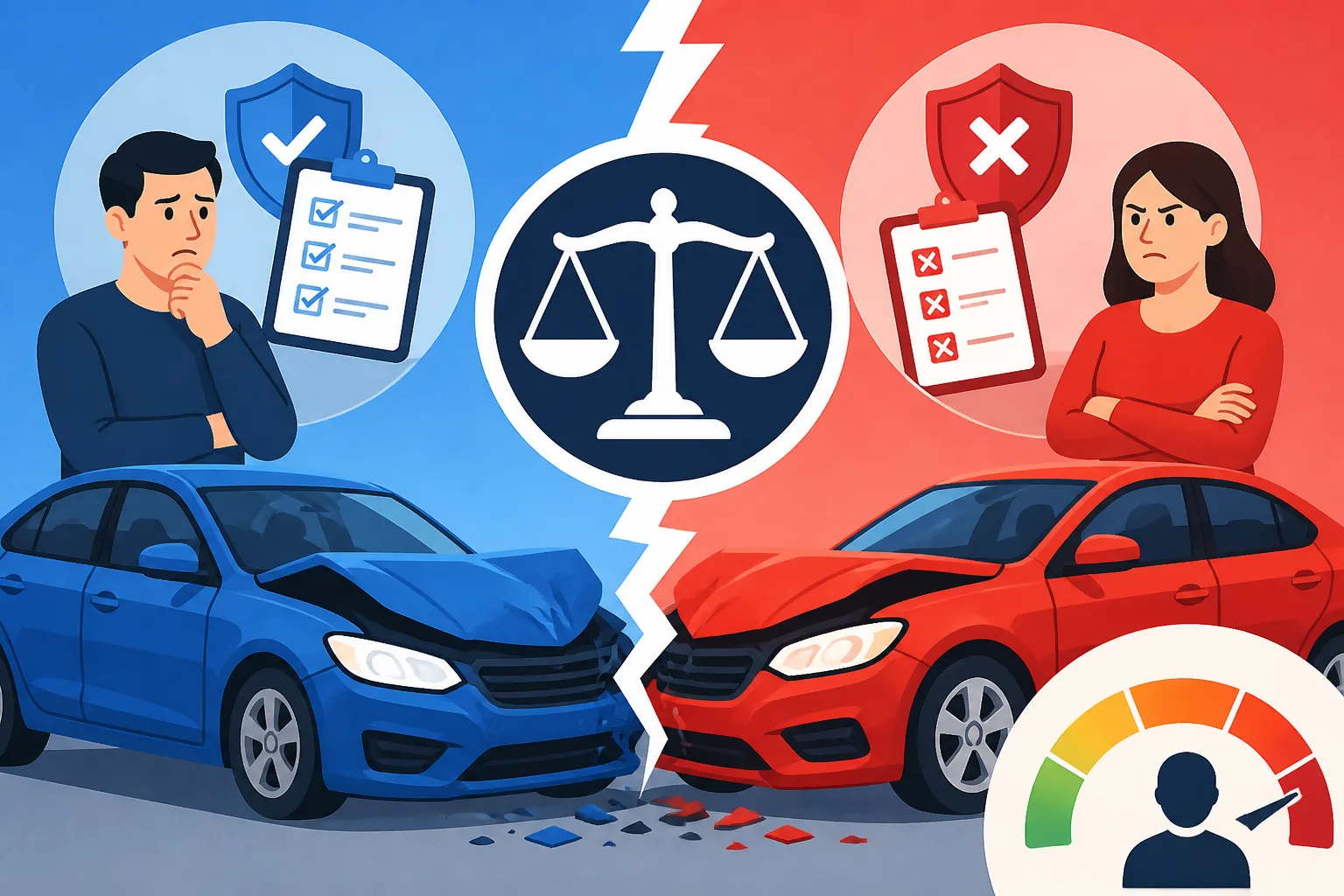
Here's a quick overview of how these systems compare:
| Fault System | Description | Recovery If You're 1% at Fault | Recovery If You're 50% at Fault | Recovery If You're 51% at Fault |
|---|---|---|---|---|
| Pure Contributory Negligence | You cannot recover any damages if you are even 1% at fault. | 0% recovery | 0% recovery | 0% recovery |
| Modified Comparative (50% Bar) | You cannot recover if you are 50% or more at fault. Otherwise, reduced by fault. | 99% recovery | 0% recovery | 0% recovery |
| Modified Comparative (51% Bar) | You cannot recover if you are 51% or more at fault. Otherwise, reduced by fault. | 99% recovery | 50% recovery | 0% recovery |
| Pure Comparative Negligence | You can recover damages, reduced by your percentage of fault, no matter how high. | 99% recovery | 50% recovery | 49% recovery |
Proving Fault and Gathering Evidence
Establishing who is to blame is rarely as simple as one person saying, "It was my fault!" Insurance companies, by their very nature, are looking to minimize payouts, and they will conduct thorough investigations to assign fault. This means you need to be proactive and strategic in gathering evidence to support your claim.
Evidence Collection at the Scene
The moments immediately following an accident are critical for evidence collection. Once you ensure everyone's safety and seek medical attention if needed, focus on documentation. A police report is often the cornerstone of your claim. Officers at the scene will interview drivers and witnesses, examine the position of the vehicles, note road conditions, and often issue citations. While the police report isn't a final legal determination of fault, it's a very strong indicator and provides valuable information that insurance companies rely on. Remember to get the report number and the name of the officer.
Beyond the police, your own actions can make a huge difference. Take plenty of photos and videos with your phone from various angles. Capture the damage to all vehicles involved, the surrounding area, road signs, traffic signals, skid marks, debris on the road, and any relevant weather conditions. If there are visible injuries, document those too. Get contact information from any witnesses who saw what happened. These details might seem small at the time, but they can be incredibly persuasive when trying to establish How to Prove the Other Driver Was at Fault.
Insurance Company Investigations
Once you've reported the accident and filed your claim, the insurance companies will spring into action. They have adjusters whose job it is to investigate the accident, determine fault, and ultimately decide how much to pay out. This process can feel daunting, as they might ask for recorded statements, access to your medical records, and scrutinize every detail you provide.
Insurance companies often use a combination of methods to determine fault. They will review the police report, analyze photos and videos, speak with witnesses, examine vehicle damage, and sometimes even reconstruct the accident scene with experts. They're looking for consistency in statements, physical evidence that backs up a particular narrative, and any evidence of negligence. Understanding How Insurance Companies Determine Who Is at Fault can help you anticipate their moves and prepare your evidence accordingly. It's a complex dance, and having your ducks in a row can significantly strengthen your position.
How Fault Impacts Your Claim's Value and Payout
The determination of fault isn't just an abstract legal concept; it has very real, tangible effects on your bottom line. It directly dictates how much compensation you can expect to receive, if any, for your injuries and property damage. This is where the rubber meets the road, and why fighting for a fair fault determination is so important.
Reduced Payouts for Shared Fault
As we explored with comparative negligence systems, if you are found even partially at fault, your total settlement or award will be reduced by your assigned percentage of fault. Let's say you're in an accident in California (a pure comparative negligence state) and suffer $50,000 in damages (medical bills, lost wages, pain and suffering). If the insurance company or a jury determines you were 25% at fault for the crash, your maximum recoverable compensation drops to $37,500. This reduction applies across the board, affecting every aspect of your damages.
This reduction can feel incredibly unfair, especially if your injuries are severe and your percentage of fault seems minor in comparison to the other driver's actions. It highlights How Comparative Fault Reduces Your Settlement and emphasizes the need to present compelling evidence that minimizes your own perceived responsibility. Every percentage point matters when your recovery is on the line.
Total Loss Scenarios and Fault
If your vehicle is severely damaged and deemed a "total loss," fault still plays a critical role. In a typical third-party claim (where you're claiming against the other driver's insurance), if they are 100% at fault, their insurance should pay you the Actual Cash Value (ACV) of your totaled vehicle, along with any applicable taxes and fees. However, if you're found partially at fault, that payout will be reduced.
For example, if your car's ACV is $20,000 and you're in a modified comparative negligence state with a 51% bar, and you're found 40% at fault, the other driver's insurance would pay you $12,000 ($20,000 minus 40%). If you were found 51% or more at fault, you might receive nothing from their insurance for your totaled vehicle, potentially leaving you to rely solely on your own collision coverage (if you have it), which would likely come with a deductible. This scenario often forces people to weigh their options carefully, especially if they have to consider Can You Still Get Paid If You're Partly at Fault? through their own policy.
Pain and Suffering Considerations
Fault also profoundly affects non-economic damages, particularly pain and suffering. These damages are subjective and compensate you for the physical discomfort, emotional distress, and reduced quality of life caused by your injuries. Insurance adjusters often use a "multiplier" method to calculate pain and suffering, multiplying your economic damages (medical bills, lost wages) by a factor between 1.5 and 5, depending on the severity of your injuries.
However, if you are found to be partially at fault, that multiplier, and the resulting pain and suffering award, will also be reduced by your percentage of fault. In some cases, adjusters might even argue for a lower multiplier to begin with if they believe your own actions contributed to the accident. This makes proving the other driver's sole negligence incredibly important for maximizing this often significant portion of your settlement. Demonstrating the full extent of your injuries and the impact on your life, while simultaneously minimizing your own fault, is a delicate balance.
When the Other Driver Blames You
It's an infuriating and all-too-common scenario: you're involved in an accident, you know it wasn't your fault, but the other driver (or their insurance company) tries to pin some or all of the blame on you. This can feel like a direct attack, and it's a common tactic used to reduce or deny claims. Don't let their accusations intimidate you into accepting blame you don't deserve.
Challenging Unfair Accusations
When the other driver or their insurance company tries to shift fault, it's crucial to stand your ground and challenge those unfair accusations. They might try to say you were speeding, that you braked suddenly, or that you somehow contributed to the crash. This is where all that evidence you gathered at the scene becomes invaluable. Your photos, witness statements, and the police report can directly contradict their claims.
Don't engage in lengthy arguments with the other driver at the scene, and definitely don't admit fault, even if you think you might have done something wrong. Emotions run high, and anything you say could be used against you. Instead, stick to the facts, provide the evidence you have, and if the insurance company persists in blaming you, consider seeking legal advice. It's not uncommon to find yourself needing to navigate What to Do If Insurance Blames You Unfairly and having strong documentation is your first line of defense.
The Role of a Lawyer
Sometimes, despite your best efforts, the fault dispute becomes a deadlock. The insurance company might continue to assign you partial fault, significantly reducing your settlement offer, or even deny your claim altogether. This is often a clear sign that it's time to consult with an experienced car accident attorney. A lawyer can step in, review all the evidence, and often has the resources to conduct a more thorough investigation, including hiring accident reconstructionists or forensic experts if necessary.
They understand the nuances of negligence laws in your state and can effectively argue against unsubstantiated claims of fault from the other side. They can also take on the burden of dealing with insurance adjusters, who are trained negotiators. An attorney's involvement can level the playing field, protect your rights, and often lead to a much more favorable outcome, especially when considering whether you need a lawyer for a car accident.
Navigating the Claims Process with Shared Fault
Even if you genuinely believe you share some minor responsibility for an accident, or if the fault determination leaves you with a percentage of blame, all is not lost. The claims process can still proceed, but it requires a more strategic approach to ensure you recover as much as possible under your state's laws.
Negotiating with Adjusters
Dealing with insurance adjusters can feel like a constant battle, especially when fault is in dispute. Their primary goal is to settle claims for the lowest possible amount, and if they can assign you even a small percentage of fault, they will use it as leverage. When you're negotiating, always be polite but firm. Never agree to a recorded statement without first consulting with a legal professional, as these statements can often be twisted and used against you later.
Focus on presenting a clear, factual account of the accident, backed by all the evidence you've gathered. Don't speculate or admit to anything. If they present you with a lowball offer because of alleged shared fault, be prepared to counter with your own calculations and justifications for why their fault assessment is incorrect or exaggerated. Understanding Dealing With Insurance Adjusters After a Car Accident is key, as is being prepared to explain why the other driver's negligence was the primary cause. This isn't a friendly chat; it's a negotiation, and you need to treat it as such.
Legal Options and Lawsuits
If negotiations with the insurance company completely break down, and you believe their fault determination is unfair or severely undervalued, pursuing legal action may be your next step. This typically involves filing a personal injury lawsuit against the at-fault driver. While the vast majority of car accident cases settle out of court, initiating a lawsuit signals to the insurance company that you are serious about pursuing fair compensation.
During a lawsuit, the court will hear arguments and evidence from both sides to definitively determine fault and the extent of damages. This process can be lengthy and complex, involving discovery, depositions, and potentially a trial. However, it can also be the most effective way to overturn an unfair fault assessment or secure a just settlement. A lawyer can guide you through every step of this process, helping you understand your chances and what to expect if you're considering a lawsuit, especially if you're trying to figure out How to Negotiate a Car Accident Settlement and hit a wall. Ultimately, your ability to recover depends on a strong case for fault and damages.
Disclaimer
Please remember that this article provides general information and is not a substitute for professional legal advice. Car accident laws vary significantly by state, and the specific facts of your case are unique. For personalized guidance regarding your car accident claim and how fault applies in your situation, it is always recommended to consult with a qualified attorney in your jurisdiction.