How Contributory Negligence Works in Virginia
Getting into a car accident is disorienting enough, but imagine discovering that even the slightest misstep on your part could completely derail your ability to recover damages. This is the harsh reality many face in Virginia, where the legal doctrine of contributory negligence can turn an otherwise clear-cut claim into a complex battle. This guide will walk you through exactly how contributory negligence works in Virginia, helping you understand this uniquely strict rule and what it means for your car accident claim.
Understanding Contributory Negligence
Virginia is one of a very small handful of states that still adheres to the pure form of contributory negligence. This doctrine is notoriously strict and can be incredibly frustrating for accident victims who believe they were mostly blameless. It essentially places a high burden on anyone seeking compensation to be entirely free of fault, which is a stark contrast to how most other states handle accident claims. It’s important to understand this foundational difference from the outset, as it dictates the entire approach to your case.
What Sets Virginia Apart
Most states operate under some form of comparative negligence, which allows accident victims to recover at least a portion of their damages even if they were partly at fault. However, Virginia stands firm on its historical application of contributory negligence. This means that if you are found to have contributed to the accident in any way, even if it was just a tiny fraction of the overall causation, you will likely be barred from recovering any compensation at all from the other driver. It doesn't matter if the other driver was 99% at fault and you were only 1% responsible; that 1% can sink your entire claim.
This strict stance makes pursuing a claim in Virginia uniquely challenging. Imagine you're driving slightly above the speed limit, and another driver runs a red light, T-boning your vehicle. In a comparative negligence state, you might still recover a significant portion of your damages, reduced by your small percentage of fault. In Virginia, however, your minor speeding could be argued as contributory negligence, potentially preventing you from recovering anything for your medical bills, lost wages, or vehicle damage. This is why understanding Contributory Negligence States Where 1% Fault Bars Recovery is so vital when dealing with a claim in Virginia.
The "All or Nothing" Rule
The core principle of contributory negligence is often referred to as the "all or nothing" rule. If you contributed to the accident in any way, shape, or form, you get nothing. It's a black-and-white system that leaves little room for nuance or shared responsibility in terms of financial recovery for personal injury and property damage. This can feel incredibly unfair, especially when the other driver's actions were clearly the primary cause of the collision.
Consider a scenario where you're making a legal left turn on a green arrow, but you momentarily failed to check your blind spot. At the same time, another driver speeds through a stale yellow light and collides with you. Even though the other driver's excessive speed and disregard for the light were major factors, if the defense can successfully argue that your failure to thoroughly check your blind spot constituted negligence, your claim for damages could be entirely dismissed. This isn't just about significant violations; even minor deviations from perfect driving can be used against you. It underscores the critical importance of proving How to Prove the Other Driver Was at Fault while simultaneously demonstrating your own lack of fault.
How It Differs from Comparative Negligence
To truly grasp the severity of Virginia's rule, it's helpful to compare it to the more common systems of comparative negligence found in most other states.
- Pure Comparative Negligence: In states like California, if you are 90% at fault, you can still recover 10% of your damages. Your recovery is simply reduced by your percentage of fault.
- Modified Comparative Negligence (50% Bar): Many states, such as Texas and Arizona, allow you to recover damages as long as your fault does not exceed 50%. If you are 50% or less at fault, your damages are reduced by your percentage of fault. If you are 51% or more at fault, you recover nothing.
- Modified Comparative Negligence (51% Bar): Other states use a 51% bar, meaning you can recover if your fault is 50% or less, but not if it's 51% or more. States like Illinois and Ohio follow this rule.
Virginia's contributory negligence rule doesn't have these thresholds; any percentage of fault, no matter how small, bars recovery. This is a fundamental difference that dictates strategy in car accident claims across the country. For more detail, you might find it useful to read about Comparative vs Contributory Negligence Explained.
Here's a quick comparison of how these systems handle shared fault:
| Negligence Type | Rule | Example (You are 20% at fault, Damages $10,000) |
|---|---|---|
| Contributory | Any fault (even 1%) bars recovery. | You recover $0. |
| Pure Comparative | Recover damages reduced by your fault percentage. | You recover $8,000 ($10,000 – 20%). |
| Modified (50% Bar) | Recover if your fault is 50% or less, reduced by percentage. | You recover $8,000 ($10,000 – 20%). |
| Modified (51% Bar) | Recover if your fault is 50% or less, reduced by percentage. | You recover $8,000 ($10,000 – 20%). |
Proving Fault and Navigating a Claim in Virginia
Given Virginia's strict contributory negligence laws, establishing who is at fault in a car accident becomes an even more critical, and often contentious, part of the entire claims process. It's not enough to simply show the other driver was primarily negligent; you must also demonstrate that you were completely free of any contributing fault. This is where many claims become incredibly difficult to manage without a deep understanding of the law and careful collection of evidence.
The Burden of Proof
In a Virginia car accident claim, the burden of proof typically falls on the plaintiff – that is, the person bringing the claim for damages. You must prove two main things:
- The other driver was negligent and that their negligence caused your injuries and damages.
- You yourself were not negligent in any way that contributed to the accident.
This second point is often the sticking point. The defendant (the at-fault driver or their insurance company) will almost certainly try to argue that you were at least partially responsible, even if that contribution was minor. Their goal is to prove even 1% fault on your part, which would allow them to deny your claim entirely. This makes every piece of evidence, every witness statement, and every detail of the accident scene critically important. Understanding How Insurance Companies Determine Who Is at Fault highlights the scrutiny your actions will undergo.
Common Scenarios Where Contributory Negligence Arises
It's easy to think, "I'm a good driver, I won't be at fault." But contributory negligence can arise from seemingly minor actions or inactions. Insurance companies and defense attorneys in Virginia are adept at finding these small details. Here are some common scenarios where a driver might be found contributorily negligent:
- Minor Speeding: Even going a few miles per hour over the limit, if it's argued that your speed contributed to your inability to avoid the collision.
- Failure to Use a Turn Signal: Neglecting to signal a turn or lane change, even if the other driver was clearly reckless.
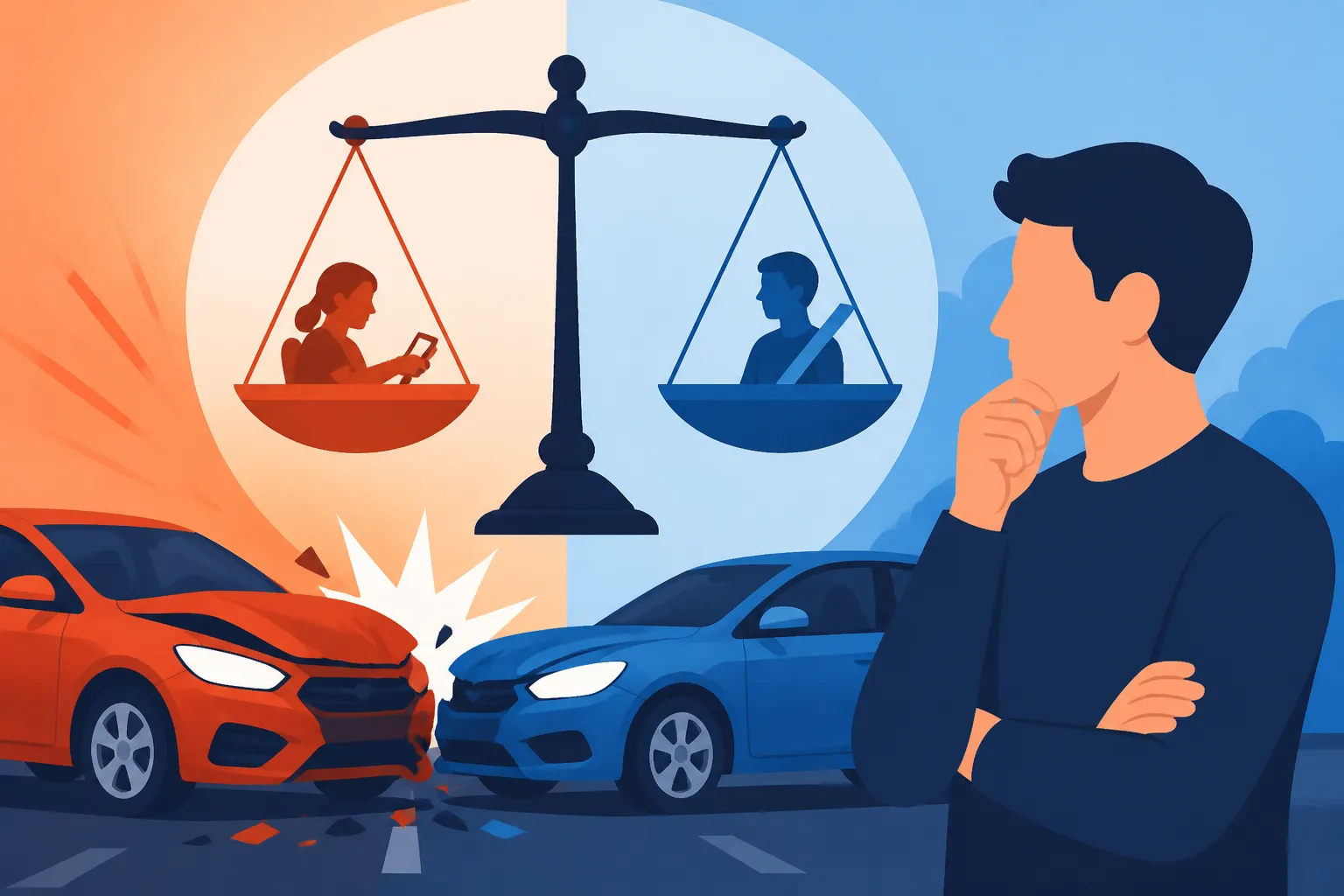
- Distracted Driving: A moment looking at your phone, adjusting the radio, or even engaging in a conversation could be used to argue you weren't paying full attention.
- Faulty Equipment: If your brake lights were out or your tires were worn, and this contributed to the accident, even if the other driver ran a stop sign.
- Improper Lane Change: Not checking your blind spot thoroughly, or signaling too late.
- Pedestrian Negligence: As a pedestrian, if you jaywalked or failed to use a crosswalk, even if a driver hit you while speeding.
- Not Wearing a Seatbelt: While not always contributing to the cause of the accident, failing to wear a seatbelt can be argued to contribute to the severity of your injuries, which some jurisdictions might consider contributory negligence regarding damages.
The takeaway here is that perfect driving is expected if you want to recover damages in Virginia. Any deviation can be used against you. This makes the initial moments after an accident and your subsequent actions incredibly important. Knowing What to Do After a Car Accident: Step-by-Step (2027) can make a significant difference.
The Role of Evidence in Establishing Negligence
Since you're fighting an "all or nothing" battle, the evidence you collect is paramount. This isn't just about proving the other driver was at fault; it's also about proving you weren't.
- Police Reports: While not always definitive, a police report can provide an initial assessment of fault and collect critical details. In Virginia, police often respond to accidents, and their observations can be crucial. Keep in mind that Police Reports and Car Accident Fault are often valuable evidence, but not the final word.
- Witness Statements: Independent witnesses who saw the accident unfold can provide unbiased accounts. Their testimony can corroborate your version of events and refute claims of your negligence.
- Photographs and Videos: Visual evidence from the scene is incredibly powerful. Capture vehicle positions, damage, road conditions, traffic signs, skid marks, and anything else relevant. Dashcam footage or footage from nearby security cameras can be game-changers.
- Traffic Laws: A thorough understanding of Virginia's traffic laws can help demonstrate that you adhered to all regulations, while the other driver did not.
- Expert Testimony: In complex cases, accident reconstruction experts can analyze the scene and provide scientific opinions on causation and fault, helping to counter allegations of contributory negligence.
- Medical Records: While not directly proving fault, prompt medical attention and detailed records are vital for proving the extent of your injuries, should you successfully overcome the contributory negligence hurdle.
Every piece of information helps build a robust case that you were completely blameless, which is your only path to recovery in Virginia.
Exceptions to Virginia's Strict Rule
While Virginia's contributory negligence rule is notoriously tough, there are a few very specific exceptions that can allow an injured party to recover damages even if they were technically found to have some fault. These exceptions are complex and often fiercely contested by defense teams, but understanding them is crucial for anyone navigating a car accident claim in the Commonwealth.
Last Clear Chance Doctrine
The "Last Clear Chance" doctrine is perhaps the most significant and commonly invoked exception to contributory negligence in Virginia. This doctrine allows a plaintiff to recover damages even if they were negligent, provided they can prove that the defendant had the "last clear chance" to avoid the accident but negligently failed to do so.
For this doctrine to apply, certain conditions must be met:
- Plaintiff's Initial Negligence: The plaintiff (you) must have been negligent in some way.
- Perilous Situation: Your negligence must have placed you in a position of "peril" from which you could not, or likely would not, escape.
- Defendant's Knowledge: The defendant (the other driver) must have known, or reasonably should have known, of your perilous situation.
- Defendant's Clear Chance: The defendant must have had a clear opportunity to avoid the accident after becoming aware of your peril, but failed to exercise reasonable care to do so.
Let's illustrate with an example: Imagine your car stalls in the middle of a lane on a highway due to a mechanical issue (your negligence). You're unable to move it. A truck driver approaching from behind sees your stalled vehicle from a significant distance, has ample time and space to change lanes and avoid you, but is distracted by their phone and crashes into you. Even though your car stalled (your initial negligence), the truck driver had the last clear chance to prevent the accident. In this scenario, you might be able to recover damages. However, if the truck driver only saw you at the last second and couldn't avoid the collision, the doctrine wouldn't apply.
Proving "Last Clear Chance" is incredibly difficult and almost always requires strong evidence and a skilled legal argument. It effectively shifts the focus back to the defendant's actions after your initial mistake.
Willful and Wanton Misconduct
Another, less common, exception to contributory negligence involves instances of the defendant's "willful and wanton misconduct." This goes beyond simple negligence and refers to actions that demonstrate an utter disregard for the safety of others, bordering on intentional recklessness.
Examples of willful and wanton misconduct might include:
- Extreme Drunk Driving: A driver with an exceptionally high blood alcohol content, swerving erratically, demonstrating a conscious disregard for the safety of others.
- Street Racing: Deliberately engaging in dangerous high-speed racing on public roads.
- Aggressive Driving: Intentional tailgating, weaving through traffic at excessive speeds, coupled with road rage, could potentially cross this threshold.
If the defendant's actions are found to be willful and wanton, the plaintiff's ordinary contributory negligence may not be a bar to recovery. This exception is very rarely applied because the standard of proof is extremely high. It requires showing that the defendant acted with a reckless indifference to the consequences, rather than just being careless.
Common Carrier Cases
A third, very specific exception applies to "common carriers." A common carrier is a person or company that transports goods or passengers for a fee. This typically includes bus companies, taxi services, and other public transportation providers. In cases involving common carriers, the standard of care owed to passengers is generally higher. While not a blanket exception to contributory negligence, courts may be less likely to find a passenger contributorily negligent when they are relying on the safe operation of a common carrier. This is a niche area and would apply to very specific types of accidents, such as a passenger injured on a public bus due to the driver's negligence.
These exceptions highlight that while Virginia's contributory negligence rule is formidable, it is not entirely absolute. However, leveraging these exceptions requires sophisticated legal knowledge and robust evidence, reinforcing why understanding Do You Need a Lawyer for a Car Accident? (2027) is particularly relevant in Virginia.
Practical Steps After an Accident in Virginia
Dealing with the aftermath of a car accident is stressful, but in Virginia, the stakes are even higher due to the strict contributory negligence rule. Every step you take, or fail to take, can profoundly impact your ability to recover damages. It’s not just about what the other driver did; it’s about meticulously documenting your own actions and the scene itself to protect your potential claim.
Documenting the Scene Thoroughly
This cannot be stressed enough in Virginia. From the moment the accident happens, you need to think about building a bulletproof case that proves you were absolutely not at fault.
- Take Photos and Videos: Use your smartphone to capture extensive visual evidence. Photograph all vehicles involved from multiple angles, showing the damage, their final resting positions, and any debris. Get wide shots to show the intersection or road layout. Zoom in on skid marks, broken glass, traffic signals, and road signs. Take pictures of weather conditions, time of day, and any obstructions to visibility. Don't forget to photograph your own injuries, if visible.
- Gather Contact Information: Exchange insurance and contact details with all drivers involved. Also, collect names and phone numbers of any witnesses, even if they claim they "didn't see much." Their minor observation could later become crucial.
- Call the Police: Always call the police, even for minor accidents. A police report, while not a definitive statement of fault, provides an official, third-party account of the incident, including diagrams, citations issued, and officer observations. This can be invaluable in countering later claims of your own negligence. This is especially true for understanding How Fault Is Determined in a Car Accident.
- Note Key Details: Write down everything you remember about the accident as soon as possible. What direction were you going? What about the other driver? What was the speed limit? Were there any specific traffic signals? What were the road conditions? Your immediate recollection will be the most accurate.
This meticulous documentation helps you construct a factual narrative that can withstand the intense scrutiny of a contributory negligence defense.
Seeking Medical Attention Promptly
Even if you feel fine immediately after an accident, seeing a doctor is critical, especially in Virginia. Delayed symptoms are common, and waiting to seek treatment can severely undermine your claim.
- Establish a Record: A prompt medical evaluation creates an official record linking your injuries directly to the accident. This is crucial for proving causation, which is a key element of any personal injury claim. Insurance companies love to argue that your injuries are not accident-related if you wait too long to seek care.
- Identify Hidden Injuries: Adrenaline can mask pain. You might have internal injuries, whiplash, or a concussion that isn't immediately apparent. A medical professional can diagnose these issues and start you on a treatment plan.
- Follow Doctor's Orders: Adhere strictly to your doctor's recommendations for treatment, medication, and follow-up appointments. Gaps in treatment or non-compliance can be used by the defense to argue your injuries weren't serious or that you didn't mitigate your damages.
Early and consistent medical care not only protects your health but also provides undeniable evidence of your injuries and their direct link to the collision, making it harder for the defense to dispute your need for compensation.
What to Avoid Saying to Insurance Companies
When dealing with insurance companies, whether yours or the other driver's, remember that anything you say can and will be used against you. This is even more critical in Virginia.
- Never Admit Fault: Absolutely never say "I'm sorry," "It was my fault," or anything that could be construed as admitting responsibility, even if you're just being polite. In a contributory negligence state, any admission, no matter how minor, can be disastrous for your claim. This is a primary piece of advice when learning What Is an Admission of Fault and How to Avoid It.
- Avoid Detailed Statements Without Legal Counsel: Be wary of giving recorded statements to the other driver's insurance company. While you must cooperate with your own insurer, their adjusters are trained to ask questions in ways that might elicit information damaging to your claim. Politely decline to give a recorded statement until you've spoken with a legal professional.
- Don't Speculate: Stick to the facts you know. Don't guess about speeds, distances, or what might have caused the accident. If you don't know, say "I don't know."
- Limit Information About Injuries: While it's important to seek medical care, avoid discussing the specifics of your injuries or how you're feeling with insurance adjusters. They are not medical professionals, and your casual comments could be misinterpreted or used to minimize your pain and suffering.
- Don't Accept Early Settlement Offers: Initial offers are almost always lowball. Accepting one means you waive your right to further compensation, and it's likely far less than what your claim is truly worth, especially considering the long-term impact of injuries.
It's highly advisable to consult with a car accident lawyer as soon as possible after an accident in Virginia. They can handle all communications with insurance companies, protecting you from inadvertently damaging your own case under the strict rules of contributory negligence. Understanding Who Is at Fault in a Car Accident Complete Guide (2026) is complex, and navigating it in a contributory negligence state like Virginia adds another layer of difficulty.
Disclaimer
Please remember that this information is for educational purposes only and should not be considered legal advice. Car accident laws are complex and vary by jurisdiction. For personalized advice regarding your specific situation in Virginia, it is crucial to consult with a qualified attorney.