Who Is at Fault in a Backing-Up Accident in California?
That stomach-dropping moment when you're slowly backing out of a parking space or your driveway, only to hear the sickening crunch of metal as you hit another vehicle – it's a truly terrible feeling. Your heart races, a wave of panic washes over you, and the immediate question that flashes through your mind is, "Oh no, am I automatically at fault?" This guide is here to shed light on how fault is typically determined in backing-up accidents, specifically within the unique legal framework of California, so you can navigate the aftermath with more confidence and understanding.
Understanding Fault in Backing-Up Accidents in California
When it comes to car accidents, fault is rarely as straightforward as we initially imagine, but backing-up incidents often follow a general rule. In the Golden State, just like elsewhere, the driver backing up usually bears the primary responsibility. However, California's specific legal approach to negligence means there can be exceptions and shared blame.
The General Rule: Driver Backing Up is Usually at Fault
The common understanding, and often the legal presumption, is that if you are backing up and collide with another vehicle or object, you are generally considered at fault. This isn't just an arbitrary rule; it's rooted in the duty all drivers have to operate their vehicles safely. When you're driving in reverse, your field of vision is naturally more restricted than when driving forward. You have larger blind spots, and it takes more effort to continually check your surroundings.
Because of this inherent limitation, drivers backing up are expected to exercise an extremely high degree of caution. This means constantly checking rearview mirrors, side mirrors, looking over your shoulder, and utilizing any backup cameras or parking sensors your vehicle might have. If you fail to take all reasonable precautions and an accident occurs, you will likely be held responsible. For example, if you're backing out of a crowded grocery store parking spot in San Diego and hit a car driving past, the onus is generally on you to prove you exercised due care and the other driver was somehow negligent.
California's Role in Determining Fault
While the general rule is a good starting point, California operates under a system of "pure comparative negligence." This is a critical detail that sets California apart from some other states. What does this mean for backing-up accidents? It means that even if you were the driver backing up, if the other driver contributed to the accident in any way, their percentage of fault can reduce your overall liability and, consequently, the amount of damages you might have to pay or the amount of compensation you can recover.
For instance, if you're backing out of your driveway in Sacramento and a driver speeds down the residential street, exceeding the posted limit, and collides with your vehicle, you might both share some degree of fault. You had a duty to check, but they had a duty to drive safely and within the speed limit. A jury or insurance adjuster might determine you were 70% at fault for backing up unsafely, but the other driver was 30% at fault for speeding. This proportion directly impacts financial outcomes. Understanding how fault is determined in a car accident and what happens if you're partially at fault are crucial aspects of the claims process in California. The principle of pure comparative negligence ensures that financial responsibility is divided based on each party's contribution to the crash, which can be a significant factor in your car accident claim.
Common Scenarios and Nuances of Backing-Up Accidents
Backing-up accidents aren't all the same. The specific circumstances of the collision can significantly influence how fault is assigned. Where the accident occurs and how the other vehicle was operating are key pieces of the puzzle.
Backing Out of a Parking Spot
This is perhaps the most common type of backing-up accident. You're trying to carefully extricate your vehicle from a tight space, and suddenly, another car appears. The challenge here is often the dynamics of a busy parking lot, where traffic rules can feel a bit more relaxed than on public roads, leading to confusion about right-of-way.
Consider a scenario in a busy shopping center parking lot in Los Angeles. You're slowly backing your SUV out of a spot, reverse lights on, looking around. Suddenly, another car zips down the lane and hits your rear bumper. While you were backing up, the other driver might have been driving too fast for parking lot conditions, distracted by their phone, or failed to pay attention. In a situation where two cars are backing out simultaneously from opposite parking spots and collide, fault can be even trickier. Often, both drivers may be deemed partially at fault because both had a duty to look and yield. Each driver had a responsibility to ensure their path was clear, and if both failed, it naturally leads to shared responsibility. It's not uncommon for these types of incidents to result in a 50/50 fault split, especially if neither driver can definitively prove the other's sole negligence. This is a classic example where California's comparative negligence comes into play for who is at fault in a parking lot accident.
Backing Out of a Driveway
Backing out of a private driveway onto a public street or alley presents its own set of challenges. Here, the backing driver has an even greater responsibility because they are entering a flow of traffic on a public thoroughfare, which typically has established right-of-way rules. Pedestrians on sidewalks also add another layer of caution needed.
Imagine you're backing out of your driveway in Pasadena. You look left, then right, and slowly begin to pull out. A cyclist, riding on the sidewalk (which may or may not be legal in that specific area, but still requires your vigilance), suddenly appears and you make contact. In this instance, you, as the driver backing out, would likely be primarily at fault for failing to yield to traffic and pedestrians on the sidewalk. However, if that cyclist was riding erratically, without lights at night, or was illegally riding against traffic, their actions could potentially reduce your percentage of fault. This is a key consideration when determining who is at fault when backing out of a driveway.
Backing Up on a Street or Highway
This is generally the most straightforward backing-up scenario in terms of fault: if you are backing up on a public street or, even worse, a highway, you are almost always going to be considered at fault if a collision occurs. Backing up on a public road is typically illegal, except in very specific circumstances, such as parallel parking, making a U-turn (where backing might be briefly required), or following specific instructions from law enforcement or road workers.
For example, if you miss your turn on a busy street in San Jose and decide to throw your car into reverse to correct it, colliding with a car behind you, you will bear nearly 100% of the fault. The only potential way the other driver might share blame is if they were also engaged in extremely reckless behavior, like driving at an incredibly excessive speed without lights on at night, or were driving under the influence. Even then, your act of backing up on a public street would be a massive contributing factor. The law prioritizes the safe and predictable flow of traffic, and backing up against it is a serious violation.
Factors That Can Shift or Share Fault
While the driver backing up is often primarily responsible, it's not always an open-and-shut case. California's comparative negligence laws allow for a more nuanced examination of who contributed to the accident. Several factors can either reduce the backing driver's fault or assign a portion of the blame to the other driver.
Distracted Driving or Speeding by the Other Driver
One of the most common ways fault can be shared or shifted is if the other driver was also negligent. If the vehicle you backed into was being operated by a distracted driver who was texting, talking on the phone, or otherwise not paying attention, their inattention could be a significant contributing factor. For example, if you're carefully backing out of a spot at a mall in Orange County, and a driver looking at their GPS instead of the parking lot traffic collides with you, their distracted driving could lead to them sharing a portion of the fault.
Similarly, if the other driver was speeding excessively for the conditions, particularly in a parking lot or residential area, this could also shift some blame. Even if you were backing up, a driver moving at an unsafe speed might not have been able to stop in time to avoid the collision, regardless of your actions. Evidence like witness statements, security camera footage, or even data from vehicle black boxes can be crucial in proving the other driver's distraction or excessive speed. This kind of negligence on the part of the other driver falls under the umbrella of fault in a distracted driving (texting) accident, and can certainly influence the final determination of who is responsible.
Illegal Parking or Stopping
Sometimes, the other vehicle's actions before the collision can contribute to the accident. If the vehicle you backed into was illegally parked or stopped in a way that obstructed your view, created an unexpected hazard, or violated traffic laws, this could be a factor in fault determination.
Imagine you're backing out of a parallel parking spot on a busy street in San Francisco. A delivery truck has illegally double-parked behind you, significantly reducing your visibility of oncoming traffic. As you cautiously back out, you hit a passing car that you simply couldn't see due to the illegally parked truck. While you still have a duty to ensure it's safe to back up, the presence of the illegally parked vehicle created a dangerous condition that contributed to the lack of visibility. In such a scenario, the owner or driver of the illegally parked vehicle might bear some responsibility, or it could at least reduce your percentage of fault. This doesn't completely absolve the backing driver, but it complicates the liability picture.
Lack of Adequate Lighting or Visibility
Environmental conditions and vehicle functionality can also play a role. If the accident occurred in an area with extremely poor lighting at night, or if the other vehicle had non-functional headlights or taillights, these factors could argue for shared fault.
Consider an accident in a dimly lit industrial park in Oakland after sunset. You're backing your vehicle, using your mirrors and camera, but the other car involved had completely burnt-out headlights and taillights. Because their vehicle was essentially invisible in the low light, it would be extremely difficult for you to spot them, even with careful checks. Similarly, if your own vehicle's reverse lights were non-functional, it might increase your fault. Factors like heavy rain, snow, or dense fog also severely impair visibility for all drivers involved. In these situations, both drivers have an increased duty to exercise caution. The role of who is at fault in bad weather (rain, snow, ice) is typically determined by assessing whether each driver took reasonable precautions given the conditions. If one driver failed to adapt their driving, they might share fault.
Here's a quick summary table of how fault might typically break down in common backing-up scenarios in California:
| Scenario | Typical Initial Fault | Potential Contributing Factors for Other Driver | Example Impact on Fault (California) |
|---|---|---|---|
| Backing out of Parking Spot | Primarily driver backing up | Speeding, distracted, failure to yield in lot | 70% backing, 30% other |
| Backing out of Driveway | Primarily driver backing up | Speeding, distracted, illegal maneuver on street | 80% backing, 20% other |
| Backing up on Public Street | Almost exclusively driver backing up | Extreme recklessness (DUI, no lights) | 95% backing, 5% other |
| Two Cars Backing Simultaneously | Shared (often 50/50 initially) | Distraction, speed, failure to use signals | 50% backing A, 50% backing B |
| Limited Visibility (e.g., fog) | Shared (both have higher duty of care) | Excessive speed for conditions, no lights | Varies widely, could be 60/40 |
What to Do After a Backing-Up Accident in California
Regardless of who you think is at fault, the steps you take immediately after a backing-up accident in California can profoundly impact your ability to prove your case and secure fair compensation. Even if it seems minor, never just drive away.
Gather Evidence at the Scene
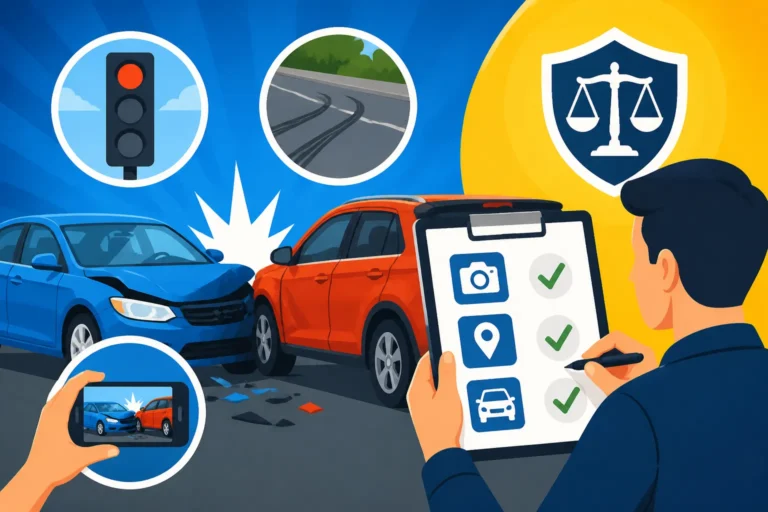
Your immediate actions at the accident scene are crucial for documentation. First and foremost, check for injuries. If anyone is hurt, call 911 immediately. If it's a minor fender-bender with no injuries, you'll still want to take proactive steps. Exchange information with the other driver: name, contact details, insurance information, driver's license number, and license plate number. Do not admit fault or get into a heated argument about who is to blame. Focus on facts.
Then, start collecting evidence. Use your phone to take comprehensive photos and videos. Get wide shots showing the position of both vehicles relative to the surrounding environment (parking lines, curbs, street signs, driveways). Take close-up photos of all damage to both vehicles. Capture any skid marks, debris, or relevant road signs. Look for security cameras in the area (e.g., on nearby businesses or homes) that might have recorded the incident. Ask if there were any witnesses and get their contact information. Even for what seems like a minor bump, a police report and car accident fault documentation is incredibly helpful for insurance purposes, especially if there's any dispute. The more information you can gather, the stronger your position will be when it comes to proving how the accident happened and who was responsible. This meticulous approach is part of what to do after a car accident: step-by-step.
Dealing with Insurance Companies
After documenting the scene, you'll need to report the accident to your insurance company. Even if you believe the other driver is entirely at fault, it's generally a good idea to inform your insurer, especially in California. Be truthful about the facts but be very careful about what you say. Do not speculate, guess, or, most importantly, admit fault. Stick to the observable facts only. Insurance adjusters are trained to collect statements that can be used to minimize payouts, so avoid giving recorded statements without legal advice.
The other driver's insurance company may contact you directly. While you are generally obligated to provide them with basic information, remember that their primary goal is to protect their client and pay out as little as possible. They will conduct their own investigation to determine how insurance companies determine who is at fault. If you feel pressured or unsure, it's okay to politely decline to answer extensive questions until you've spoken with your own insurer or legal counsel.
Seeking Legal Guidance
Navigating a car accident claim, particularly one involving fault disputes or injuries, can be incredibly complex. This is especially true in a pure comparative negligence state like California, where percentages of fault can significantly alter your recovery. If you're injured, if fault is disputed, or if the damages are substantial, it's highly advisable to consult with a car accident lawyer.
An experienced attorney can help you understand your rights, gather additional evidence, negotiate with insurance companies, and ensure you don't inadvertently jeopardize your claim. They can help prove how the other driver's actions contributed to the collision, even if you were the one backing up. An attorney understands the nuances of California law and can build a strong case to maximize your compensation for medical bills, lost wages, and pain and suffering. They also understand when to hire a car accident lawyer and can determine if your specific situation warrants legal intervention.
Disclaimer
Please remember that this article provides general information and is not legal advice. Every car accident case is unique, and the specific facts and circumstances of your incident will determine the outcome. If you have been involved in a car accident, it is always recommended to consult with a qualified legal professional to discuss your specific situation and rights.