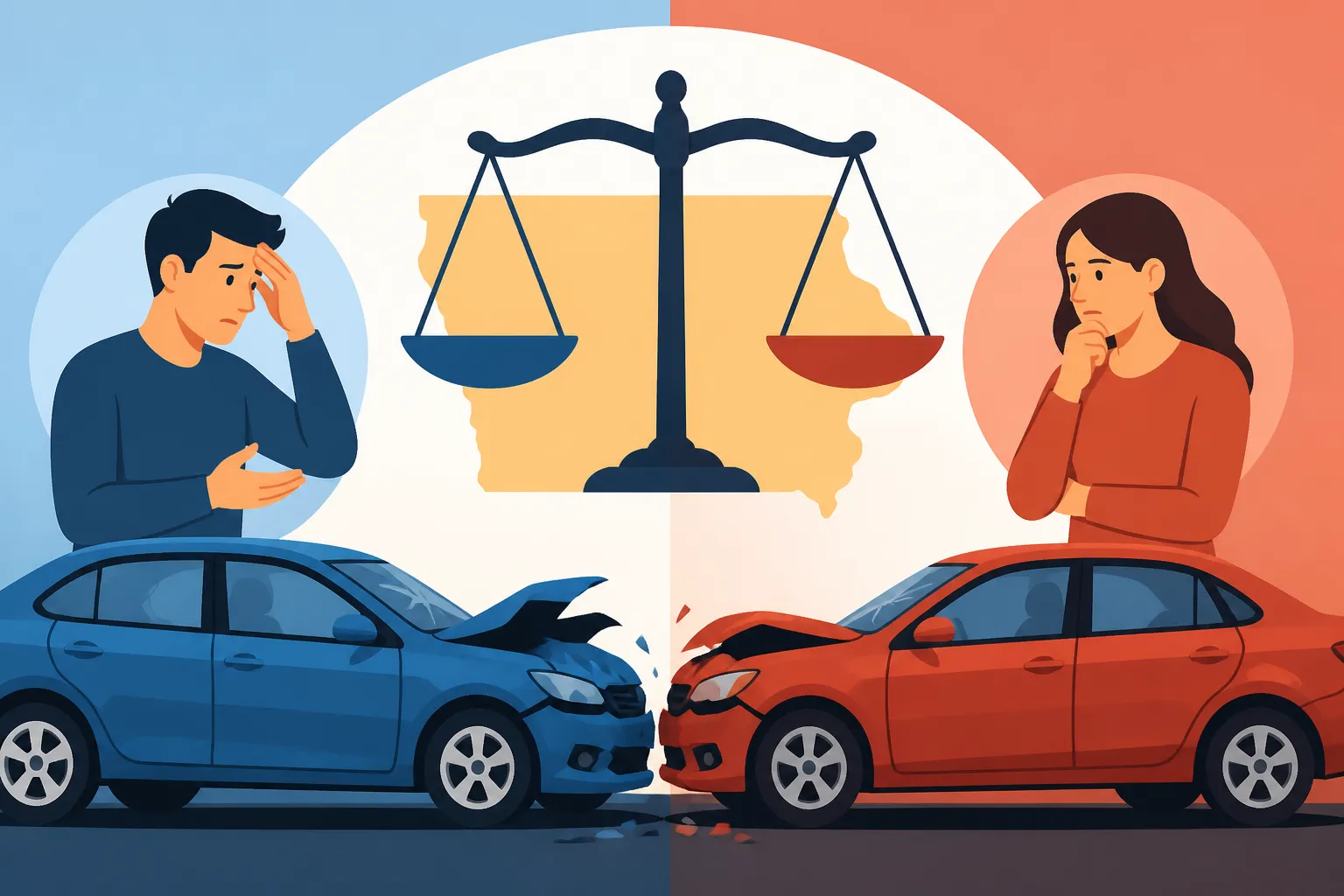
Comparative Negligence Laws in Iowa
Dealing with the aftermath of a car accident is never easy. Beyond the initial shock and potential injuries, you're often left wondering, "Who's to blame for all this?" And perhaps even more critically, "How does that blame affect my ability to get compensation?" For drivers in Iowa, understanding the state's comparative negligence laws is absolutely essential, as these rules directly dictate how much, if any, financial recovery you can expect. This guide will meticulously break down Iowa's specific approach to fault and how it impacts your car accident claim.
Understanding Comparative Negligence
When two vehicles collide, it's rarely a black-and-white situation where one driver is 100% at fault and the other is completely blameless. Often, there's a blend of responsibilities, and that's where the concept of comparative negligence comes into play. It's the legal framework designed to handle these shared fault scenarios, ensuring that each party's contribution to an accident is acknowledged.
What is Comparative Negligence?
At its core, comparative negligence is a legal doctrine that allows an injured party to recover damages even if they were partially at fault for the accident. Instead of completely barring recovery, as some older laws used to do, comparative negligence systems reduce the amount of compensation the injured party can receive by their percentage of fault. For example, if you sustained $10,000 in damages but were found 20% at fault, you would only be able to recover $8,000 (100% – 20% = 80% of $10,000). It’s an effort to make the system fairer, acknowledging that fault often exists on a spectrum rather than being an all-or-nothing proposition.
Iowa's Specific Rule: Modified Comparative Negligence (50% Bar Rule)
Iowa operates under a "modified comparative negligence" system, specifically the "50% bar rule." This is a crucial distinction that dramatically impacts accident claims within the state. What does this mean for you? Well, it means that while you can recover damages if you're partially at fault, there's a strict cutoff. If you are found to be 50% or more responsible for the accident, you are legally barred from recovering any compensation from the other party. Zero. Zilch.
Let's unpack that:
- If you are 49% or less at fault: You can recover damages, but your total compensation will be reduced by your percentage of fault. So, if your damages are $20,000 and you are 30% at fault, you would receive $14,000 ($20,000 – 30%).
- If you are 50% or more at fault: You cannot recover any damages from the other party, even if they were also significantly at fault. This "50% bar" acts as a hard line, completely preventing recovery once your fault meets or exceeds this threshold.
This system is designed to prevent a driver who is equally (or more) responsible for a crash from collecting compensation from the other party. It really drives home the importance of proving the other driver was primarily at fault. If you're wondering What Happens If You're Partially at Fault?, this 50% rule is the answer in Iowa.
How This Differs from Other Systems
To truly appreciate Iowa's modified comparative negligence rule, it's helpful to understand how it stands apart from other fault systems used across the United States. Not all states approach shared fault the same way, and these differences can have monumental consequences for injured drivers.
- Pure Comparative Negligence: Some states, like California and Florida, adhere to a "pure comparative negligence" standard. In these states, an injured party can recover damages no matter how high their percentage of fault, even if they are 99% responsible. Their compensation is simply reduced by their fault percentage. So, if you're 90% at fault in a pure comparative state with $10,000 in damages, you could still recover $1,000. This is a much more lenient system than Iowa's.
- Contributory Negligence: On the opposite end of the spectrum, a handful of states, such as Alabama, Maryland, North Carolina, and Virginia, still follow the old "contributory negligence" rule. This is the harshest system: if you are found even 1% at fault for an accident, you are completely barred from recovering any damages. If you live in or travel through one of these states, understanding Contributory Negligence States (Where 1% Fault Bars Recovery) is critical, as a minor misstep could cost you everything.
- Modified Comparative Negligence (51% Bar Rule): Iowa's 50% bar rule is often confused with the "51% bar rule," which is another form of modified comparative negligence. In states with a 51% bar, you can still recover damages if you are 50% at fault. You are only barred from recovery if your fault is 51% or higher. While this difference seems small (just one percentage point), it's a huge distinction in practical terms. Iowa is stricter, cutting off recovery at the halfway point. This nuance is why understanding Modified Comparative Negligence (50% vs 51% Bar) is so important for Iowa drivers.
How Fault is Determined and Applied in Iowa Accidents
Understanding the legal framework is one thing, but seeing how it plays out in the real world after a stressful car accident is another. In Iowa, determining who is at fault and to what degree is a complex process involving various parties and types of evidence. This assessment is the critical step that decides whether you can receive compensation and how much.
The Investigation Process
After an accident, several factors contribute to figuring out How Fault Is Determined in a Car Accident. Law enforcement, insurance companies, and potentially legal teams all conduct their own investigations, gathering details to build a picture of what happened.
- Police Reports: If police officers responded to the scene, they will typically generate an official police report. This report often includes their assessment of the accident, diagrams, witness statements, and sometimes even a preliminary determination of fault. While not legally binding, a police report carries significant weight with insurance companies and can be a strong piece of evidence in your favor. Knowing how Police Reports and Car Accident Fault play a role is crucial.
- Witness Statements: Eyewitnesses can provide invaluable, unbiased accounts of the accident. Their perspectives can corroborate your story or shed light on details you might have missed in the chaos. Collecting contact information from any witnesses at the scene is a vital step.
- Physical Evidence: This includes vehicle damage, skid marks, debris on the road, traffic camera footage, and even cell phone records (if distracted driving is suspected). Every scratch and dent tells a story, and accident reconstruction experts can often piece together the sequence of events from these physical clues.
- Driver Statements: Both drivers will provide their accounts of the accident to the police and their respective insurance companies. It's incredibly important to be factual and avoid admitting fault, even inadvertently. What you say in the immediate aftermath can significantly impact the fault determination later on.
Insurance adjusters will meticulously review all this information. Their job is to assign a percentage of fault to each driver involved. This isn't always a quick process; it can involve multiple phone calls, reviewing documents, and sometimes even visiting the accident scene.
Impact on Your Claim and Settlement
Once fault percentages are assigned by the insurance companies, Iowa's 50% modified comparative negligence rule kicks in. This directly impacts the value of your claim and how much you ultimately receive in a settlement. Understanding How Insurance Companies Determine Who Is at Fault is critical because their decision directly affects your bottom line.
Let's imagine a scenario in Des Moines: You're involved in a collision, and your total damages (medical bills, lost wages, vehicle repair, pain and suffering) amount to $50,000.
- Scenario 1: You are 25% at fault. Under Iowa law, your recovery would be reduced by that 25%. So, you could theoretically receive $37,500 ($50,000 – 25% = $37,500).
- Scenario 2: You are 49% at fault. Your recovery would be reduced by 49%. You could receive $25,500 ($50,000 – 49% = $25,500). While significantly less, it's still some compensation. This shows How Comparative Fault Reduces Your Settlement.
- Scenario 3: You are 50% at fault. This is the tricky one. Because Iowa has the 50% bar rule, if you are found exactly 50% at fault, you would recover nothing. Your claim would be completely barred. The same applies if you are found 51% or more at fault.
This demonstrates just how critical those percentage points are in Iowa. Even a seemingly small difference in fault assessment can mean the difference between a significant settlement and no settlement at all.
Real-World Scenarios in Iowa
The application of Iowa's comparative negligence laws can be seen in various accident types. Let's look at a couple of common situations.
- Rear-End Collisions: Often, the trailing driver in a rear-end collision is deemed 100% at fault for following too closely or not paying attention. However, there are exceptions. If the lead driver suddenly slammed on their brakes without warning, or if their brake lights weren't working, some fault could be assigned to them. If the lead driver in Ankeny was found 10% at fault for faulty brake lights, and their damages were $10,000, they could recover $9,000. If they were found 50% at fault, they would recover nothing. This is why knowing Rear-End Collision Fault: Who Is Responsible? is important even if you're the one hit from behind.
- Left-Turn Accidents: These are often classic examples of shared fault. A driver making a left turn typically has a responsibility to yield to oncoming traffic. However, if the oncoming driver was speeding, ran a red light, or was distracted, they might also bear some responsibility. Imagine a driver in Cedar Rapids making a left turn, being hit by a speeding oncoming car. If the turning driver is found 60% at fault (for failing to yield) and the speeding driver 40% at fault, the turning driver would get no compensation in Iowa due to the 50% bar rule. The speeding driver, however, could recover 60% of their damages. This is a complex area, often covered in detail by posts like Left-Turn Accident Fault Rules.
These examples highlight why a thorough investigation and understanding of the law are so critical. Every piece of evidence helps build a case for minimizing your own fault percentage.
Practical Steps for Iowa Drivers After an Accident
Navigating the aftermath of a car accident in Iowa, especially with its specific comparative negligence laws, requires a proactive and informed approach. Your actions immediately following a crash, and in the days and weeks that follow, can significantly impact the outcome of your claim.
Documenting the Scene and Your Injuries
Your immediate focus after an accident should always be safety and seeking medical attention. However, once you're safe, thorough documentation is your best friend when it comes to proving fault and damages under Iowa's legal system.
- Gather Information at the Scene: Take photos and videos of everything – vehicle damage from multiple angles, skid marks, road conditions, traffic signs, debris, and the surrounding area. Get contact and insurance information from all parties involved, and crucially, collect names and phone numbers of any witnesses. Even in a minor fender bender in Davenport, this information is vital. Knowing What Information to Exchange After a Car Accident is fundamental.
- Call the Police: Even for seemingly minor accidents, it's often wise to call the police. An official police report provides an objective record of the incident, which can be invaluable for your insurance claim.
- Seek Medical Attention Promptly: Even if you feel fine, see a doctor. Many injuries, like whiplash or concussions, have delayed symptoms. A medical record from soon after the accident creates a clear link between the crash and your injuries, which is essential for proving damages. Documenting Common Car Accident Injuries thoroughly with medical professionals is key. Keep detailed records of all appointments, diagnoses, treatments, and prescriptions.
Dealing with Insurance Companies
Interacting with insurance companies can feel like navigating a minefield, especially when fault is in question. Remember, the other driver's insurance company is not on your side; their goal is to minimize their payout.
- Report the Accident: You generally need to report the accident to your own insurance company promptly, even if you believe the other driver was 100% at fault. This doesn't mean admitting fault, just informing them of the incident.
- Be Cautious with Statements: While you must cooperate with your own insurer, be very careful what you say to the other driver's insurance adjuster. Avoid making speculative statements, downplaying your injuries, or admitting any fault. Remember, anything you say can be used against you to increase your percentage of fault, potentially pushing you over Iowa's 50% bar.
- Do Not Accept a Quick Settlement: Insurance companies might try to offer a fast, lowball settlement, especially if they believe you might bear some fault. Do not accept it without fully understanding the extent of your injuries and all your damages. Once you accept, you waive your right to further compensation. Knowing How to Deal With a Lowball Insurance Offer is critical to protecting your rights.
- Understand What Your Policy Covers: Review your own policy to understand what your coverage entails, such as medical payments (MedPay) or uninsured/underinsured motorist coverage, which can be lifesavers if the other driver has insufficient insurance or if fault is highly contested.
When to Seek Legal Counsel in Iowa
Given Iowa's 50% modified comparative negligence rule, the stakes can be very high, especially in cases where fault is disputed or injuries are significant.
- Disputed Fault: If the other driver or their insurance company is trying to place significant blame on you, an experienced Iowa car accident attorney can be instrumental. They understand how to gather evidence, negotiate with adjusters, and present a compelling case to minimize your assigned fault and protect your right to compensation.
- Serious Injuries: If you've suffered more than minor bumps and bruises – perhaps a Herniated Disc From a Car Accident or a Concussion Symptoms After a Car Accident – the value of your claim will be much higher, making the 50% fault bar even more perilous. An attorney can help calculate the full extent of your damages, including future medical costs and pain and suffering, and fight for the compensation you deserve. They can also explain How Car Accident Settlements Are Calculated.
- Complex Cases: Accidents involving multiple vehicles, commercial trucks, or those with unclear liability can be incredibly complicated. A lawyer can navigate these complexities, ensuring all responsible parties are identified and held accountable.
- Dealing with Adjusters: Insurance adjusters are trained negotiators. If you feel overwhelmed or believe the insurance company isn't treating you fairly, an attorney can step in, handle all communications, and represent your best interests. Many wonder, Do You Need a Lawyer for a Car Accident?, and in Iowa, particularly with the 50% rule, the answer is often yes, especially for significant claims.
Even if you just have questions or feel unsure about your next steps, a free consultation with an attorney in Iowa can provide clarity and peace of mind without any obligation. It's an opportunity to understand your rights and options under Iowa's specific laws.
Comparative Negligence Systems at a Glance
| Feature | Contributory Negligence (e.g., Alabama) | Modified Comparative Negligence (50% Bar) (Iowa) | Modified Comparative Negligence (51% Bar) (e.g., Texas) | Pure Comparative Negligence (e.g., California) |
|---|---|---|---|---|
| Recovery if 1% at fault | NO | YES (reduced by 1%) | YES (reduced by 1%) | YES (reduced by 1%) |
| Recovery if 49% at fault | NO | YES (reduced by 49%) | YES (reduced by 49%) | YES (reduced by 49%) |
| Recovery if 50% at fault | NO | NO (barred from recovery) | YES (reduced by 50%) | YES (reduced by 50%) |
| Recovery if 51% at fault | NO | NO (barred from recovery) | NO (barred from recovery) | YES (reduced by 51%) |
| Strictest/Most Lenient | Strictest (any fault bars recovery) | Stricter (50% fault bars recovery) | Moderate (51% fault bars recovery) | Most Lenient (recovery regardless of fault percentage) |
Disclaimer
Please remember that this information is intended for general guidance and informational purposes only, and does not constitute legal advice. Car accident laws are complex and can change. It is always recommended to consult with a qualified Iowa personal injury attorney for advice specific to your individual situation.