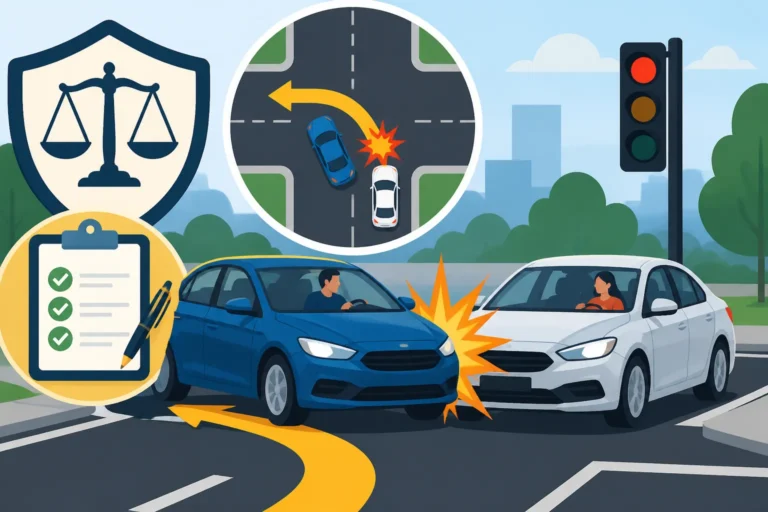
Comparative Negligence Laws in Arizona
Getting into a car accident is disorienting enough, but imagine the added stress when you realize that figuring out who's "at fault" isn't always a black-and-white situation. Many people find themselves in a tough spot, wondering if they can still seek compensation if they bear some responsibility for the crash. This guide is here to untangle the complexities of comparative negligence laws, specifically focusing on how Arizona handles shared fault in car accident claims.
Navigating the Complexities of Car Accident Fault in Arizona
When two vehicles collide, it’s rarely a scene from a movie where one person is clearly, unequivocally to blame and the other is a blameless victim. In the real world, especially on busy Arizona roads, multiple factors and drivers often contribute to an accident. This reality is precisely why legal systems have developed doctrines like comparative negligence. It’s a way to acknowledge that fault can, and often does, exist on a spectrum, not just as an all-or-nothing proposition.
The Basics of Shared Responsibility
At its core, shared responsibility in a car accident means that more than one party contributed to the cause of the collision. Maybe one driver was speeding, but the other made an illegal turn. Or perhaps you were following a bit too closely, but the car in front suddenly slammed on their brakes without warning, creating an unexpected hazard. In these scenarios, it feels unfair to assign 100% blame to just one person. That's where the concept of comparative negligence steps in. It's a legal principle designed to allow accident victims to recover damages even if they were partially responsible for the incident. This system acknowledges the nuanced reality of traffic accidents, moving away from older, harsher laws that might have barred any recovery if you had even 1% of the blame. Understanding these foundational principles is crucial for anyone involved in a motor vehicle accident, as it directly impacts what you might be able to recover. It's a more equitable approach to justice, ensuring that individuals aren't entirely shut out from compensation simply because they weren't completely blameless.
How Arizona's System Stands Out
Different states approach comparative negligence with varying rules, and knowing which system applies to your situation is paramount. Some states follow what's called "contributory negligence," an older, stricter rule where if you are found to be even 1% at fault, you get nothing. Thankfully, Arizona doesn't operate under such a harsh framework. Instead, Arizona employs a system known as "pure comparative negligence." This is a vital distinction because it means that even if you are deemed to be mostly at fault for an accident – say, 70% or even 90% responsible – you are still entitled to recover compensation for the portion of damages attributed to the other driver's fault. This system is designed to provide some level of recourse for victims, preventing complete financial devastation due to partial blame. It means that the court, or the insurance adjusters, will weigh each party's contribution to the accident and adjust the final settlement amount accordingly. This approach aims for a fairer distribution of costs, reflecting the actual degree of fault of each party involved. If you're wondering Who Is at Fault in a Car Accident? Complete Guide (2026), understanding Arizona's pure comparative negligence system is a critical first step.
Deeper Dive into Arizona's Pure Comparative Negligence
Arizona's commitment to pure comparative negligence is a cornerstone of its personal injury law. It's a system built on the idea that everyone should bear responsibility for their share of the blame, but no more. This means that if you're injured in an accident and someone else contributed to it, you shouldn't be entirely out of luck just because you also made a mistake. It’s a pragmatic approach to the often messy reality of car crashes, ensuring that the legal system can adapt to a wide array of scenarios where fault isn't neatly confined to one party.
What "Pure" Comparative Negligence Truly Means
In a pure comparative negligence state like Arizona, your ability to recover damages is directly tied to the percentage of fault assigned to the other party. There's no cutoff point or "bar" that prevents you from seeking compensation. Let's say, for example, a jury determines that your total damages from a car accident amount to $100,000. If they also find that you were 25% at fault for the accident, your recoverable damages would be reduced by that 25%. So, instead of receiving the full $100,000, you would receive $75,000. This calculation adjusts your compensation downwards, reflecting your contribution to the incident.
The "pure" aspect really shines when a driver is found to be predominantly at fault. Imagine another scenario where you are found to be 80% at fault for a collision, but the other driver was 20% responsible. If your total damages are $50,000, you could still theoretically recover $10,000 (20% of $50,000) from the other driver. This is a crucial distinction and sets Arizona apart from states that might bar recovery if your fault exceeds a certain threshold, like 50% or 51%. This system ensures that even a minor degree of fault on the other driver's part can lead to some financial recovery for you, regardless of how much you contributed to the accident. Understanding What Happens If You're Partially at Fault? is key to navigating your claim.
A Stark Contrast to Other State Laws
To truly appreciate Arizona’s pure comparative negligence system, it helps to briefly look at how other states handle shared fault. Many states operate under a "modified comparative negligence" rule. Within this category, there are two common variations: the "50% bar" rule and the "51% bar" rule.
In a state with a "50% bar" rule, if you are found to be 50% or more at fault for an accident, you cannot recover any damages from the other party. If you are 49% at fault, you can recover 51% of your damages, but cross that 50% line, and your claim is completely barred. Examples of states using the 50% bar include North Carolina and South Dakota. Then there's the "51% bar" rule, which is a bit more forgiving. In these states, you can recover damages as long as your fault is 50% or less. If you are found to be 51% or more at fault, your claim is barred. States like Georgia, Illinois, and Ohio follow this model.
Arizona’s pure comparative negligence stands in direct opposition to both of these modified systems and, of course, the very strict contributory negligence rule (where any fault bars recovery). This unique legal landscape means that victims in Arizona have a broader opportunity to seek justice and compensation, even when they played a significant role in the accident. It requires a detailed assessment of fault percentages by all parties involved, often involving skilled accident reconstructionists and legal experts to accurately determine each driver's contribution. The nuances between these legal frameworks highlight why specific state laws, such as those discussed in Comparative vs Contributory Negligence Explained, are so important for accident victims.
Here's a quick comparison of how fault affects recovery in different systems:
| Negligence System | Description | Example: Total Damages $100,000, Your Fault 60% |
|---|---|---|
| Pure Comparative (Arizona) | You can recover damages even if you are mostly at fault, but your compensation is reduced by your percentage of fault. There is no upper limit on your fault percentage that bars recovery. | You recover $40,000 (100% – 60% fault = 40% recovery). |
| Modified Comparative (50% Bar) | You can recover damages only if your fault is less than 50%. If your fault is 50% or more, you recover nothing. | You recover $0 because your fault (60%) is 50% or more. |
| Modified Comparative (51% Bar) | You can recover damages only if your fault is 50% or less. If your fault is 51% or more, you recover nothing. | You recover $0 because your fault (60%) is 51% or more. |
| Contributory Negligence | If you are found to be at fault in any way, even 1%, you cannot recover any damages from the other party. This is a very strict and increasingly rare system, found in a few states like Alabama, Maryland, North Carolina, Virginia, and the District of Columbia (though some have exceptions). | You recover $0 because you are 1% or more at fault. |
Practical Impact on Your Car Accident Claim in Arizona
The legal framework of pure comparative negligence in Arizona has very real, tangible consequences for anyone involved in a car accident. It means that the initial assessment of fault is not a simple question of "who hit whom," but a complex investigation into all contributing factors. This impacts every stage of your claim, from initial negotiations with insurance companies to potential litigation. Understanding how this system directly influences your potential settlement is crucial for setting realistic expectations and navigating the claims process effectively.
Calculating Your Reduced Compensation
Let's get down to brass tacks: how does Arizona's pure comparative negligence actually affect the money in your pocket? Once the total value of your damages is established – which includes things like medical bills, lost wages, pain and suffering, and vehicle repair costs – your assigned percentage of fault is subtracted directly from that total.
For instance, consider a scenario where you sustained injuries and property damage totaling $80,000 from an accident on Camelback Road in Phoenix. After a thorough investigation, perhaps it's determined that you were partially distracted and therefore 30% at fault for the collision, while the other driver, who ran a stop sign, was 70% at fault. Under Arizona's pure comparative negligence law, you would be able to recover 70% of your total damages. So, $80,000 multiplied by 70% equals $56,000. That's the amount you would be entitled to recover from the at-fault driver's insurance company. Even if the roles were reversed and you were found 70% at fault, you'd still be eligible for $24,000 (30% of $80,000). This system, while sometimes leading to a lower payout than a completely blameless scenario, prevents total loss of compensation, which is a significant relief for many accident victims. For a broader understanding of potential recovery, explore How Comparative Fault Reduces Your Settlement.
The Role of Evidence in Determining Fault Percentages
In a pure comparative negligence state, gathering robust evidence is absolutely critical. Since fault isn't an all-or-nothing game, every piece of information that helps assign percentages becomes incredibly valuable. Insurance companies will be meticulously sifting through details to establish fault, and you need to be prepared to present your side comprehensively.
Think about the immediate aftermath of an accident: documenting the scene with photos and videos from multiple angles is paramount. This includes vehicle positions, road conditions, traffic signs, and any visible injuries or damage. Witness statements, if available, can provide an objective account of what happened. A detailed police report, even if it doesn't definitively assign fault in a legal sense, often contains crucial observations, diagrams, and contact information for all parties. Medical records proving the extent of your injuries and how they connect to the accident are also non-negotiable. Furthermore, any dashcam footage, traffic camera recordings, or even cell phone records (to prove you weren't distracted) can be powerful tools. Without strong evidence, the insurance company might try to pin a higher percentage of fault on you, directly reducing your potential compensation. For guidance on what to do right after a crash, see What to Do After a Car Accident: Step-by-Step (2027). The more evidence you have to support your version of events and minimize your perceived fault, the stronger your position will be when negotiating your settlement. This diligence in evidence collection often dictates the outcome of a shared fault claim.
Strategies for Dealing with Insurance Adjusters
Navigating the claims process with insurance adjusters, especially when shared fault is a factor, can feel like walking through a minefield. Their primary goal is to minimize their company's payout, and they are experts at doing so. They might subtly try to get you to admit fault or downplay your injuries. It's essential to approach these conversations with caution and a clear strategy.
First and foremost, avoid giving recorded statements without legal advice. Anything you say can and will be used against you to assign a higher percentage of fault. Stick to the facts you know and avoid speculating or apologizing, as apologies can be misconstrued as admissions of fault. When an adjuster tries to assign you a high percentage of fault, politely but firmly disagree and ask them to provide concrete evidence for their assessment. This is where your diligently collected evidence becomes your shield. You might hear them suggest a lowball offer, perhaps implying that your partial fault justifies a much smaller settlement. Always remember that their initial offer is rarely their best. Be prepared to negotiate, presenting your evidence and arguing for a lower percentage of fault on your part. If they refuse to budge, or if you feel overwhelmed, it might be time to consider professional help. For more details on this process, consider reading Dealing With Insurance Adjusters After a Car Accident. Remember, the adjuster works for the insurance company, not for you.
Steps to Take When You're Partially at Fault in Arizona
Even when you believe you bear some responsibility for an accident, it's crucial to understand that your journey to recovery isn't over. Arizona's pure comparative negligence system is designed to allow you to still seek compensation. However, this means you need to be strategic and proactive from the very beginning. Your actions in the immediate aftermath and the subsequent weeks can significantly influence the outcome of your claim. Don't let the feeling of partial fault deter you from protecting your rights and seeking what you are justly owed.
Documenting the Scene and Your Injuries
The moments immediately following an accident are often chaotic and stressful, but they are also crucial for gathering evidence. Even if you suspect you might be partly to blame, resist the urge to admit fault at the scene. Focus instead on gathering facts. Take comprehensive photos and videos of everything: all vehicles involved, road conditions, traffic signs, skid marks, debris, and any visible injuries you or your passengers sustained. Get contact information from any witnesses, as their objective accounts can be invaluable. If police respond, cooperate fully, but remember that a police report is an officer's opinion and not a final legal determination of fault. It's also vital to seek medical attention immediately, even if your injuries seem minor or delayed. Some severe injuries, like whiplash or concussions, don't manifest symptoms right away. A prompt medical evaluation creates an official record linking your injuries to the accident, which is essential for any claim. Detailed medical records will be vital for proving your damages. When considering How to Prove Injuries in a Car Accident Claim, this immediate documentation forms the bedrock of your case.
Seeking Professional Guidance
The complexities of Arizona's pure comparative negligence laws, coupled with the tactics of insurance companies, can be incredibly daunting for someone dealing with an injury and property damage. Even if you understand the law in theory, applying it effectively to your unique situation, gathering the right evidence, and negotiating with adjusters can be a full-time job. This is where professional legal guidance becomes not just helpful, but often essential. An experienced car accident attorney in Arizona can help you understand your rights, investigate the accident thoroughly to build a strong case, and negotiate with insurance companies on your behalf. They are adept at countering claims of high comparative fault and can work to maximize your settlement by focusing on the other party's negligence. They can also explain How Insurance Companies Determine Who Is at Fault and challenge their findings. Furthermore, if negotiations fail, they can represent you in court. Don't hesitate to seek a consultation; many personal injury lawyers offer free initial consultations to discuss your case and assess your options without any upfront cost. Deciding whether you need a lawyer for a car accident is a personal choice, but in cases of shared fault, it can significantly impact your recovery.
Disclaimer
Please remember that this article provides general information and is not a substitute for professional legal advice. Car accident laws are complex and vary by jurisdiction, and the specifics of your case will always depend on its unique facts and circumstances. If you have been involved in a car accident in Arizona, it is strongly recommended that you consult with a qualified personal injury attorney to discuss your specific situation and understand your legal options.