Fault in a Drunk Driving Accident
Getting into a car accident is a jarring, disorienting experience, but discovering the other driver was intoxicated adds a whole new layer of shock, anger, and profound injustice. It's a violation of trust on the road, leaving you not only with physical injuries and vehicle damage but often with emotional trauma that can be hard to process. When you're dealing with the aftermath of a drunk driving accident, understanding how fault is determined is absolutely critical to ensuring you receive fair compensation and justice. This guide will meticulously break down the intricacies of fault in drunk driving accidents, from initial police reports to the complexities of insurance claims and potential legal actions, helping you navigate this incredibly challenging situation.
Understanding Fault in Drunk Driving Accidents
When a drunk driver causes an accident, the question of fault often seems painfully obvious. However, the legal and insurance processes still require a thorough understanding of how this "obvious" fault is established and what it means for your claim. It's not just about common sense; it's about specific laws and evidentiary standards that work to protect your rights.
The Immediate Presumption of Negligence
In the vast majority of car accidents, determining fault involves analyzing traffic laws, right-of-way, driver actions, and a host of other factors. It can be a nuanced process, often leading to arguments and disputes between parties and their insurance companies. But with a drunk driving accident, things shift considerably. The act of driving under the influence of alcohol (or drugs) is, in itself, a negligent act. It demonstrates a blatant disregard for the safety of others on the road, directly violating established traffic laws and societal expectations for responsible driving.
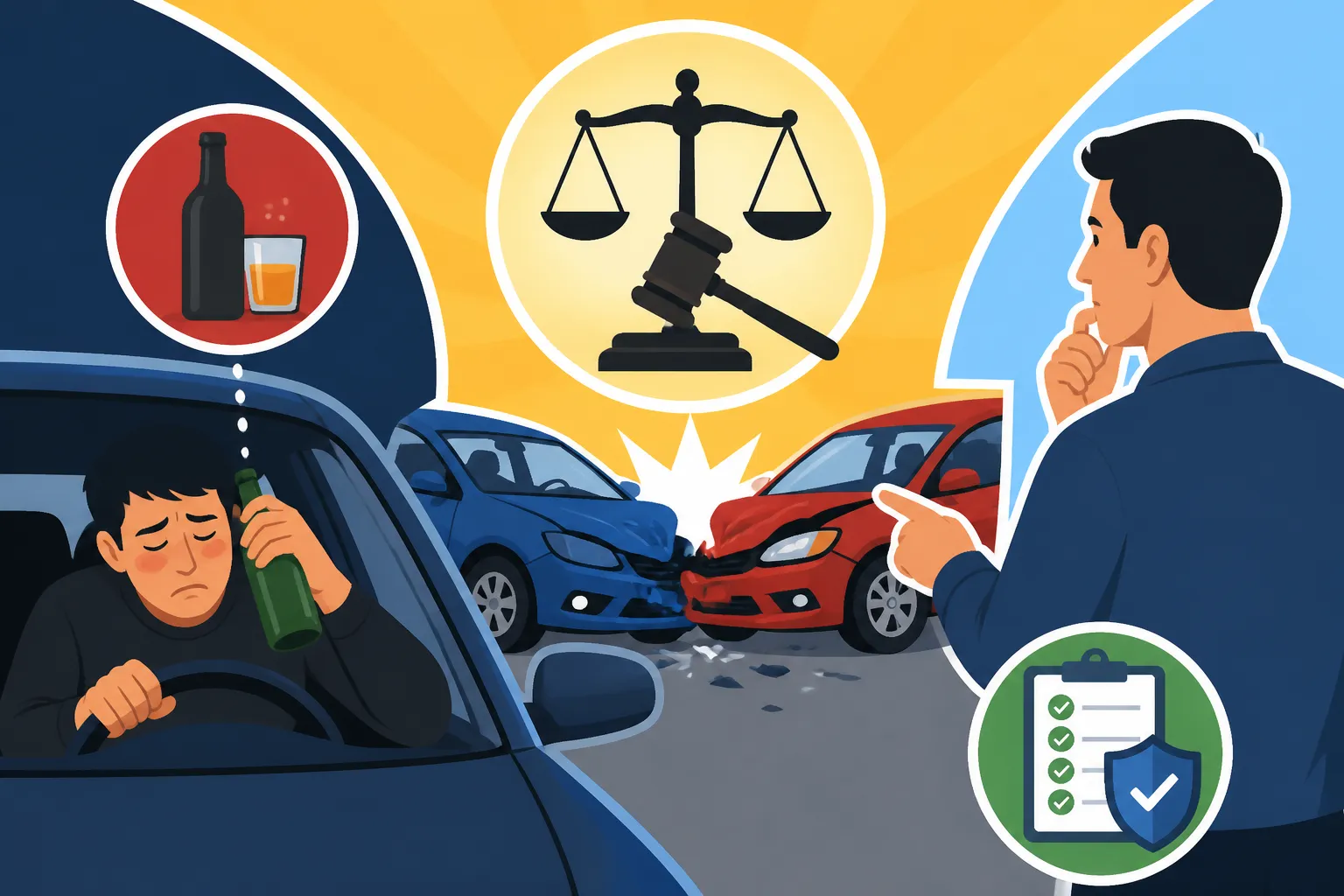
Because driving while intoxicated is inherently reckless, there's an immediate, strong presumption of negligence on the part of the drunk driver. This doesn't mean the investigation stops, but it certainly simplifies the initial determination of who caused the crash. The focus quickly turns from "who ran the red light?" to "how intoxicated was the at-fault driver?" and "what damages did this negligence cause?". This established negligence forms a powerful foundation for any claims you might pursue, whether through insurance or a personal injury lawsuit. It's a key reason why these cases are often viewed differently than a typical fender bender.
Legal Definitions of Impairment BAC Levels
While common sense tells us a drunk driver is at fault, the legal system relies on specific, measurable criteria to define impairment. The most widely recognized standard in the United States is a Blood Alcohol Content (BAC) of 0.08% or higher for drivers 21 and over. This isn't just an arbitrary number; it's the legal threshold for intoxication, and exceeding it immediately puts a driver in violation of the law in every state. For commercial drivers, the limit is often lower, around 0.04%, and for drivers under 21, it's typically a zero-tolerance policy, meaning any detectable amount of alcohol can lead to a DUI charge.
It's important to understand that a driver can still be considered impaired and at fault even if their BAC is below 0.08%. If their driving abilities were noticeably compromised by alcohol or drugs, and this impairment directly contributed to the accident, they can still be found negligent. Think about someone who had a couple of drinks and is swerving, slow to react, or making poor judgments – they might not hit 0.08% but are clearly not safe to drive. The legal definition of impairment, especially the 0.08% BAC, provides a clear-cut way for law enforcement and legal professionals to establish initial fault and open the door for more severe consequences.
The Distinction Between Criminal and Civil Fault
This is a crucial point that often confuses accident victims. When someone is arrested for driving under the influence after an accident, they are facing criminal charges. These charges, like DUI or DWI, are brought by the state and aim to punish the offender for breaking the law, potentially leading to fines, jail time, license suspension, and mandatory alcohol education programs. The standard of proof in a criminal case is "beyond a reasonable doubt," which is a very high bar.
However, your car accident claim, seeking compensation for your injuries and damages, is a civil matter. In a civil case, you (the victim) are seeking to recover damages from the at-fault driver. The standard of proof in a civil case is "a preponderance of the evidence," meaning it's more likely than not that the drunk driver's negligence caused your harm. While a criminal conviction for DUI is incredibly helpful in establishing civil fault, it's not strictly necessary. Even if the drunk driver avoids a criminal conviction, you can still pursue a civil claim against them if you can prove their impairment caused the accident. This distinction allows victims to seek justice and compensation for their losses regardless of the outcome of any parallel criminal proceedings. It truly highlights the different goals of the two legal systems: punishment for the state vs. compensation for the individual. If you're wondering, "Who Is at Fault in a Car Accident? Complete Guide (2026)" offers more general insights into how fault is determined overall.
How Evidence Establishes Fault Against a Drunk Driver
While the presumption of negligence is strong, you still need solid evidence to back up your claim. This evidence isn't just for the criminal case against the drunk driver; it's absolutely vital for your civil claim to ensure you can recover your damages. Without proper documentation and collection of evidence, even the clearest case can face hurdles.
Police Reports and DUI Investigations
The police report is often the cornerstone of establishing fault in any car accident, and it becomes even more critical in a drunk driving scenario. When officers respond to an accident scene, they're not just documenting vehicle positions and damage; they're also observing the drivers involved. If they suspect intoxication, their investigation will shift to a DUI protocol. This includes observing physical signs like slurred speech, bloodshot eyes, unsteady gait, and the smell of alcohol. They'll also typically administer field sobriety tests (FSTs) and, if probable cause exists, request a breathalyzer test at the scene or transport the driver for more definitive chemical testing.
The police report will detail these observations, the results of any tests, and any charges filed against the drunk driver. This official documentation from law enforcement is incredibly powerful in supporting your civil claim. It provides an independent, professional assessment that the other driver was operating their vehicle while impaired, directly linking their illegal actions to the cause of the accident. It helps lay out "Police Reports and Car Accident Fault," making it a foundational piece of evidence. Remember, even if the police don't immediately charge them with DUI, their notes on suspicious behavior can still be valuable.
Chemical Tests and Witness Testimonies
Beyond the initial police observations, chemical tests provide definitive, scientific proof of intoxication. These include breath, blood, or urine tests that measure the driver's BAC or the presence of other impairing substances. A blood test, often performed at a hospital or police station, is considered the most accurate method for determining BAC. The results of these tests, when available, are almost irrefutable evidence of the driver's impairment at the time of the accident. These results become a centerpiece of both criminal prosecution and your civil claim, making it very difficult for the drunk driver or their insurance company to dispute their intoxication.
Furthermore, witness testimonies can play a significant role. Imagine other drivers, passengers, or even bystanders who observed the drunk driver's erratic driving before the crash, or their behavior after the crash. Perhaps they saw them stumbling out of a bar minutes before. These firsthand accounts can corroborate the police's observations and chemical test results, painting a more complete picture of the driver's impairment and how it contributed to the accident. Even if a witness only saw parts of the incident, their observations can fill in crucial gaps and strengthen your case.
Gathering Additional Evidence at the Scene
While the police handle the official investigation into the DUI, you, as the victim, also have a critical role to play in gathering evidence at the scene, if you're able. The more information you collect, the stronger your position will be when dealing with insurance companies and potential legal action. This includes taking photos and videos of everything: the damage to both vehicles, the position of the cars, any skid marks, traffic signs, and especially any visual cues of the other driver's impairment. Did they drop their keys? Were there open containers in their car? Did they slur their words when speaking to you?
Exchange contact and insurance information with the other driver, but keep interactions brief and avoid accusatory language. You should also gather contact information from any witnesses. If possible, make notes about the weather conditions, time of day, and specific details of the road. Even something as simple as the type of vehicle the drunk driver was operating can be relevant. This meticulous documentation will serve as valuable support for your claim and complement the official police investigation, helping you to "How to Prove the Other Driver Was at Fault."
| Type of Evidence | Description | Importance in Drunk Driving Cases |
|---|---|---|
| Police Report | Official record of the accident, officer observations, field sobriety tests, and charges. | Establishes probable cause for DUI, initial finding of fault, and details of the incident. |
| BAC Test Results | Breath, blood, or urine tests showing Blood Alcohol Content or presence of drugs. | Scientific, undeniable proof of intoxication beyond legal limits. |
| Witness Statements | Accounts from bystanders, passengers, or other drivers. | Corroborates impaired driving behavior, events leading to and following the crash. |
| Photos/Videos | Images/footage of the scene, vehicle damage, driver behavior, open containers. | Visual documentation of the accident, physical evidence of impairment, and contributing factors. |
| Medical Records | Your treatment for injuries sustained in the accident. | Links your injuries directly to the accident caused by the drunk driver. |
| Dashcam/Surveillance Footage | Recordings from your vehicle, nearby businesses, or traffic cameras. | Objective, real-time evidence of the crash sequence and driver actions. |
The Impact of Drunk Driving on Your Car Accident Claim
Dealing with the aftermath of any car accident is tough enough, but when alcohol is involved, the complexities of your claim can amplify significantly. While the at-fault driver's intoxication might seem to make your claim straightforward, there are specific factors that come into play, potentially impacting both the process and the ultimate compensation you receive.
Navigating Insurance Claims with a Drunk Driver
When you're involved in an accident with a drunk driver, you'll generally file a claim with your own insurance company (if you have collision coverage) or directly with the drunk driver's insurance company. The good news is that proving fault against a drunk driver is typically less contentious than in other types of accidents because of the clear negligence involved. Insurance companies are often quicker to accept liability when intoxication is confirmed, as it's hard to dispute.
However, don't let this ease lull you into a false sense of security. Insurance adjusters, even in drunk driving cases, are still looking to minimize payouts. They might still try to downplay your injuries, question the necessity of your medical treatment, or argue over the extent of your vehicle damage. They may also try to find any small way to assign partial fault to you, which could reduce your overall settlement. It's crucial to be prepared, maintain detailed records of all your medical treatments, expenses, and communications, and remember that their initial offer is rarely their best offer. Knowing "How Insurance Companies Determine Who Is at Fault" in these unique situations is key.
Potential for Enhanced Damages Punitive Damages
One of the most significant differences in a drunk driving accident claim is the potential for punitive damages. In most car accident cases, compensation (known as "damages") is limited to economic damages (like medical bills, lost wages, property damage) and non-economic damages (like pain and suffering, emotional distress). These are called compensatory damages because they are designed to compensate you for your losses.
However, drunk driving often qualifies for punitive damages. Punitive damages are not about compensating the victim; they are specifically designed to punish the at-fault driver for their egregious behavior and to deter others from committing similar acts. Because driving under the influence shows a willful and wanton disregard for human life and safety, many states allow for these enhanced damages in civil lawsuits. Awarding punitive damages sends a strong message that such reckless behavior will not be tolerated. This can significantly increase the total value of your claim, making it a crucial aspect to explore. For a deeper dive, consider reading "What Are Punitive Damages in a Car Accident?".
How a Criminal Conviction Affects Your Civil Claim
As we discussed, criminal and civil cases are separate. However, if the drunk driver is convicted of a DUI or DWI charge in criminal court, this conviction becomes a powerful piece of evidence in your civil personal injury claim. In many jurisdictions, a criminal conviction can be used as "proof of negligence per se" in your civil case. This means that because the driver was found guilty of breaking a safety law (driving while intoxicated), their negligence in causing the accident is automatically established. You wouldn't have to re-prove that they were negligent; you would only need to prove that their negligence caused your injuries and damages.
This significantly streamlines the civil claim process, making it much harder for the drunk driver's insurance company or legal team to dispute liability. While you can still pursue a civil claim even without a criminal conviction, having that conviction in hand provides a substantial advantage, often leading to quicker settlements and potentially higher payouts because the element of fault is so clearly solidified.
When the Drunk Driver Isn't Solely at Fault
You might think that if a driver is drunk, they are automatically 100% at fault for any accident they are involved in. And while their intoxication undeniably plays a massive role, there are rare, complex scenarios where fault might not be entirely clear-cut, or where other parties could also bear some responsibility. It's frustrating to consider, but understanding these nuances is important.
Comparative and Contributory Negligence in Drunk Driving Cases
Even in an accident involving a drunk driver, the concept of comparative or contributory negligence can sometimes come into play, depending on the state where the accident occurred. This refers to situations where you, as the victim, might also have contributed to the accident in some small way. For instance, if you were speeding, failed to use your turn signal, or had a broken taillight, an insurance company or defense attorney might try to argue that your actions also played a part, however minor.
- Contributory Negligence States: In a handful of states (like Alabama, Maryland, North Carolina, Virginia, and the District of Columbia), if you are found even 1% at fault for the accident, you could be barred from recovering any damages. This is a harsh rule that rarely applies in drunk driving cases given the egregious nature of the drunk driver's actions, but it's theoretically possible.
- Comparative Negligence States: Most states follow comparative negligence laws. This means your damages would be reduced by the percentage of fault assigned to you. For example, if you sustained $100,000 in damages but were found 10% at fault, your recovery would be reduced to $90,000.
Even with a drunk driver, the defense might try to argue you were partially at fault to reduce their liability. However, it is an uphill battle for them, as the drunk driver's impairment almost always overshadows minor contributing factors. You can delve deeper into these concepts with "Comparative vs Contributory Negligence Explained."
Dram Shop Laws and Social Host Liability
Sometimes, the drunk driver isn't the only party who can be held liable. Many states have "dram shop laws" or "social host liability" laws, which can extend financial responsibility to establishments or individuals who served alcohol to the impaired driver.
- Dram Shop Laws: These laws allow victims to sue establishments (like bars, restaurants, or liquor stores) that served alcohol to a visibly intoxicated person or to a minor, who then went on to cause an accident. For example, if a bartender at a local pub in Phoenix, Arizona, continued serving drinks to someone who was clearly slurring their words and stumbling, and that person then got into a crash, the bar could potentially be held liable for damages.
- Social Host Liability: Some states also have laws that hold private individuals liable for serving alcohol to a minor who then causes an accident, or, less commonly, for serving a visibly intoxicated guest at their home. This means that if you were injured by a minor who was illegally served alcohol at a house party in California, the host of that party might share some responsibility for your injuries.
These laws add another layer of complexity but also offer additional avenues for victims to seek compensation, especially if the drunk driver has insufficient insurance or assets to cover the full extent of your damages. It’s about holding all responsible parties accountable for their role in the tragedy.
Unexpected Scenarios: Shared Responsibility
While it's rare, there might be other contributing factors that muddy the waters of "sole fault" even in drunk driving cases. For example:
- Vehicle Malfunction: What if the drunk driver's brakes failed, but a reputable mechanic had recently botched a repair, leading to the malfunction? The mechanic could potentially share some liability.
- Road Defects: If the accident occurred on a stretch of road with severe, unmarked potholes or a poorly designed intersection that significantly contributed to the crash, the municipality or road maintenance company could theoretically bear some responsibility.
- Other Drivers: In a multi-car pileup, another sober driver's reckless actions might have also contributed to the chain of events, even if the primary cause was the drunk driver's initial negligence.
These scenarios are exceptions rather than the rule, and the drunk driver's liability will almost always remain paramount. However, a thorough investigation by experienced professionals will consider all possibilities to ensure that every party responsible for your injuries is identified and held accountable. Understanding how all aspects of "How Fault Is Determined in a Car Accident" is crucial, even when impairment is involved.
Your Steps After an Accident with a Drunk Driver
Being involved in an accident is a terrifying experience, and discovering the other driver is drunk only intensifies the trauma. It’s natural to feel overwhelmed, angry, and scared. But despite the emotional turmoil, the steps you take immediately after the crash, and in the days that follow, are absolutely critical for your safety, your health, and the strength of your future car accident claim.
Prioritizing Safety and Medical Attention
Your immediate safety and physical well-being must be your absolute top priority. First, if you can, move your vehicle to a safe location out of the flow of traffic. Turn on your hazard lights. If you suspect the other driver is intoxicated, do not engage with them beyond exchanging necessary information, and certainly do not get into an argument or confrontation. Their judgment is impaired, and their behavior can be unpredictable.
Next, and perhaps most importantly, seek medical attention immediately, even if you don't feel seriously injured. Adrenaline often masks pain, and some serious injuries, like whiplash, concussions, or internal bleeding, may not manifest symptoms until hours or even days later. A visit to the emergency room or an urgent care clinic creates an official medical record of your condition soon after the accident, which is vital evidence for your claim. This record establishes a direct link between the accident and any injuries you sustained. Delaying medical care can make it harder to prove your injuries were caused by the crash, and it can give insurance companies an opening to argue your injuries aren't as severe as you claim. For more detailed guidance, consider "What to Do After a Car Accident: Step-by-Step (2026)."
Documenting the Scene and Gathering Information
Once your immediate safety and medical needs are addressed, documenting the accident scene becomes paramount. If you're physically able, take as many photos and videos as you can. Capture:
- Vehicle Damage: Get wide shots showing the position of both cars, as well as close-ups of all damage to your vehicle and the drunk driver's vehicle.
- The Scene: Photograph skid marks, road conditions, traffic signs, debris, and any environmental factors.
- Visible Evidence of Intoxication: If you see any open containers in the other car, or if the driver is exhibiting clear signs of intoxication, try to discreetly record it without putting yourself at risk.
- People Involved: Take photos of the other driver's license plate and their physical appearance (from a safe distance).
Gather contact information from the other driver (name, phone, insurance details) and any witnesses. Do not admit fault or apologize, even casually, as these statements can be misconstrued later. When the police arrive, cooperate fully, providing them with all the information you've gathered. Ensure you specifically mention your suspicion that the other driver was intoxicated, as this will trigger their DUI investigation. This detailed record is essential for "How to File a Car Accident Insurance Claim" later.
Seeking Legal Guidance and Understanding Your Rights
Dealing with a drunk driving accident often involves complex legal and insurance issues, especially with the potential for punitive damages and criminal proceedings. This is precisely when you need professional help. Contacting a car accident lawyer as soon as possible after the accident is highly advisable. An experienced attorney can:
- Protect Your Rights: They will ensure you don't inadvertently say or do anything that could jeopardize your claim.
- Investigate: They can conduct an independent investigation, gathering evidence like police reports, toxicology results, witness statements, and even surveillance footage that you might not be able to access.
- Negotiate with Insurers: Lawyers are skilled negotiators and can deal with the at-fault driver's insurance company, ensuring you don't accept a lowball offer and that all your damages, including pain and suffering, are properly accounted for.
- Pursue Punitive Damages: They can assess whether your case qualifies for punitive damages and build a strong legal argument to pursue them.
- Navigate the Legal System: If a settlement cannot be reached, they can guide you through the process of filing a personal injury lawsuit.
Trying to manage all of this on your own, especially while recovering from injuries and trauma, is incredibly difficult. A lawyer can be your advocate, allowing you to focus on your recovery. For insights on when legal help is crucial, you might find "Do You Need a Lawyer for a Car Accident? (2026)" to be a valuable resource, and for specifics on recovery, "Common Car Accident Injuries: Complete Guide (2026)" can offer further perspective.
Disclaimer
Please remember that this article provides general information and guidance regarding fault in drunk driving accidents. It is not intended as legal advice. Every accident and legal situation is unique, and laws vary significantly by jurisdiction. For personalized advice regarding your specific circumstances, you should consult with a qualified legal professional in your area.