Comparative Negligence Laws in Hawaii
Getting into a car accident is stressful enough, but when you throw in the complexities of determining who's actually at fault, it can feel like you're drowning in a sea of confusion. Many drivers are left wondering if they can still seek compensation if they believe they share even a small percentage of the blame. This guide is here to untangle the nuances of comparative negligence laws specifically in Hawaii, helping you understand your rights and the realities of what happens when fault isn't a simple one-sided affair in the Aloha State.
Understanding Comparative Negligence in Car Accidents
When a car accident occurs, one of the most immediate and critical questions is, "Who caused this?" While sometimes the answer is crystal clear, often, multiple factors and drivers contribute to the crash. This is where the legal concept of comparative negligence comes into play, a system designed to fairly distribute responsibility and damages when more than one person shares the blame.
What is Comparative Negligence?
At its heart, comparative negligence is a legal principle that allows an injured party to recover damages even if they are partly responsible for the accident. Unlike older, stricter laws (like contributory negligence, which we’ll touch on briefly), comparative negligence acknowledges that accidents aren't always black and white. It recognizes that sometimes, both drivers, or even more parties, might have acted carelessly in some way that led to the collision. This system aims for a more equitable outcome, rather than completely barring someone from recovery just because they had a tiny percentage of fault.
Think of it this way: if you're involved in a fender bender and you were slightly distracted, but the other driver was speeding excessively, comparative negligence seeks to weigh those contributions. It's about assigning a percentage of fault to each party involved. This percentage then directly influences the amount of compensation you can recover. It’s a common-sense approach to the messy reality of everyday traffic.
The Different Types of Comparative Negligence
Not all states handle comparative negligence in the exact same way. There are two main categories you'll encounter, each with its own rules about how much fault an injured party can bear before their ability to recover damages is affected. Understanding these distinctions is crucial because the type of comparative negligence system a state follows can significantly impact your car accident claim.
First, you have "pure comparative negligence." In states that adhere to this rule, an injured party can recover damages no matter how high their percentage of fault, even if they are 99% to blame. The recovery is simply reduced by their percentage of fault. So, if you were 90% at fault and your damages totaled $10,000, you could still receive $1,000. It’s a very lenient system aimed at ensuring some level of compensation regardless of blame.
Then there's "modified comparative negligence," which is the more common approach across the country. This system introduces a threshold: if an injured party's fault meets or exceeds a certain percentage, they are barred from recovering any damages. There are typically two versions of modified comparative negligence: the "50% bar" rule and the "51% bar" rule. In a 50% bar state, if you are found 50% or more at fault, you cannot recover. In a 51% bar state, you can recover as long as your fault is not more than the other party's fault—meaning if you are 50% at fault, you can still recover, but if you are 51% or more, you cannot. This distinction is incredibly important, as even a single percentage point can mean the difference between recovering substantial compensation and receiving nothing at all. Many people wonder, "What does 50/50 fault mean for your claim?" and the answer depends heavily on which type of modified comparative negligence law applies.
Hawaii's Modified Comparative Negligence Law (The 51% Rule)
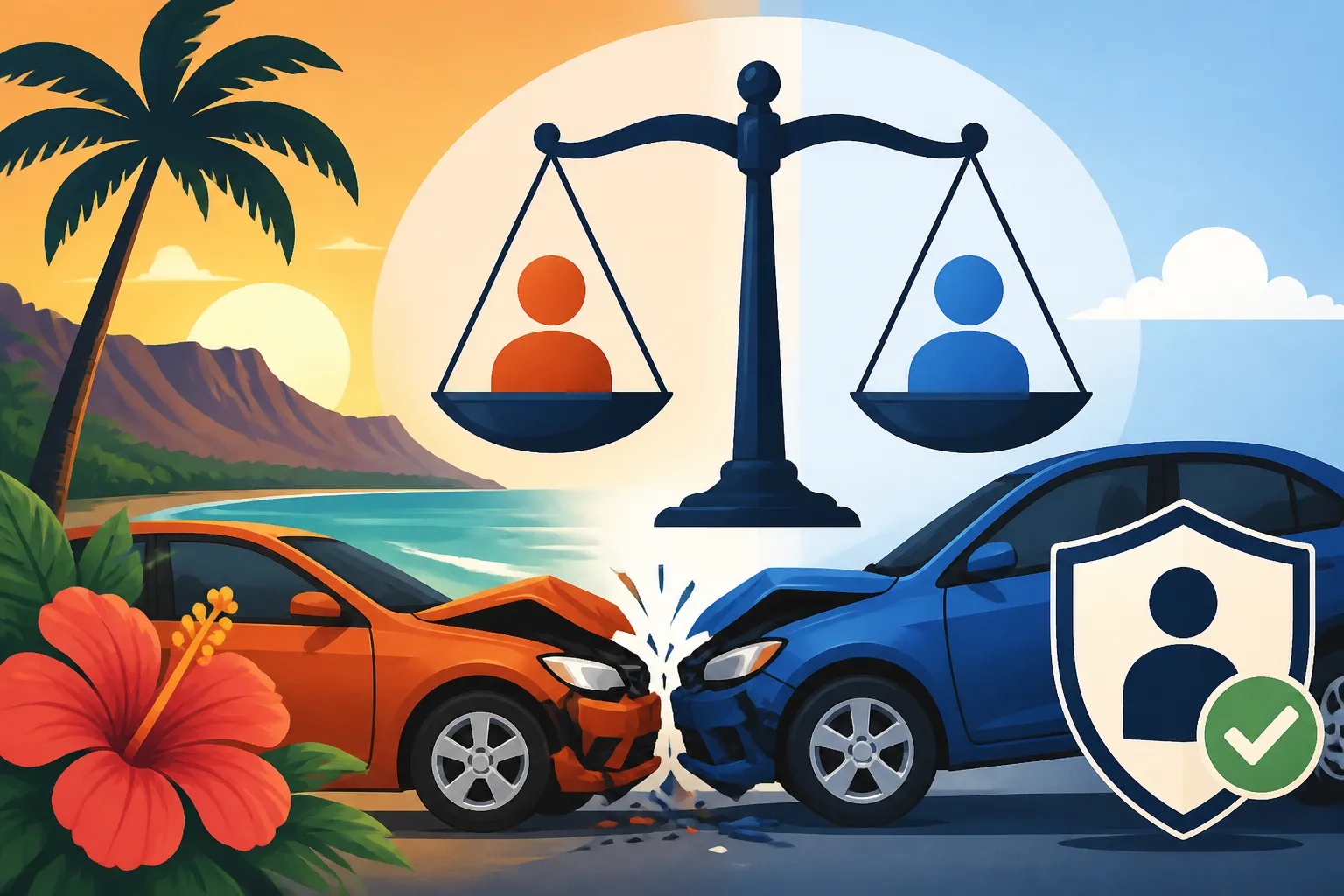
Now, let’s bring it home to the beautiful islands. If you find yourself in a car accident in Hawaii, it’s important to know that the state operates under a modified comparative negligence system, specifically employing the "51% bar" rule. This is a critical piece of information for anyone involved in a collision here, as it directly impacts your eligibility for compensation and how your claim will proceed.
How Hawaii Assigns Fault
In Hawaii, when a car accident occurs and there's a question of shared responsibility, the legal system will assess the degree of fault for each party involved. The key takeaway for Hawaii drivers is this: you can recover damages for your injuries and losses as long as your percentage of fault for the accident does not equal or exceed 51%. If you are found to be 50% at fault or less, you can still recover, but the total amount of your damages will be reduced by your assigned percentage of fault. If, however, your fault is determined to be 51% or higher, you will generally be barred from recovering any compensation from the other party.
This means that if a jury or an insurance company determines you were, say, 40% responsible for the crash, and your total damages are $10,000, you would only be able to recover $6,000 (your total damages minus 40%). But if that percentage creeps up to 51%, your claim for damages against the other party essentially vanishes. This "51% bar" is a fundamental aspect of car accident claims in Hawaii and can lead to intense negotiations between parties and insurance companies over who is truly responsible. It highlights why it's so important to understand How Fault Is Determined in a Car Accident after an accident.
Real-World Scenarios in Hawaii
Let’s walk through a couple of hypothetical situations to really illustrate how Hawaii’s modified comparative negligence rule works in practice. Understanding these examples can help you envision how your own situation might be assessed.
Imagine a scenario: You’re driving on Kuhio Highway in Kauai. You’re slightly distracted by the stunning ocean view, momentarily drifting a bit over the lane line. At the same time, another driver, who is behind you, decides to pass you illegally on the right, exceeding the speed limit. A collision occurs. After an investigation, it’s determined that you were 20% at fault for your momentary lapse in lane discipline, while the other driver was 80% at fault due to their aggressive and illegal maneuver. If your total damages (medical bills, lost wages, vehicle repair, pain and suffering) are calculated to be $25,000, you would be eligible to recover $20,000 from the other driver and their insurance company (your $25,000 in damages reduced by your 20% fault). In this case, since your fault is below the 51% threshold, you can still receive significant compensation, albeit a reduced amount.
Now, consider a different scenario on the H-1 Freeway in Honolulu. You are weaving through traffic, aggressively changing lanes without signaling, and are generally exhibiting risky driving behavior. Another driver, while also perhaps not driving perfectly, suddenly swerves into your lane, causing a collision. Upon review, it's determined that your aggressive driving and lane changes were 60% responsible for the accident, while the other driver's sudden swerve contributed 40%. Because your assigned fault (60%) is 51% or higher, you would generally be barred from recovering any damages from the other driver in Hawaii. Even if you sustained severe injuries and extensive vehicle damage, the law in Hawaii would prevent you from seeking compensation from the other party due to your majority fault. This stark difference underscores why even a small percentage point in fault determination can be monumental.
The Impact on Your Car Accident Claim in Hawaii
When you've been in a car accident in Hawaii, the implications of comparative negligence laws extend far beyond just who gets a ticket. They directly shape how your insurance claim will be handled, the strategies you'll need to employ to prove your case, and ultimately, the amount of compensation you might receive. It's a game of percentages, and every point matters.
How Fault Affects Your Settlement
The percentage of fault assigned to you directly translates into a reduction in your potential settlement amount. This is perhaps the most immediate and tangible impact of Hawaii's comparative negligence law. Let's say your total provable damages, including medical expenses, lost income, and pain and suffering, come out to $50,000. If you are found to be 25% at fault for the accident, that $50,000 will be reduced by 25%, meaning you would only be able to collect $37,500. It's a straightforward calculation, but the challenge lies in the initial determination of those percentages.
Insurance companies, as you might expect, are in the business of minimizing payouts. Therefore, after an accident, the at-fault driver's insurance company will often try to pin as much blame as possible on you, the claimant. They know that if they can push your fault percentage to 51% or higher, they might not have to pay anything at all. Even if they can't reach that threshold, every percentage point they assign to you directly reduces their financial obligation. This is a critical point when considering How Comparative Fault Reduces Your Settlement and why insurance companies work so hard to prove a higher percentage of fault for the claimant. This contentious process is exactly why it's vital to understand How Insurance Companies Determine Who Is at Fault.
Proving the Other Driver Was at Fault
Given the "51% bar" in Hawaii, gathering compelling evidence to demonstrate the other driver's fault, and to minimize your own, is absolutely paramount. It’s not enough to simply believe they were at fault; you have to prove it with tangible evidence. Without solid proof, your ability to recover compensation could be severely hampered, or even completely denied.
The process of proving fault often begins at the scene of the accident. Thoroughly documenting the scene, taking photos and videos of vehicle damage, road conditions, traffic signs, and any visible injuries, can be invaluable. Witness statements from impartial observers can also carry significant weight. If there was a police investigation, the official police report will be a cornerstone of your claim, providing crucial details and often an initial assessment of fault, though it's not always the final word. Knowing how to prove the other driver was at fault is key. Medical records from your initial treatment and ongoing care serve to substantiate your injuries and connect them directly to the accident. Dashcam footage, if available, can offer an irrefutable account of the events leading up to the crash. Every piece of evidence helps build a stronger case, ensuring that the blame isn't unfairly shifted to you.
Navigating Insurance Claims and Potential Disputes
Dealing with the aftermath of a car accident in Hawaii means navigating a sometimes confusing and often frustrating insurance claims process. The unique aspects of Hawaii's comparative negligence laws add another layer of complexity, particularly when it comes to disputing fault and ensuring you receive fair compensation. It's rarely a straightforward path, and understanding the challenges ahead can better prepare you.
Dealing with Insurance Adjusters
After an accident, one of the first people you'll likely communicate with from the other side will be an insurance adjuster. These individuals work for the insurance company, and their primary goal is to settle claims for the lowest possible amount. They are highly skilled negotiators and will often attempt to find ways to reduce the amount they have to pay out, frequently by trying to assign a higher percentage of fault to you. This is a common tactic, and it's essential to be prepared for it.
Adjusters might ask for recorded statements, detailed accounts of the accident, and access to your medical records. While you generally need to cooperate to some extent, it's wise to be cautious. Any statements you make could potentially be used against you to argue for a higher percentage of your own fault. They might suggest that your injuries weren't directly caused by the accident or that you could have done more to avoid the crash. It's often recommended to consult with an attorney before providing detailed statements, especially if you suspect shared fault. Understanding Dealing With Insurance Adjusters After a Car Accident is vital for protecting your interests. Remember, their job is not to be your friend; it’s to save their company money.
What Happens If You're Partially at Fault?
The reality of Hawaii’s 51% modified comparative negligence rule is that if you are found to be partially at fault (50% or less), you can still pursue a claim for damages. However, your recovery will be reduced proportionally to your assigned fault. This means that if you've incurred $10,000 in damages and are found 30% at fault, you would be eligible to recover $7,000. It's a system designed to allow for some recovery while acknowledging shared responsibility. This scenario highlights a common question: Can you still get paid if you're partly at fault?
The challenge, though, comes in the negotiation phase. The other driver’s insurance company will often try to inflate your percentage of fault to minimize their payout. This is where disputes commonly arise, and why having strong evidence and clear documentation of the accident and your injuries becomes so critical. If an insurance company blames you unfairly, it's a battle you need to be ready to fight. It's important to keep in mind that what happens if you're partially at fault? can vary greatly based on the specifics of the case and the evidence presented.
Here's a quick overview of how comparative negligence plays out:
| Type of Negligence | Description | Hawaii's Rule |
|---|---|---|
| Contributory | If you are found any percentage at fault (even 1%), you are completely barred from recovering damages. Very few states still follow this strict rule. | Does NOT Apply: Hawaii does not follow the contributory negligence rule. |
| Pure Comparative | You can recover damages regardless of your percentage of fault. Your recovery is simply reduced by your fault percentage (e.g., 90% at fault, recover 10% of damages). | Does NOT Apply: While more lenient than contributory, Hawaii does not use pure comparative negligence. |
| Modified Comparative | You can recover damages unless your fault reaches or exceeds a certain threshold (usually 50% or 51%). Your recovery is reduced by your fault percentage. | Applies (51% Bar): In Hawaii, if your fault is 51% or greater, you cannot recover damages. If your fault is 50% or less, you can recover, reduced by your percentage of fault. |
The Role of Police Reports and Legal Counsel
Police officers responding to an accident often create a police report detailing their observations, witness statements, and sometimes, their preliminary assessment of fault. While a police report is not always the definitive final word in determining liability, it carries significant weight and can be a crucial piece of evidence in your insurance claim. For instance, if the report clearly assigns fault to the other driver for a traffic violation, it strengthens your position considerably. However, it's also important to remember that police reports and car accident fault can be challenged, and sometimes the officer's initial assessment might not fully capture all the complexities of the situation.
Given the complexities of Hawaii’s comparative negligence laws and the potential for insurance companies to dispute fault, many individuals find it beneficial to consult with an attorney. A lawyer specializing in car accident claims can help you understand your rights, gather necessary evidence, negotiate with insurance adjusters, and represent you if your case needs to go to court. They can often provide invaluable guidance on how insurance companies determine who is at fault and help ensure that your fault percentage isn't unfairly inflated, maximizing your chances of a fair settlement.
Disclaimer
Please remember that this article provides general information and insights into comparative negligence laws in Hawaii. It is not intended as legal advice. Every car accident case is unique, and the application of these laws can vary based on specific circumstances. For personalized advice regarding your particular situation, it is always recommended to consult with a qualified legal professional in Hawaii.