How Contributory Negligence Works in North Carolina
Experiencing a car accident is disorienting enough, but the legal aftermath can be downright frustrating, especially when you live in a state like North Carolina with its unique approach to determining fault. If you've been in a crash and are wondering if you can even get compensation, understanding how contributory negligence works here is absolutely critical. This guide will walk you through North Carolina's strict fault rules and how they might impact your car accident claim.
Understanding Contributory Negligence in Car Accident Claims
When you're involved in a car accident, one of the first things that needs to be established is who was at fault. This seems straightforward, but different states handle it in vastly different ways. North Carolina operates under a legal principle that can make recovering damages incredibly challenging for injured parties.
The Core Concept of Contributory Negligence
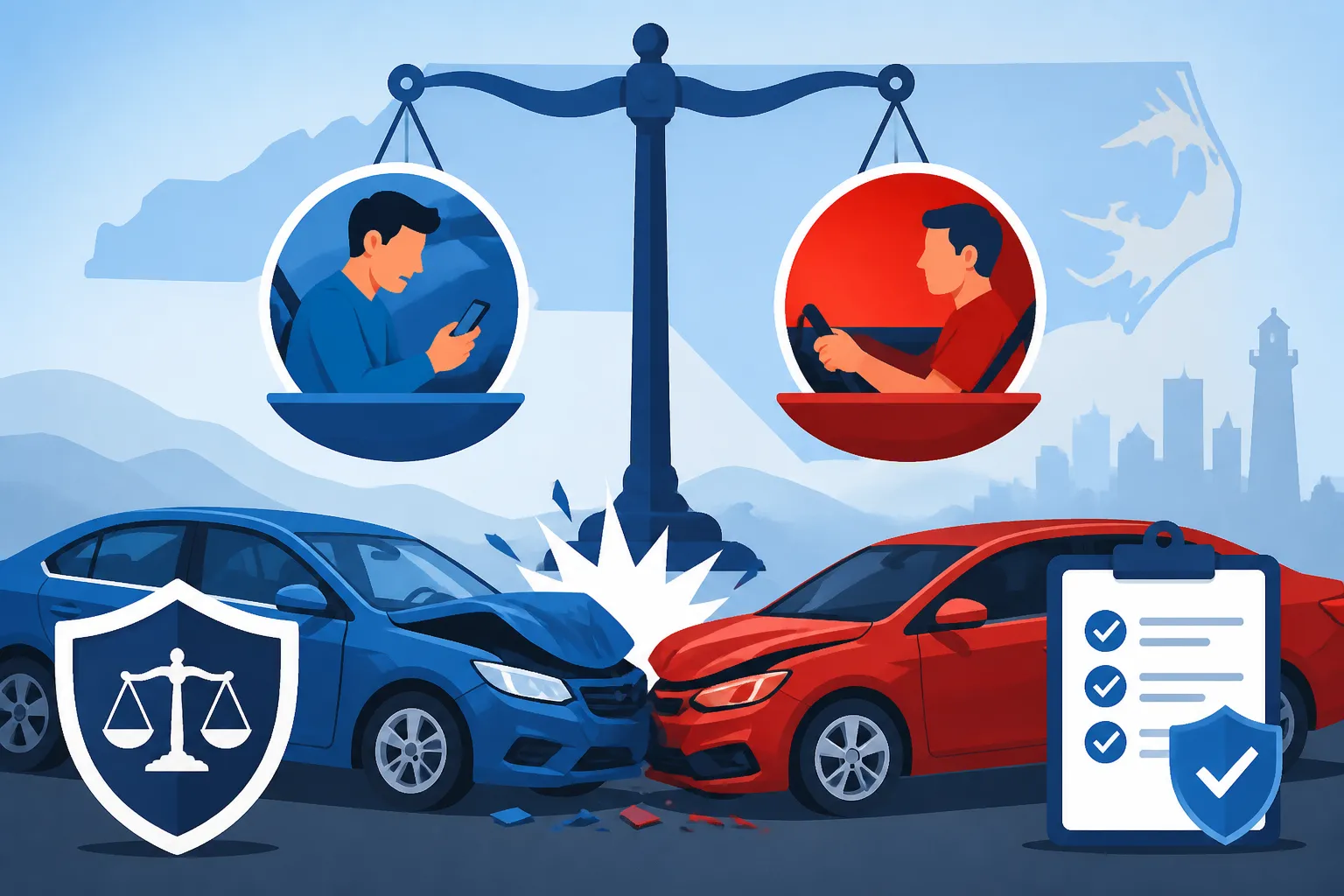
At its heart, contributory negligence is an "all or nothing" rule. This means that if you, the injured party, are found to have contributed to the cause of the accident in any way, even as little as one percent, you are completely barred from recovering compensation for your injuries and damages from the other driver. It doesn't matter how severely you were injured or how overwhelmingly the other driver was at fault; if your actions, however slight, contributed to the collision, your claim can be denied.
Imagine a scenario: you're driving slightly over the speed limit (a minor contribution to the accident), and another driver runs a red light and T-bones your vehicle. In many states, you might still recover a large percentage of your damages because the other driver was clearly more at fault. However, under pure contributory negligence, that slight speeding could be enough for the other driver's insurance company to argue you contributed to the crash, potentially leaving you with no compensation at all. This is a stark contrast to comparative negligence systems, where your compensation would simply be reduced by your percentage of fault. For example, in a state with comparative negligence, if you were 10% at fault, you would still recover 90% of your damages.
North Carolina's Strict Approach to Fault
North Carolina stands as one of the few states in the entire country that still adheres to the strict rule of pure contributory negligence. This means that the stakes are incredibly high for anyone involved in an accident here. While the majority of states have moved towards some form of comparative negligence, North Carolina has maintained this older, more rigid system. This adherence to contributory negligence can feel incredibly unfair to accident victims who might have only played a minor role in a collision, yet lose their entire right to compensation.
This strict rule puts a significant burden on anyone pursuing a car accident claim. You're not just trying to prove the other driver was negligent; you're essentially trying to prove that you were completely free from any negligence that contributed to the accident. This makes the investigative phase after a crash, and indeed the entire claims process, far more complex and adversarial in North Carolina than almost anywhere else. Understanding this fundamental difference is the first step in protecting your rights after a crash in the Tar Heel State.
How Contributory Negligence Impacts Your Car Accident Claim in North Carolina
The "all or nothing" nature of North Carolina's contributory negligence rule creates a very specific dynamic when it comes to car accident claims. It profoundly influences how insurance companies operate and what you, as the injured party, need to prove.
The "All or Nothing" Rule
Let's be blunt: the "all or nothing" rule is as unforgiving as it sounds. If the insurance company or a jury finds that you were even 1% responsible for the accident, your entire claim for damages, including medical bills, lost wages, and pain and suffering, can be completely barred. This means you could walk away with nothing, even if the other driver's actions were the primary cause of the crash and resulted in severe injuries.
Consider a simple parking lot accident in Raleigh, North Carolina. You're backing out of a parking spot, checking your mirrors, but perhaps you momentarily glanced down at your radio. At that precise moment, another driver, who was speeding excessively through the parking lot, collides with your vehicle. While the other driver's speeding is clearly negligent, the insurance company might argue that your momentary glance away, however brief, was a contributing factor to the accident. In a state like North Carolina, this small act could be enough to deny your entire claim. The other driver's insurer will almost certainly try to find any piece of evidence to prove you were partly at fault, because if they succeed, they pay nothing.
Proving the Other Driver Was Solely at Fault
Because of this strict rule, the burden of proof in North Carolina car accident claims falls heavily on the injured party. You must meticulously demonstrate that the other driver was solely at fault for the accident, and that your own actions did not contribute to the collision in any way whatsoever. This isn't just about showing negligence on their part; it's about eliminating any negligence on yours.
To achieve this, gathering comprehensive evidence at the scene and immediately following the accident is paramount. This includes a detailed police report, which can be crucial in establishing fault. For more insights on this, you might find our guide on Police Reports and Car Accident Fault helpful. Additionally, collecting witness statements, photographs and videos of the accident scene (including vehicle positions, damage, road conditions, and traffic signs), and any available dashcam or surveillance footage can be invaluable. Every piece of evidence helps build a clearer picture and can counteract an insurance company's attempt to assign you even minor fault. It's a challenging endeavor, and often requires a thorough understanding of How to Prove the Other Driver Was at Fault.
Common Scenarios and Potential Exceptions
While North Carolina's contributory negligence rule is notoriously strict, there are a few very limited exceptions that might allow an injured party to recover damages even if they were partly at fault. These exceptions are complex and are often fiercely contested by insurance companies.
Last Clear Chance Doctrine
One of the most frequently discussed exceptions to contributory negligence in North Carolina is the "last clear chance" doctrine. This doctrine comes into play when, despite your own negligence, the other driver had the "last clear chance" to avoid the accident but failed to do so. Essentially, it argues that even if you put yourself in a position of peril, if the other driver could have prevented the collision with reasonable care and failed to do so, their negligence becomes the proximate cause of the accident.
Let's consider a practical example. Imagine your car stalls in the middle of a busy highway lane late at night due to an unforeseen mechanical issue – perhaps you neglected routine maintenance, a minor form of negligence. You quickly put on your hazard lights. Another driver, clearly distracted by their phone or driving recklessly, approaches your stalled vehicle from behind. They have ample time and space to see your hazards and swerve to avoid you, but they fail to do so and rear-end your car. In this scenario, even though your stalled car might be considered a contributing factor to the situation, the other driver had the "last clear chance" to prevent the collision. Their failure to act could negate their ability to use contributory negligence as a defense against your claim. This is a very specific legal argument and requires strong evidence to prove.
Gross Negligence and Reckless Conduct
Another, albeit rarer, scenario where contributory negligence might not completely bar a claim involves the other driver's extreme misconduct. While not a direct "exception" in the same vein as "last clear chance," if the at-fault driver's actions were so egregious as to be considered gross negligence, willful, or wanton conduct, it can make it much harder for them to successfully argue contributory negligence as a defense. This isn't about simple negligence; it's about a complete disregard for the safety of others.
For instance, if you're involved in an accident with a drunk driver, their actions are generally considered willful or wanton misconduct. Even if there was some minor, non-willful negligence on your part, a court might be less inclined to apply the contributory negligence rule to bar your claim entirely when faced with such extreme recklessness. We delve deeper into such situations in our article on Fault in a Drunk Driving Accident. However, it's vital to understand that simply being found slightly negligent on your part could still be enough for an insurance company to attempt to deny your claim, even against a grossly negligent driver. These are highly complex legal arguments that almost always require the expertise of an attorney.
Navigating a Contributory Negligence Defense
Given North Carolina's strict contributory negligence laws, navigating the aftermath of a car accident here can feel like walking through a minefield. Insurance companies are well-versed in using this rule to their advantage, and you need to be equally prepared.
The Insurance Company's Strategy
Make no mistake, insurance adjusters in North Carolina are trained to look for any and every opportunity to assign fault to you, the claimant. Their primary goal is to protect their company's bottom line, and the contributory negligence rule is a powerful tool in their arsenal. They will scrutinize police reports, witness statements, accident reconstruction analysis, and even your own recorded statements for any shred of evidence that suggests you contributed to the crash. Even a slight deviation from a perfect driving record, a small misjudgment, or a delayed reaction could be seized upon.
This is why it's incredibly important to be cautious in all communications after an accident. You might feel compelled to apologize out of politeness or stress, but even a simple "I'm so sorry, are you okay?" could potentially be twisted into an admission of fault by an adjuster. It's often best to stick to factual information exchange at the scene and avoid discussing fault with anyone other than law enforcement. For more detailed advice on this, check out our piece on What Is an Admission of Fault (and How to Avoid It)?. Be wary of giving recorded statements to the other driver's insurance company without consulting with your own counsel, as anything you say can and will be used to try and discredit your claim. Learning how to effectively deal with insurance adjusters is key, and our article, Dealing With Insurance Adjusters After a Car Accident, provides valuable strategies.
Gathering and Preserving Evidence
Your ability to counteract a contributory negligence defense hinges almost entirely on the quality and quantity of evidence you collect. The moment an accident happens, your actions can make or break your claim.
Here are the crucial steps you should take:
- Document the Scene Immediately: If it's safe to do so, take extensive photographs and videos of everything. Capture the positions of all vehicles, damage to all vehicles, skid marks, road conditions, traffic signs, traffic lights, weather, and any debris. Get wide shots to show the overall intersection or road, and close-ups of specific damage. This comprehensive guide on How to Document a Car Accident Scene can provide more detail.
- Identify Witnesses: Ask anyone who saw the accident for their contact information. Their impartial testimony can be invaluable in establishing who was truly at fault and can contradict self-serving statements from the other driver.
- Call the Police: Even for minor accidents, getting a police report in North Carolina is highly recommended. The officer's findings regarding fault, while not definitive, carry significant weight with insurance companies and in court.
- Seek Medical Attention: Even if you feel fine, some injuries have delayed symptoms. Seeing a doctor immediately after an accident creates an official record of your physical state and links any subsequent injuries directly to the crash. This is crucial for proving your damages. Our article Why You Should See a Doctor After a Car Accident explains this importance in detail.
- Keep Detailed Records: Maintain a file with all accident-related documents, including police reports, medical bills, treatment records, receipts for out-of-pocket expenses, and records of lost wages.
Following a clear action plan after a collision can dramatically improve your chances. We cover all these critical steps and more in our comprehensive guide, What to Do After a Car Accident: Step-by-Step (2027).
The Role of Legal Counsel in Contributory Negligence Cases
Given the complex and unforgiving nature of North Carolina's contributory negligence law, trying to handle a significant car accident claim on your own is incredibly risky. This is precisely where experienced legal counsel becomes not just helpful, but often essential.
A seasoned car accident lawyer understands the intricacies of North Carolina's fault laws and the tactics insurance companies employ. They can:
- Investigate Thoroughly: Lawyers can conduct their own independent investigation, gathering evidence you might not even know exists, such as black box data from vehicles, surveillance footage from nearby businesses, or expert accident reconstruction analysis.
- Challenge Contributory Negligence Claims: They are skilled at dissecting the insurance company's arguments about your alleged fault and presenting counter-evidence to prove the other driver was solely responsible, or to argue one of the rare exceptions like the "last clear chance" doctrine.
- Negotiate Effectively: Attorneys know how to negotiate with insurance companies, armed with strong evidence and a deep understanding of the law. They can advocate for your rights and push back against unfair denials.
- Represent You in Court: If a fair settlement cannot be reached, your lawyer can prepare and present your case in court, which is often necessary when a contributory negligence defense is raised.
Deciding whether you need a lawyer after a car accident is a big decision, but in North Carolina, the strict fault rules heavily weigh in favor of seeking professional legal advice. Our guides on Do You Need a Lawyer for a Car Accident? (2027) and When to Hire a Car Accident Lawyer offer extensive information to help you make this critical choice. Don't let the intricacies of contributory negligence leave you without the compensation you deserve; an attorney can be your strongest ally.
| Feature | Contributory Negligence (e.g., North Carolina) | Comparative Negligence (Most States) |
|---|---|---|
| Recovery Rule | All or Nothing | Partial Recovery Based on Fault |
| Fault Threshold | Even 1% at fault bars recovery | Recovery is reduced by your percentage of fault (e.g., 20% fault = 80% recovery) |
| Burden of Proof | High for claimant to prove 0% fault | Claimant needs to prove other driver's fault, but not necessarily 100% |
| Legal Complexity | High, especially with "last clear chance" | Moderate to High, depending on the specific comparative negligence system |
| State Examples | North Carolina, Virginia, Maryland | California, Florida, Texas, New York (most other states) |
| Impact on Claimant | Severe, potential for no compensation | Less severe, still possible to recover significant damages |
Disclaimer
Please remember that the information provided in this article is intended for general informational purposes only and does not constitute legal advice. Car accident claims are highly complex, especially in states with unique laws like North Carolina's contributory negligence rule. It is crucial to consult with a qualified attorney in your jurisdiction for advice tailored to your specific situation. Laws can change, and individual circumstances vary greatly.