Comparative Negligence Laws in Kansas
Experiencing a car accident is already stressful enough, but when you realize that determining who's at fault isn't always a clear-cut, black-and-white situation, the whole process can feel overwhelming. Many people assume fault means one person is 100% to blame, but in states like Kansas, the law recognizes that multiple drivers can contribute to a crash. This guide will walk you through Kansas's specific comparative negligence laws and explain exactly how shared fault can impact your car accident claim.
Understanding Comparative Negligence in Car Accidents
When you’re involved in a car accident, one of the first things that comes to mind, after making sure everyone is safe, is usually, "Whose fault was this?" It's a natural question, as fault dictates a lot about how insurance claims proceed and who ultimately bears financial responsibility for damages and injuries. However, the legal definition of "fault" can be far more nuanced than many people realize, especially when you consider different state laws.
What "Fault" Really Means in an Accident
In the world of car accidents, "fault" isn't just about who slammed into whom. It's about who acted negligently, meaning they failed to exercise reasonable care, and whose negligence directly caused or contributed to the collision and any resulting injuries or property damage. For instance, if someone runs a red light and T-bones your car, their fault might seem obvious. But what if you were speeding slightly at the time? Or perhaps your brake lights weren't working perfectly? While their action might be the primary cause, these smaller details can sometimes open the door for a shared responsibility argument.
The determination of fault is a complex process that insurance companies and, if necessary, courts undertake. They look at police reports, witness statements, accident reconstruction, photos, videos, and even traffic laws to piece together the sequence of events and assign percentages of responsibility. This isn't just a theoretical exercise; it directly impacts how much compensation you might receive or have to pay out. For a deeper dive into this topic, you might find our comprehensive guide on How Fault Is Determined in a Car Accident to be incredibly helpful.
The Core Concept of Comparative Negligence
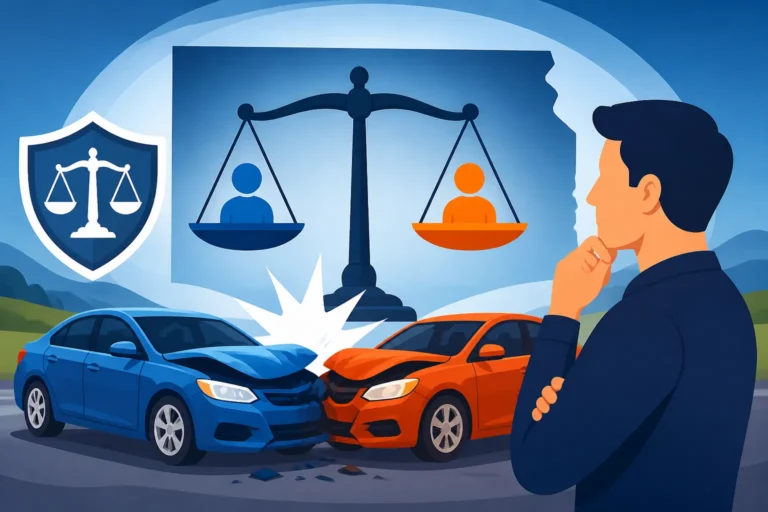
Now, let's talk about comparative negligence. This legal doctrine is used in most states to address situations where more than one party shares some degree of responsibility for an accident. Instead of a rigid "all or nothing" approach, comparative negligence allows for damages to be divided based on each party's percentage of fault. This is a stark contrast to a handful of states that follow "contributory negligence," which completely bars recovery if you are found even 1% at fault. If you're curious about the broader differences, our article on Comparative vs Contributory Negligence Explained offers a great overview.
Under a comparative negligence system, if you are deemed partially at fault for an accident, your potential compensation will be reduced by your percentage of fault. For example, if you sustained $10,000 in damages but were found 20% at fault, you would only be able to recover $8,000 from the other driver's insurance. This system aims for a fairer distribution of costs, reflecting the reality that accidents often have multiple contributing factors.
Kansas' Specific Approach to Comparative Negligence
Understanding the general concept of comparative negligence is one thing, but knowing the specific rules in your state is absolutely crucial. Each state's laws can differ significantly, and Kansas has its own distinct way of applying comparative negligence that directly affects car accident victims.
The Modified Comparative Negligence (50% Bar Rule) in Kansas
Kansas operates under a system known as modified comparative negligence, often referred to as the "50% bar rule." What does this mean for you? Simply put, you can still recover damages even if you are partially at fault for the accident, as long as your fault does not exceed 49%. If your share of the blame is found to be 50% or more, you are completely barred from recovering any damages from the other party.
This "50% bar rule" is a critical threshold. Let’s say you were involved in a collision in Wichita, and the damages totaled $50,000. If an investigation determines you were 25% at fault, you could still recover 75% of your damages, or $37,500. However, if that investigation concludes you were 50% at fault, or even 51% at fault, you would receive nothing from the other driver's insurance company. This is a significant difference compared to "pure comparative negligence" states, where you can recover even if you are 99% at fault, albeit with a proportional reduction in your payout. Our guide on Modified Comparative Negligence (50% vs 51% Bar) delves deeper into this specific type of law.
This rule emphasizes the importance of meticulously documenting the accident scene and gathering evidence to minimize your percentage of fault. Even a small difference in assigned fault percentage can have a massive impact on the outcome of your claim.
How Shared Fault Impacts Your Claim in Kansas
When you file a car accident claim in Kansas, the insurance companies involved will conduct their own investigations to assign fault. This is where the intricacies of comparative negligence truly come into play. Your claim’s value, including compensation for medical bills, lost wages, and pain and suffering, will be directly reduced by your assigned percentage of fault. If your fault hits or exceeds that 50% mark, your claim effectively disappears.
This isn't just about the financial payout; it also affects how you interact with insurance adjusters. They will likely try to find ways to assign some degree of fault to you, even if it's minor, to reduce their payout. Knowing Kansas's 50% bar rule gives you a clear understanding of the stakes involved. If they can push your fault to 50% or higher, it's a complete win for them. Therefore, it's vital to understand what happens if you're partially at fault and how to protect your interests. For insights into navigating these conversations, consider reading Dealing With Insurance Adjusters After a Car Accident.
Here’s a table illustrating how different fault percentages can affect a hypothetical $10,000 claim under Kansas’s modified comparative negligence:
| Driver A's Fault Percentage | Driver A's Recoverable Damages (from $10,000) | Outcome |
|---|---|---|
| 0% | $10,000 | Full recovery |
| 10% | $9,000 | Partial recovery |
| 25% | $7,500 | Partial recovery |
| 49% | $5,100 | Partial recovery |
| 50% | $0 | No recovery (barred) |
| 75% | $0 | No recovery (barred) |
As you can see, the difference between 49% and 50% fault is monumental.
Practical Implications for Your Car Accident Claim
Navigating a car accident claim in Kansas, especially when shared fault is a possibility, requires a strategic approach. It's not enough to simply believe you're not at fault; you need to be prepared to demonstrate it. This impacts everything from the evidence you collect to how you communicate with insurance companies.
Gathering Evidence to Support Your Lack of Fault
The success of your claim, particularly in a modified comparative negligence state like Kansas, hinges heavily on the evidence you present. Immediately after an accident, if you are able, documenting the scene thoroughly is paramount. This includes taking clear photographs and videos of vehicle positions, damage, road conditions, traffic signs, skid marks, and any debris. Get contact information from witnesses who saw what happened. A police report, while not always definitive on fault, can provide crucial details and observations from an objective party.
Medical records are also vital. Seeking prompt medical attention, even for seemingly minor aches, creates a paper trail linking your injuries directly to the accident. Delays can give insurance adjusters an opening to argue your injuries weren't crash-related or were pre-existing. Every piece of information helps build a stronger case to minimize your comparative fault and maximize your potential recovery. For a detailed checklist on what to do, refer to How to Prove the Other Driver Was at Fault.
Negotiating with Insurance When Fault is Shared
Negotiating with insurance companies is rarely a straightforward process, and it becomes even more challenging when there's a dispute over shared fault. Insurers are businesses, and their goal is to pay out as little as possible. They will often try to pin some percentage of fault on you, regardless of how minor, to reduce the settlement amount or, in Kansas, to push you past the 50% bar.
When presented with a fault assessment from an insurance company, don't automatically accept it. Review their reasoning carefully. If you disagree, be prepared to counter with your evidence. This is where having a clear understanding of How Insurance Companies Determine Who Is at Fault can be beneficial. They might cite obscure traffic violations or imply you could have acted differently to avoid the crash. Be firm, stick to the facts, and avoid admitting fault or making speculative statements. Remember, anything you say can be used to assign you a higher percentage of fault. Being well-prepared and knowing your rights under Kansas law is your strongest defense.
Real-World Scenarios and Outcomes in Kansas
To truly grasp how Kansas's comparative negligence laws play out, let's look at a couple of common accident scenarios. These examples highlight why the "50% bar rule" is so critical and how seemingly minor details can change a claim's trajectory.
Examples of Shared Fault in Common Accidents
Imagine a common scenario in Kansas City: A driver, let's call her Sarah, is attempting a left turn at an intersection. She believes she has a clear path and initiates her turn. At the same time, David, approaching from the opposite direction, is going slightly over the speed limit. A collision occurs.
-
Scenario 1: Sarah is 70% at fault, David is 30% at fault. In this case, turning left across traffic often carries a higher burden of fault. Sarah failed to yield, a significant contributing factor. David was speeding, but perhaps not excessively. If Sarah's damages are $20,000, under Kansas law, she would recover nothing from David because her fault exceeds 49%. David, however, if he suffered $10,000 in damages, could recover $7,000 ($10,000 minus 30% fault) from Sarah's insurance. This demonstrates the harshness of the 50% bar for the party with greater fault. Our article on Left-Turn Accident Fault Rules offers more specific details on fault in these types of crashes.
-
Scenario 2: Sarah is 40% at fault, David is 60% at fault. Let's say Sarah's turn was almost complete, and David was distracted by his phone, leading to him not slowing down or reacting in time, even though he was only slightly over the speed limit. Here, David's distracted driving makes him primarily at fault. If Sarah had $20,000 in damages, she could recover $12,000 ($20,000 minus 40% fault) from David's insurance. David, with $10,000 in damages, would recover nothing because his 60% fault exceeds the 49% threshold. This shows how crucial that fault percentage is for both parties.
These examples underscore that even if you believe the other driver was mostly to blame, your own actions, however minor, can significantly impact your ability to recover compensation under Kansas law. It’s a harsh reality that many people face.
Potential Settlement Adjustments Based on Fault
The negotiation phase of a car accident claim in Kansas will heavily revolve around fault percentages. Insurers for the "at-fault" driver will try to increase your assigned percentage of fault to reduce their payout. Conversely, your own insurance, or an attorney representing you, will work to minimize your fault percentage.
Let's say you're negotiating a settlement for a whiplash injury and minor car damage in Topeka, Kansas. Your total damages are calculated at $15,000.
- Initial Offer: The other driver's insurance company offers you $9,000, claiming you were 40% at fault for the accident because you were slowing down slightly before turning.
- Your Counter: You, with the help of evidence like dashcam footage showing the other driver tailgating, argue your fault was minimal, perhaps 10%.
- Final Settlement: After negotiation, you might settle on 20% fault. In this case, your $15,000 in damages would be reduced by 20% ($3,000), resulting in a $12,000 settlement.
This adjustment directly shows How Comparative Fault Reduces Your Settlement. If you couldn't agree on a fault percentage, the case could even go to court, where a jury would ultimately assign fault. The ability to effectively negotiate and present strong evidence is key to protecting your financial recovery in Kansas. It highlights why understanding What Happens If You're Partially at Fault? is so important from the very beginning of the claims process.
Disclaimer
Please remember that this article provides general informational guidance based on Kansas law and is not legal advice. Every car accident case is unique, and the specific facts and circumstances of your situation will determine its outcome. If you have been involved in a car accident in Kansas, it is highly recommended that you consult with a qualified legal professional to discuss your individual rights and options.