Comparative Negligence Laws in Louisiana
Getting into a car accident is jarring enough, but then you're hit with the confusing aftermath: who's to blame? And what happens if both drivers share some responsibility? This question becomes even more complex, and often frustrating, when you live in a state like Louisiana, which has its own specific rules for determining fault and how that impacts your ability to recover compensation. This guide is here to untangle the complexities of comparative negligence laws in Louisiana, helping you understand how shared fault can affect your car accident claim.
Understanding Comparative Negligence in Louisiana
The concept of fault is rarely black and white after a car accident. Often, both drivers might have done something that contributed to the collision. This is where comparative negligence comes into play, a legal principle designed to fairly allocate responsibility and damages when multiple parties are at fault. It’s a crucial aspect of Who Is at Fault in a Car Accident? Complete Guide (2027) and deeply impacts how your claim is handled.
What Is Comparative Negligence?
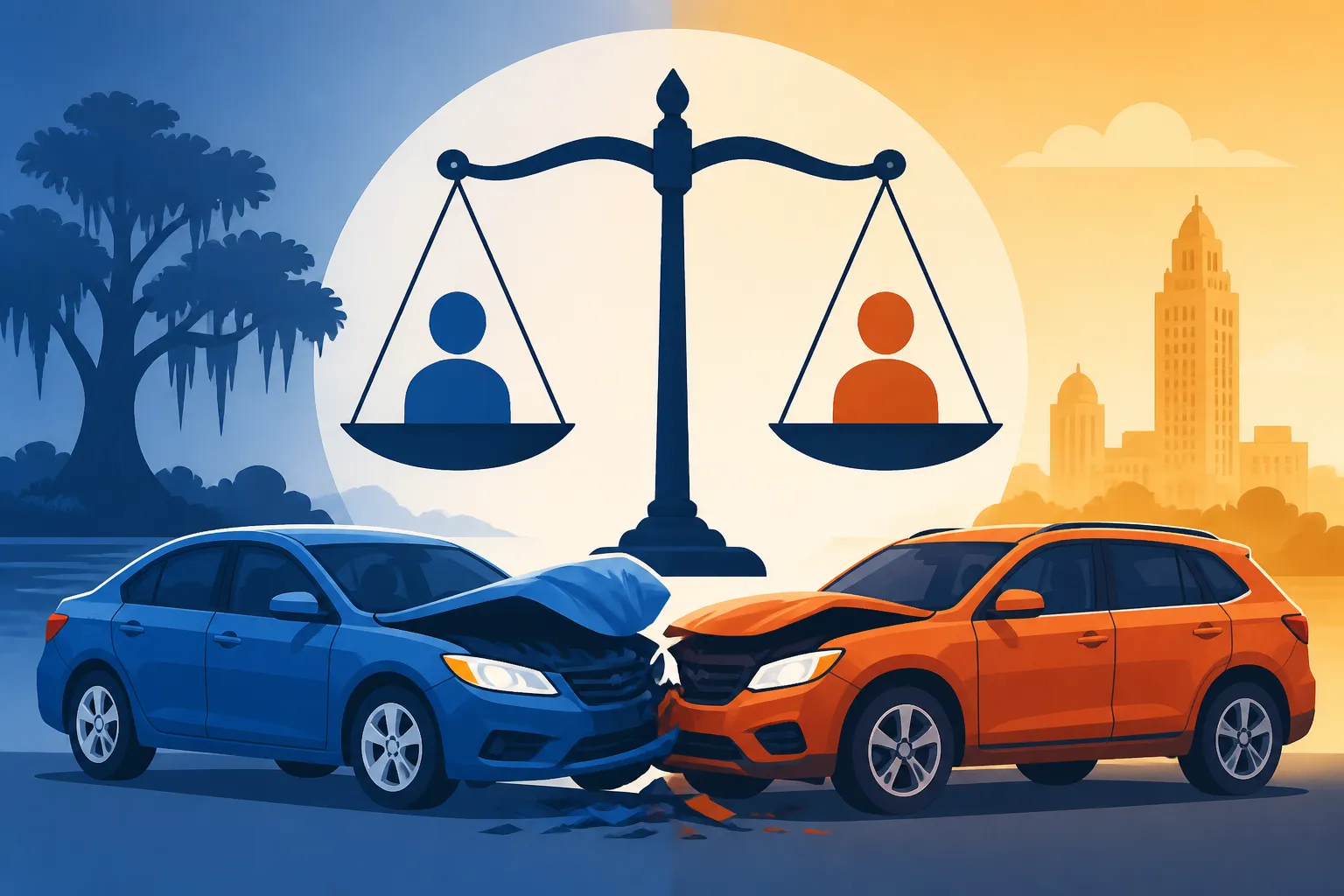
Imagine two cars collide. Driver A was speeding, and Driver B ran a stop sign. Who is entirely at fault? Neither, really. Both actions contributed to the crash. This is precisely the kind of scenario comparative negligence addresses. Instead of forcing all the blame onto one party, it allows a court or insurance company to assign a percentage of fault to each driver involved.
Historically, some states followed what's called "contributory negligence." In those states, if you were found even 1% at fault for an accident, you couldn't recover any damages from the other driver. It was an all-or-nothing system that often felt incredibly unfair to accident victims who suffered significant injuries but might have made a minor error. Comparative negligence, on the other hand, is a much more equitable system, ensuring that if you're injured, you can still seek compensation, even if you bear some responsibility for the crash. It shifts the focus from an absolute blame game to a more nuanced assessment of each party's contribution.
How Louisiana's Pure Comparative Negligence Works
Louisiana operates under a system known as "pure comparative negligence." This is a key distinction, as not all comparative negligence states are the same. In a pure comparative negligence state, you can recover damages even if you are found to be mostly at fault for the accident, up to 99% responsible. Your compensation is simply reduced by your percentage of fault. There's no cutoff point, no 50% or 51% bar that prevents you from recovering anything, which you might find in a state like Texas, for instance, where Comparative Negligence Laws in Texas follow a different rule.
So, let's say a jury determines your total damages (medical bills, lost wages, pain and suffering) are $100,000. If that same jury decides you were 20% at fault for the accident, your recoverable damages would be reduced by 20%. This means you would receive $80,000. Even if you were found 70% at fault, you would still be able to recover $30,000 of your $100,000 in damages. This system is designed to ensure that victims receive compensation proportional to the other party's fault, regardless of how significant their own contribution to the accident may have been. It provides a level of protection for accident victims that isn't available in other negligence systems.
Real-World Scenarios and Examples
Let's walk through a few scenarios to really grasp how this plays out in Louisiana:
Scenario 1: The Distracted Driver and the Speeder
Maria is driving on St. Charles Avenue in New Orleans, slightly distracted, perhaps glancing at her phone (which we all know we shouldn't do). She drifts a little into the next lane, just as John, who is driving well over the speed limit, tries to pass her on the right. A collision occurs.
- Fault Determination: An investigation reveals Maria's distraction contributed, but John's excessive speeding also made the accident unavoidable and significantly worsened the impact.
- Louisiana's Application: A jury might find Maria 30% at fault for distracted driving and John 70% at fault for speeding. If Maria sustained $50,000 in damages, she could still recover $35,000 from John's insurance (70% of $50,000). Conversely, if John sustained $10,000 in damages, he could recover $3,000 from Maria's insurance (30% of $10,000). This illustrates the reciprocal nature of the pure comparative negligence rule.
Scenario 2: The Left Turn and the Impatient Driver
Sarah is attempting a left turn at a busy intersection in Baton Rouge. She misjudges the speed of an oncoming car, driven by David, and begins her turn. David, seeing her start to turn, accelerates, hoping to beat her, rather than slowing down. They collide in the intersection.
- Fault Determination: It's often assumed the turning driver is at fault, but David's decision to accelerate could be seen as contributing to the severity of the crash or even partially causing it. Left-Turn Accident Fault Rules can be tricky!
- Louisiana's Application: The court or adjusters could assign Sarah 60% fault for making an unsafe left turn and David 40% fault for reckless acceleration. If Sarah's damages total $80,000, she would still be eligible to receive $32,000 (40% of $80,000) from David's insurance.
These examples highlight that even if you believe you made a mistake, you shouldn't assume you're entirely out of luck when it comes to compensation in Louisiana. The focus is on allocating proportional blame to all parties involved.
How Fault Is Determined in Louisiana Accidents
Pinpointing who is at fault in a car accident is rarely straightforward, and it's certainly not just about what happened right at the moment of impact. In Louisiana, especially with comparative negligence, a thorough investigation is critical to properly assign percentages of fault. This process can feel daunting and intrusive, but understanding it can help you protect your claim.
The Role of Evidence and Investigation
Evidence is the backbone of any car accident claim. Without solid proof, it's incredibly difficult to argue your case, especially when fault is shared. Immediately after an accident, the steps you take can make a huge difference, impacting everything from Police Reports and Car Accident Fault to your eventual settlement.
- Police Reports: While not always definitive, a police report provides an official, third-party account of the accident scene, including initial observations, witness statements, and sometimes even a preliminary determination of fault. Officers responding to a crash on I-10 near Metairie, for example, will document road conditions, vehicle positions, and any statements made by drivers or witnesses.
- Witness Statements: Independent witnesses can provide unbiased accounts that are invaluable. Their perspective, free from the emotional bias of those involved, can often shed light on crucial details overlooked or disputed by drivers.
- Photographs and Videos: Your cell phone is your best friend after a crash. Take pictures of vehicle damage from multiple angles, skid marks, road conditions, traffic signs, and any visible injuries. Dashcam footage or nearby security camera footage can be gold, offering irrefutable evidence of what occurred.
- Medical Records: These are essential to proving the extent of your injuries and directly linking them to the accident. Detailed medical documentation from Ochsner Medical Center or any other facility you visit will be vital for your claim.
- Expert Analysis: In complex cases, especially those involving severe injuries or significant disputes over fault, accident reconstruction specialists might be brought in. These experts can analyze skid marks, vehicle damage, and other physical evidence to create a detailed understanding of how the accident happened.
Insurance Company Investigations
Once you file a claim, the insurance companies of all involved parties swing into action. Their primary goal, from their perspective, is to assess liability and minimize their payout, so be prepared for a thorough and sometimes challenging process. This is why understanding How Insurance Companies Determine Who Is at Fault is so important.
An insurance adjuster will be assigned to your case. They will:
- Review the Police Report: This is often their starting point for gathering basic facts.
- Interview Drivers and Witnesses: They'll want recorded statements from everyone involved. Be cautious here; anything you say can be used to assign you a higher percentage of fault.
- Examine Vehicle Damage: Adjusters will inspect the damage to all vehicles to see if it's consistent with the accident description.
- Analyze Medical Records: For injury claims, they'll scrutinize your medical history to identify pre-existing conditions or gaps in treatment that could affect your claim.
- Consider Traffic Laws: They'll consider whether any traffic laws were violated, such as speeding, running a red light, or improper lane changes. For example, if you were involved in a collision while changing lanes on the Huey P. Long Bridge, the adjuster would investigate How Fault Works When Changing Lanes on the Highway.
The adjuster will then assign a percentage of fault to each driver based on their findings. This is their initial determination, and it's not always the final word, especially if you disagree.
Legal Implications and Disagreements
It's not uncommon for drivers to dispute the fault percentages assigned by an insurance company. This is where the legal system, and potentially legal counsel, becomes incredibly important.
If you disagree with the fault assessment, you have options:
- Negotiation: Your personal injury lawyer can negotiate directly with the insurance company, presenting additional evidence or legal arguments to challenge their fault determination. They might highlight precedents or specific details of Louisiana law that the adjuster overlooked.
- Mediation: Sometimes, parties agree to a neutral third-party mediator to help facilitate a settlement. The mediator doesn't decide fault but helps the parties find common ground.
- Lawsuit: If negotiations fail, a lawsuit may be filed. In a lawsuit, a judge or jury will ultimately determine the percentages of fault, applying Louisiana's pure comparative negligence laws to the evidence presented. This is where What Happens If You Can't Agree on a Settlement? becomes a very real possibility.
Given the complexities of shared fault, navigating the aftermath of an accident in Louisiana can be overwhelming. Understanding how fault is determined is the first step in ensuring your rights are protected.
Impact on Your Car Accident Claim and Settlement
When you've been in an accident in Louisiana, and there's a possibility of shared fault, it's natural to worry about your claim. The good news with pure comparative negligence is that you can still pursue compensation, but the amount you receive will be directly affected by your assigned percentage of fault. This is fundamental to understanding How Comparative Fault Reduces Your Settlement.
Reducing Your Settlement Amount
The most direct impact of comparative negligence is the reduction of your total recoverable damages. The percentage of fault assigned to you acts as a direct multiplier against your claim. This means that even if your injuries are severe and your damages are substantial, any portion of blame placed on you will chip away at your final payout.
Let's look at a concrete example using a hypothetical total damage amount of $100,000 for medical bills, lost wages, and pain and suffering:
| Your Percentage of Fault | Other Driver's Percentage of Fault | Your Total Damages | Your Recoverable Settlement |
|---|---|---|---|
| 10% | 90% | $100,000 | $90,000 |
| 25% | 75% | $100,000 | $75,000 |
| 50% | 50% | $100,000 | $50,000 |
| 70% | 30% | $100,000 | $30,000 |
| 90% | 10% | $100,000 | $10,000 |
As you can see, even if you are significantly at fault, the pure comparative negligence system still allows you to recover a portion of your damages. This is a crucial difference from contributory negligence states, where even 1% fault would mean $0 recovery. This table clearly illustrates How Much Is My Car Accident Settlement Worth? (2026) under various fault scenarios.
Seeking Compensation Even if Partially at Fault
One of the greatest benefits of Louisiana's pure comparative negligence system is that it empowers accident victims to seek compensation even when they weren't entirely blameless. This means you won't be completely shut out of a claim just because you made a mistake or contributed to the accident in some way.
For instance, if you were involved in a Rear-End Collision Fault: Who Is Responsible? and the other driver rear-ended you, but you were found to have a non-functioning tail light, you might be assigned a small percentage of fault. Even then, you would still be able to recover the vast majority of your damages. This system acknowledges the reality that accidents are often complex and that fault isn't always singular. The key is to demonstrate the other party's negligence and how it contributed to your injuries and damages.
This ability to still get paid if you're partly at fault is a significant relief for many who fear their entire claim will be dismissed due to some minor error on their part. The focus remains on fairness and ensuring that the at-fault party is held accountable for their share of the responsibility.
The Importance of Legal Counsel
Navigating a car accident claim in Louisiana, especially when comparative negligence is a factor, can be incredibly challenging. Insurance companies are experts at minimizing payouts, and they will undoubtedly try to assign you a higher percentage of fault to reduce their liability. This is where experienced legal counsel becomes invaluable.
A skilled personal injury attorney can:
- Investigate Thoroughly: They'll gather all necessary evidence, including police reports, witness statements, medical records, and expert testimony, to build the strongest possible case for you.
- Negotiate with Insurance Companies: Lawyers are adept at countering insurance adjusters' tactics and arguing for a lower percentage of fault on your part, maximizing your potential settlement. They understand the nuances of How Car Accident Settlements Are Calculated and can advocate effectively.
- Protect Your Rights: They ensure you don't inadvertently say or do anything that could jeopardize your claim, such as making a recorded statement without legal advice.
- Represent You in Court: If a fair settlement can't be reached, your attorney will be prepared to take your case to trial, presenting your case to a judge or jury to secure the compensation you deserve.
Having an attorney by your side, particularly one familiar with Louisiana's specific comparative negligence laws and the local court system, can make a monumental difference in the outcome of your car accident claim. They can help you understand Do You Need a Lawyer for a Car Accident? (2027) and ensure you receive fair treatment and compensation under the law.
Disclaimer
Please remember that this article provides general information about comparative negligence laws in Louisiana and should not be considered legal advice. Car accident claims are highly fact-specific, and the laws can be complex. It is always recommended to consult with a qualified personal injury attorney in Louisiana to discuss the specifics of your situation and understand your legal options.