Left-Turn Accident Fault Rules
There's nothing quite as frustrating as being involved in a car accident, especially when it involves a left turn. Many people assume that the driver making a left turn is always at fault, and while there's often a presumption against them, that's not always the complete story. The reality is far more nuanced, and understanding the specific rules and factors involved can make a huge difference in protecting your rights and ensuring a fair outcome. This comprehensive guide will meticulously break down the left-turn accident fault rules, demystifying the process and empowering you with the knowledge you need.
The Common Misconception About Left-Turn Fault
When two vehicles collide, particularly at an intersection, it's natural for people to quickly point fingers. For left-turn accidents, the common assumption is almost always that the driver attempting the left turn is to blame. You hear it all the time: "They turned in front of me!" or "You should have waited!" While this assumption holds true in many, if not most, cases, it's a huge oversimplification and can lead to unfair outcomes if not properly investigated. This pervasive belief often causes stress and confusion for drivers who believe they might not be entirely at fault, leaving them feeling helpless against the prevailing narrative.
Why Left Turns Are Inherently Risky
Let's be honest, making a left turn across oncoming traffic is one of the more anxiety-inducing maneuvers we face on the road. Unlike a right turn, which typically flows with traffic or turns into a clear lane, a left turn requires judging the speed and distance of multiple oncoming vehicles, often while navigating complex intersections with varying signal timings and other drivers also trying to make their moves. There's a reason why so many accidents occur at intersections; the sheer number of conflicting movements happening simultaneously creates a high-risk environment. Even a momentary lapse in judgment or an unexpected action from another driver can lead to a devastating collision, making these turns a consistent source of concern for every driver.
The "Presumption of Fault" Myth
It's crucial to address the idea of a "presumption of fault" head-on. In many jurisdictions, and certainly in the eyes of insurance adjusters, there is often an initial lean towards placing fault on the driver making the left turn. This isn't an ironclad law, but rather an interpretation based on the general traffic rule that a driver making a left turn must yield the right-of-way to oncoming traffic. However, this presumption is rebuttable. It means that while the burden might initially be on the turning driver to prove they were not at fault, it is absolutely possible to challenge this assumption with compelling evidence. Simply because the other driver or an insurance company quickly assigns blame doesn't mean it's the final word. Understanding this distinction is your first line of defense. For a broader view, you might want to read our guide on how fault is determined in a car accident.
Understanding Right-of-Way at Intersections
The concept of right-of-way is fundamental to determining fault in any car accident, but it's especially critical in left-turn scenarios. Essentially, right-of-way dictates which driver has the legal privilege to proceed through an intersection or perform a maneuver first. When a collision occurs, one of the primary questions investigators and insurance companies will ask is: "Who had the right-of-way?" The answer often points directly to liability, but as we'll explore, even right-of-way can be complicated by external factors and the actions of other drivers.
Unprotected Left Turns vs. Protected Left Turns
The type of left turn you're making significantly impacts right-of-way.
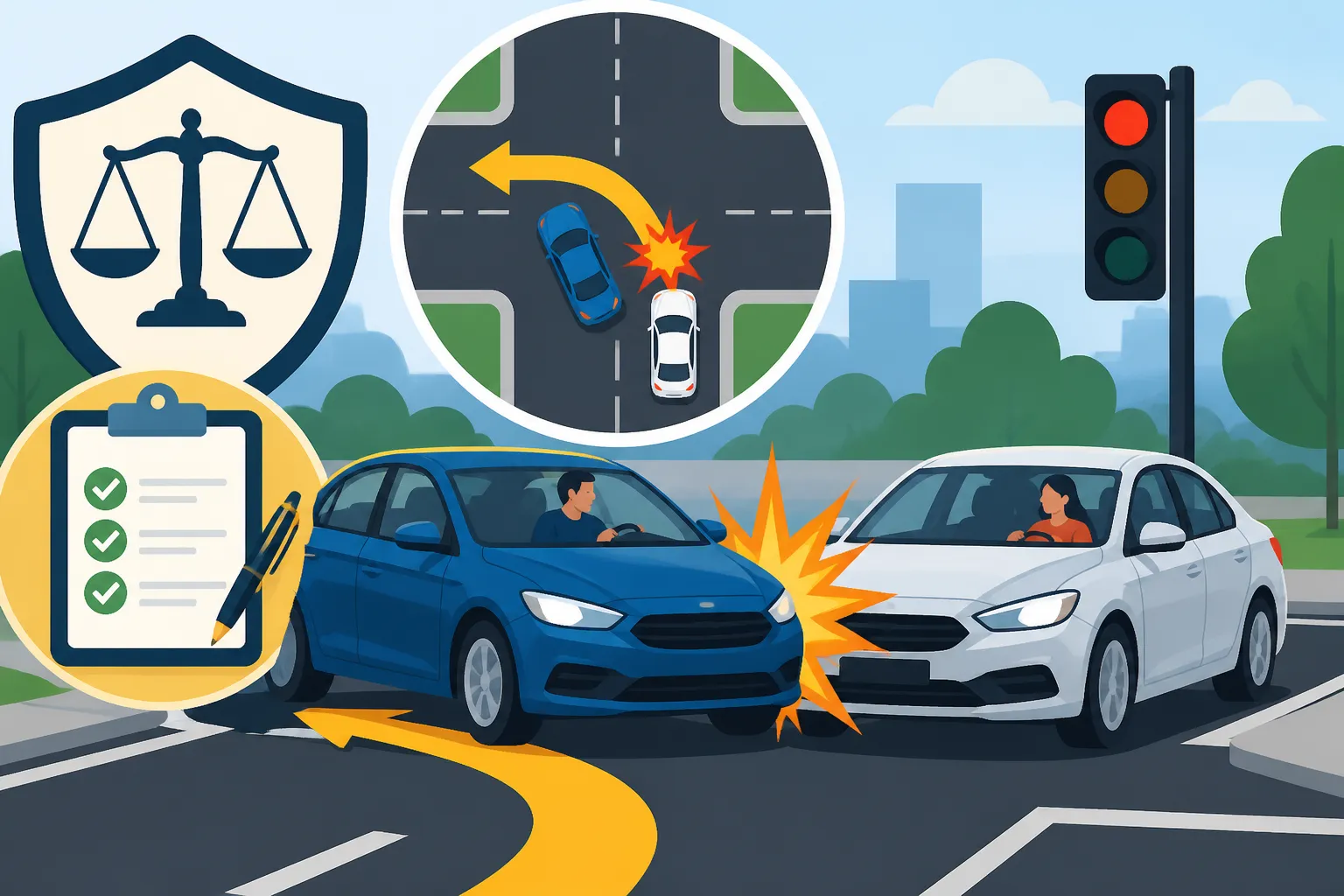
- Unprotected Left Turns: These are the classic left turns where you have a green light but no dedicated green arrow. In this situation, the law almost universally states that you must yield to any oncoming vehicles that are close enough to constitute an immediate hazard. This means you must wait until oncoming traffic clears or there's enough space to safely complete your turn without impeding or cutting off other drivers. If you turn and an accident occurs, you are generally considered at fault because you failed to yield the right-of-way. This is where the "presumption of fault" against the turning driver truly comes into play.
- Protected Left Turns: These turns are indicated by a green arrow, which signals that you have the exclusive right-of-way to turn left. Oncoming traffic will typically have a red light or a red arrow, meaning they are required to stop. If you are making a left turn on a green arrow and are struck by an oncoming vehicle, the other driver is almost certainly at fault, as they would have run a red light or ignored their corresponding signal. This is a much clearer-cut case of fault compared to an unprotected turn.
Yielding to Oncoming Traffic
The rule for yielding to oncoming traffic during an unprotected left turn is perhaps the most critical aspect of left-turn accident fault. It's not just about waiting for all traffic to clear, but waiting for traffic that is immediately hazardous. What constitutes "immediately hazardous" can sometimes be subjective and is often the source of dispute. If you turn, and an oncoming car suddenly appears or accelerates, leading to a crash, an insurance company will likely argue that you failed to yield. This is why vigilance is paramount, and why it's always safer to err on the side of caution and wait for a larger gap in traffic than you think you might need. Sometimes, waiting a few extra seconds can prevent a lifetime of headaches.
Traffic Signals and Arrows
Traffic signals and arrows provide explicit instructions on right-of-way, but they also introduce layers of complexity.
- Flashing Yellow Arrow: This increasingly common signal means you may turn left, but you must yield to oncoming traffic and pedestrians. It functions essentially as an unprotected left turn, emphasizing caution.
- Solid Green Light (without arrow): As discussed, this is an unprotected left turn, requiring you to yield to oncoming traffic.
- Green Arrow: This is a protected left turn, granting you the right-of-way.
- Red Light/Red Arrow: If you turn left on a red light or arrow and cause an accident, you are unequivocally at fault. This is a clear traffic violation.
However, things get complicated if a light malfunctions or is obscured. What if the oncoming driver claims they had a green light, but you also claim you had a green arrow? This is where objective evidence like witness statements, traffic camera footage, or even the timing of the traffic light cycle can become vital. Understanding Police Reports and Car Accident Fault can be really helpful here, as officers will often note signal information.
Situations Where the Turning Driver May Not Be at Fault
While the default assumption often leans towards the left-turning driver being at fault, there are absolutely scenarios where this isn't the case. It's incredibly disheartening to be blamed for something you didn't cause, and recognizing these exceptions is key to challenging an unfair fault determination. You need to know that you're not automatically doomed to take the blame just because you were making the turn.
Oncoming Vehicle Speeding or Running a Red Light
This is one of the most common ways a left-turning driver can be absolved of, or at least share, fault. Imagine you're waiting patiently to turn left. You see a reasonable gap in oncoming traffic and begin your turn, only for a car to suddenly appear, traveling at an excessive speed. Had they been going the posted limit, you would have cleared the intersection safely. Similarly, if you started your turn when your light was green (or a green arrow) and an oncoming vehicle barrels through a red light and strikes you, they are clearly at fault. Your duty to yield does not extend to anticipating and accounting for other drivers' illegal and reckless behavior. Proving this often requires witness testimony, traffic camera footage, or accident reconstruction. For related information on proving the other driver was at fault, check out our resource on How to Prove the Other Driver Was at Fault.
Oncoming Vehicle Distracted or Impaired
A driver who is distracted by their phone, intoxicated, or otherwise impaired poses an extreme hazard, and their negligence can certainly shift the fault dynamics. If you began your left turn, having properly assessed what appeared to be a safe gap, and an oncoming driver, due to their impairment or distraction, failed to react appropriately, swerved into your path, or simply wasn't paying attention, they could be held responsible. For instance, if an oncoming driver was texting and driving, didn't see you, and failed to brake, their distracted driving could be the primary cause of the collision, even if you were making a left turn. This is why documenting everything you observe about the other driver's behavior at the scene is so important. You might find our article on Fault in a Distracted Driving (Texting) Accident particularly relevant.
Other Drivers' Illegal Maneuvers
Beyond speeding or running a red light, other illegal maneuvers by oncoming drivers can also mitigate or eliminate your fault.
- Sudden Lane Changes: An oncoming driver might suddenly change lanes within the intersection, directly into your path, making it impossible for you to avoid them, even if you had initially yielded to traffic in their original lane.
- Illegal U-Turns: Sometimes, what appears to be an oncoming vehicle might suddenly initiate an illegal U-turn, cutting across multiple lanes of traffic and colliding with your turning vehicle.
- Driving Without Headlights at Night: If you're turning left at night and an oncoming vehicle is driving without its headlights on, making it invisible until the last second, it can be extremely difficult to judge their presence and speed. This negligence on their part could easily shift fault.
In these situations, it's not about whether you were making a left turn, but rather whether the other driver's unlawful and unexpected actions were the proximate cause of the accident. You couldn't reasonably anticipate or avoid such sudden and illegal movements.
Key Factors in Determining Fault for Left Turns
When it comes to figuring out who's truly responsible after a left-turn accident, it’s rarely as simple as one driver saying "I had the green light" and the other saying "No, I did." A thorough investigation involves piecing together various bits of evidence, each shedding light on the sequence of events. Ignoring any of these crucial details could lead to an unfair determination of fault. It's a bit like being a detective, gathering clues to reconstruct the exact moments leading up to impact.
Witness Statements and Dashcam Footage
These are often the gold standard for unbiased evidence.
- Witness Statements: An independent witness, someone who isn't involved in the accident but saw it happen, can provide an objective account of traffic signals, vehicle speeds, and driving behavior. If a witness saw the oncoming vehicle speeding, or noticed them running a red light, their testimony can be incredibly powerful in challenging the typical left-turn presumption. It's vital to get their contact information at the scene, if possible, as their perspective can be invaluable.
- Dashcam Footage: With the rise of dashcams, this technology has become a game-changer. A dashcam provides an indisputable, real-time recording of exactly what happened. It can show the color of the traffic light, the speed of vehicles, and the exact moment of impact. If your vehicle, or even the other vehicle, had a dashcam, that footage could be the single most important piece of evidence in proving or disproving fault. This can save you countless headaches and arguments with insurance adjusters down the line.
Police Reports and Citations
While a police report doesn't officially determine fault from a legal standpoint in every state, it's an incredibly influential document.
- Officer's Observations: The investigating officer will document the accident scene, including vehicle positions, damage, road conditions, and any traffic citations issued. If the officer cites the oncoming driver for speeding, running a red light, or distracted driving, this strongly suggests their negligence contributed to the crash. Conversely, if the turning driver is cited for failure to yield, it creates an initial presumption of their fault.
- Statements Recorded: The report will also contain statements from both drivers and any witnesses. While these are often self-serving, they can highlight inconsistencies or admissions that are useful later. For more details, see our guide on Police Reports and Car Accident Fault. It’s important to remember that if an officer doesn’t issue a citation, it doesn’t automatically mean no one was at fault; it just means they didn't see a clear violation.
Vehicle Damage and Point of Impact
The physical evidence on the vehicles themselves can tell a compelling story about how the accident occurred.
- Point of Impact: Where the vehicles made contact can reveal crucial information. If the front of the oncoming vehicle struck the side of your turning vehicle, it supports the narrative of you turning in front of them. However, if the impact is more towards the rear of your vehicle, it might suggest you were nearly through the turn and the other driver had more time to react, or was traveling at excessive speed.
- Type of Damage: The extent and nature of the damage can also indicate the force of the collision and the angles involved. Accident reconstruction specialists can often use this data to calculate approximate speeds and determine the precise sequence of events, helping to verify or refute driver statements. This forensic analysis can be pivotal when liability is heavily disputed.
Road Conditions and Visibility
Environmental factors can sometimes play a role in fault determination, especially in left-turn accidents.
- Weather Conditions: Rain, snow, ice, or heavy fog can significantly reduce visibility and make it harder for drivers to stop or react in time. While drivers are expected to adjust their driving to conditions, if exceptionally poor visibility made it impossible for the turning driver to see oncoming traffic until it was too late, or for the oncoming driver to see the turning vehicle, it might introduce an element of shared fault or even shift blame.
- Obstructions: Sometimes, parked cars, overgrown bushes, or even architectural features near an intersection can obstruct a driver's view of oncoming traffic, creating a blind spot. If a turning driver's view was significantly impaired by such an obstruction, and that impairment contributed to the accident, it could be a factor in determining that they weren't solely responsible. However, drivers are generally expected to proceed with extreme caution if their view is obstructed.
How Comparative and Contributory Negligence Apply
It's a common misconception that in an accident, one person is 100% at fault and the other is 0%. The reality, especially in left-turn collisions, is often much more complex, with both drivers potentially sharing some degree of blame. This is where the legal doctrines of comparative and contributory negligence come into play, and understanding them is absolutely vital because they can dramatically impact your ability to recover compensation.
Shared Fault in Left-Turn Collisions
Let's consider a scenario: you're making an unprotected left turn, and you turn in front of an oncoming vehicle. Initially, it seems clear you're at fault for failing to yield. However, what if that oncoming vehicle was also speeding significantly above the posted limit, or perhaps they had a burnt-out headlight at dusk, making them harder to see? In this instance, while you might still hold some responsibility for initiating the turn, the other driver's actions also directly contributed to the collision. This is a classic example of shared fault. Instead of one person being entirely to blame, both drivers bear a percentage of responsibility. This kind of nuanced assessment is particularly common in left-turn cases because of the inherent risks and the multiple factors that can influence the outcome.
Impact on Your Claim in Different States
The way shared fault impacts your compensation depends entirely on the laws of the state where the accident occurred. There are generally three categories:
- Pure Comparative Negligence: In states like California, New York, and Florida, you can recover damages even if you are mostly at fault, though your compensation will be reduced by your percentage of blame. For example, if you are found 70% at fault for a left-turn accident, but your total damages are $10,000, you could still recover $3,000 (30% of your damages). This system allows for more equitable distribution of responsibility. For a more detailed breakdown, our guide on Comparative vs Contributory Negligence Explained covers this extensively.
- Modified Comparative Negligence (50% Bar): Many states, including Texas, Colorado, and Oregon, follow this rule. Here, you can only recover damages if your fault is 50% or less. If you are found 51% or more at fault, you cannot recover anything. If you are 50% or less at fault, your recovery is reduced by your percentage of fault. So, if you're 50% at fault, you get 50% of your damages. If you're 51% at fault, you get nothing. This is a critical distinction, as even a small difference in fault percentage can completely bar your claim.
- Modified Comparative Negligence (51% Bar): Similar to the 50% bar, but you can only recover if your fault is 51% or less. If you are found 52% or more at fault, you cannot recover. States like Illinois and Ohio operate under this rule. The implications are very similar to the 50% bar, with a slightly higher threshold for recovery.
- Contributory Negligence: A handful of states, such as Alabama, Maryland, North Carolina, and Virginia, adhere to this harsh rule. If you are found even 1% at fault, you are completely barred from recovering any damages from the other driver. This means that if you are involved in a left-turn accident in a contributory negligence state and are found to have contributed in any way, even slightly, to the collision, your claim for compensation is effectively over. This is why understanding What Happens If You're Partially at Fault? is so vital, especially in these states.
Here's a quick table to illustrate the state fault rules:
| State Fault Rule Type | Description | Example Scenario (Left-Turn Driver 70% At Fault, $10,000 Damages) |
|---|---|---|
| Pure Comparative | Can recover damages, reduced by percentage of fault, regardless of how much | Recovers $3,000 (30% of $10,000) |
| Modified (50% Bar) | Can recover if 50% or less at fault; recovery reduced by fault percentage | Recovers $0 (because 70% > 50%) |
| Modified (51% Bar) | Can recover if 51% or less at fault; recovery reduced by fault percentage | Recovers $0 (because 70% > 51%) |
| Contributory | Cannot recover any damages if even 1% at fault | Recovers $0 (because 70% > 1%) |
It's clear that the state you're in dramatically affects your potential outcome. You need to know the specific laws that govern your situation, as they will directly influence your settlement.
The Role of Insurance Companies in Fault Determination
After a left-turn accident, one of the most stressful parts of the entire ordeal is dealing with insurance companies. They are the primary entities that will officially determine fault and decide who pays for damages. It's a complex process, and their adjusters are trained to investigate claims with their company's bottom line in mind. Understanding their process and how they view these tricky left-turn scenarios can help you prepare and protect yourself.
Adjusters' Investigation Process
When you file a claim, the insurance adjuster for each party will launch their own investigation. They don't just take your word for it, nor do they simply assume the turning driver is always at fault. They will typically:
- Gather Statements: They'll speak with both drivers, asking for their detailed accounts of the accident. Be careful with what you say; even seemingly innocent comments could be interpreted as an Admission of Fault (and How to Avoid It).
- Review Police Reports: The official police report is a key piece of evidence that provides a neutral account of the scene, driver information, and any citations issued.
- Examine Vehicle Damage: They'll often send an appraiser to inspect the damage to all vehicles involved, using the point and type of impact to reconstruct the accident.
- Seek Witness Accounts: If there were independent witnesses, adjusters will try to get statements from them.
- Look for Additional Evidence: This includes dashcam footage, traffic camera footage, and even cell phone records if distracted driving is suspected.
- Consult Experts: In complex or high-value cases, they might even bring in accident reconstruction experts.
All of this information is then weighed against traffic laws, right-of-way rules, and the specifics of the intersection to assign a percentage of fault to each driver. For more insight into this process, read our comprehensive article on How Insurance Companies Determine Who Is at Fault.
The Importance of Documentation
Given the adjusters' meticulous process, your own documentation becomes incredibly powerful. The more evidence you can provide, the stronger your position will be, especially if you're trying to prove that you, the left-turning driver, were not entirely at fault.
- Detailed Notes: Immediately after the accident, write down everything you remember: time, date, weather, road conditions, what you saw, what the other driver did, and any conversations you had.
- Photographs and Videos: Capture extensive photos and videos of the accident scene, including vehicle damage (from multiple angles), road signs, traffic signals, skid marks, debris, and any visible injuries.
- Witness Information: Collect names, phone numbers, and email addresses of anyone who saw the accident.
- Medical Records: If you're injured, seek prompt medical attention and keep thorough records of all diagnoses, treatments, and expenses. These are crucial for proving damages.
- Lost Wage Documentation: If you miss work, keep records of your salary, hours missed, and any employer statements.
Without this solid documentation, it becomes your word against theirs, and the adjusters might lean on the common presumption of fault against the turning driver. Good documentation provides tangible proof to back up your claims and challenge any unfair accusations. It also helps if the other driver starts blaming you unfairly, as detailed in our guide on What Happens If the Other Driver Blames You?.
What to Do Immediately After a Left-Turn Accident
Being involved in any car accident is chaotic and stressful, but a left-turn collision can be particularly disorienting given the potential for disputes over fault. Your actions in the immediate aftermath can significantly influence the outcome of your claim. It's easy to feel overwhelmed, but staying calm and following these steps can help protect your safety and your legal rights.
Prioritizing Safety and Seeking Medical Attention
Your first priority should always be the safety of everyone involved.
- Move to Safety: If possible and safe to do so, move your vehicles to the side of the road or out of active traffic lanes to prevent further collisions. If the vehicles are too damaged or people are injured, leave them in place and turn on your hazard lights.
- Check for Injuries: Assess yourself and others for injuries. Even if you feel fine, adrenaline can mask pain. Ask passengers and the other driver if they are hurt.
- Call 911: Always call 911 for emergency services, especially if there are injuries, significant damage, or if the accident is blocking traffic. Police can secure the scene, direct traffic, and create an official accident report. Even for minor incidents, it’s often wise to have law enforcement document the situation.
- Seek Medical Care: Even if you don't feel injured, it's crucial to get checked out by a doctor as soon as possible. Some injuries, like whiplash or concussions, can have Delayed Injury Symptoms After a Car Accident and may not manifest for hours or even days. Prompt medical attention creates an official record linking your injuries to the accident, which is vital for any future insurance claim. For a complete guide on what to do, refer to What to Do After a Car Accident: Step-by-Step (2027).
Gathering Evidence at the Scene
The accident scene is a treasure trove of evidence, and you have a limited window to collect it.
- Photographs and Videos: Use your smartphone to take as many pictures and videos as possible. Focus on:
- The position of both vehicles from multiple angles.
- Close-ups of all damage to both vehicles.
- Skid marks, debris on the road, and broken glass.
- Traffic signs, signals (especially the color of the lights), and road markings.
- Any environmental factors like weather, road conditions, or obstructions to visibility.
- The other driver's license plate, insurance card, and driver's license.
- Exchange Information: Get the other driver's:
- Name and contact information.
- Insurance company name and policy number.
- Vehicle make, model, year, and license plate number.
- If there are witnesses, get their names and contact information too.
- Officer's Information: Get the investigating officer's name, badge number, and the report number for the accident.
This evidence will be invaluable when you or your lawyer begin building your case.
Not Admitting Fault
This is perhaps one of the most challenging but crucial pieces of advice: do not admit fault, apologize, or make any statements that could be interpreted as accepting responsibility.
- Keep Explanations Factual: When speaking with the other driver or the police, stick to the objective facts. "I was turning left at the intersection," not "I'm so sorry, I didn't see you!" Even an innocent "I'm sorry" can be used against you by an insurance company.
- Avoid Speculation: Don't speculate on what might have caused the accident or make assumptions about the other driver's actions. Stick to what you know.
- Your Perspective is Key: Present your version of events calmly and clearly, but do not engage in arguments or debates about who is to blame. Let the evidence speak for itself. You can find more advice on this in our article What Is an Admission of Fault (and How to Avoid It)?. Remember, you're not a professional accident investigator, and you might not have all the facts in the heat of the moment. It's always best to reserve judgment.
Navigating the Claims Process for Left-Turn Accidents
Once the immediate aftermath of the accident has settled, the real work of dealing with the financial and legal consequences begins. The claims process can be daunting, especially with the added complexity of fault in a left-turn collision. You'll be dealing with insurance companies, potentially medical bills, and lost wages, and it's easy to feel overwhelmed. Knowing the steps ahead can help you feel more in control.
Filing Your Insurance Claim
This is the official start of your journey to recover damages.
- Notify Your Insurer Promptly: Even if you believe the other driver is 100% at fault, you should notify your own insurance company about the accident as soon as possible. Your policy likely has a clause requiring prompt notification. They are there to protect you, and they can guide you through the initial steps. If you're wondering whether you should even call your insurance, our guide Should You Call Your Insurance If It Wasn't Your Fault? offers clear advice.
- Decide on First-Party vs. Third-Party Claim:
- First-Party Claim: If you want your own insurance to pay for your damages (under collision or personal injury protection/Med-Pay coverage), you'll file a claim with them. They will then subrogate (seek reimbursement) from the at-fault driver's insurance.
- Third-Party Claim: If you believe the other driver is at fault, you'll file a claim directly with their insurance company. This is usually the route taken for property damage and bodily injury claims.
- Provide All Documentation: Submit all the evidence you gathered at the scene – photos, witness statements, police report numbers, and medical records – to the insurance company. This documentation is crucial, especially in left-turn accidents where fault can be heavily contested. Our article on How to File a Car Accident Insurance Claim provides a detailed walkthrough.
- Be Patient, But Persistent: The claims process can take time, especially if liability is disputed. Stay in regular communication with the adjuster, but also be prepared for delays. Keep a log of all communications, including dates, names, and what was discussed.
When to Consult a Car Accident Lawyer
Many people wonder if they really need a lawyer, especially if they think the fault is clear. However, in left-turn accidents, where fault is rarely black and white, a lawyer can be an invaluable asset.
- Disputed Fault: If the other driver or their insurance company is trying to place blame on you, even partially, for the left-turn accident, a lawyer can step in to negotiate and advocate on your behalf. They understand the nuances of traffic law and can present evidence in a way that challenges unfair accusations.
- Serious Injuries: If you've suffered more than minor bumps and bruises – like whiplash, broken bones, or a concussion – the potential for significant medical bills, lost wages, and pain and suffering increases dramatically. A lawyer can help ensure you receive fair compensation for all your damages, not just the obvious ones.
- Lowball Settlement Offers: Insurance companies are in the business of saving money, and their initial offers might be far less than what your claim is truly worth. A lawyer can negotiate effectively, citing legal precedents and ensuring all your damages are accounted for.
- Complex Cases: If there were multiple vehicles involved, or if the accident involved a commercial truck, a lawyer can navigate the added complexities of these types of claims.
- Statute of Limitations: There are strict deadlines (statutes of limitations) for filing a personal injury lawsuit, which vary by state. A lawyer will ensure you don't miss any critical deadlines.
Ultimately, if you're feeling overwhelmed, if your injuries are significant, or if fault is being disputed, consulting with an experienced car accident lawyer is almost always a wise decision. They can assess your case, explain your options, and fight to protect your rights, allowing you to focus on your recovery. For a deeper dive, consider reading Do You Need a Lawyer for a Car Accident? (2027).
Disclaimer
Please note that this article provides general information about left-turn accident fault rules and is not intended as legal advice. Every accident is unique, and the specific laws and circumstances of your case may vary. For personalized advice regarding your situation, it is always recommended to consult with a qualified legal professional.