Who Is at Fault in an Intersection Accident in Texas?
Getting into a car accident at an intersection can be an incredibly jarring and confusing experience, especially when you're trying to figure out who was actually at fault. The immediate aftermath is often filled with adrenaline, uncertainty, and the sinking feeling of needing to navigate insurance claims and potential injuries. This comprehensive guide will walk you through the specifics of how fault is determined in intersection accidents in Texas, providing clarity and actionable insights to help you understand your situation.
Understanding Intersection Accidents and Texas Traffic Laws
Intersections are notorious hotspots for vehicle collisions. They're complex environments where multiple drivers, pedestrians, and sometimes cyclists converge, often relying on traffic signals, signs, and the understanding of right-of-way rules. When an accident occurs here, pinpointing fault isn't always straightforward because there are often conflicting accounts and various factors at play. In Texas, determining fault hinges heavily on specific traffic laws and how each driver adhered to them.
Navigating these rules can be a maze, and many people feel overwhelmed by the process. It’s not just about who hit whom; it's about who had the legal right to occupy that space at that precise moment. Understanding these fundamental principles is your first step in making sense of the chaos. Texas law, like that of many states, has very clear guidelines about how drivers should behave at intersections, and deviations from these guidelines are often the root cause of collisions.
The Foundation of Texas Right-of-Way Laws
The Texas Transportation Code provides the backbone for determining who has the right-of-way at any given intersection. These aren't just suggestions; they are legally binding rules that drivers are expected to follow. Essentially, right-of-way is the privilege of the immediate use of the highway. It’s not something you can demand, but rather something you yield or are granted under specific circumstances.
For example, when approaching an uncontrolled intersection (one without traffic lights or stop signs), the driver on the left is generally expected to yield to the driver on the right. Similarly, a driver turning left must yield to oncoming traffic that is proceeding straight. These rules are designed to prevent collisions by creating a predictable flow of traffic, but all too often, drivers either don't know them, forget them, or simply choose to ignore them. When someone fails to yield as required by law, they are typically the one considered at fault in the event of a collision.
The Role of Traffic Signals and Stop Signs
Traffic signals and stop signs are explicit directives, leaving little room for interpretation about who has the right-of-way. A red light means stop, and a green light means proceed, assuming the intersection is clear. Similarly, a stop sign requires a complete stop before proceeding safely. When a driver disregards these clear directives, their fault in an accident becomes much easier to establish.
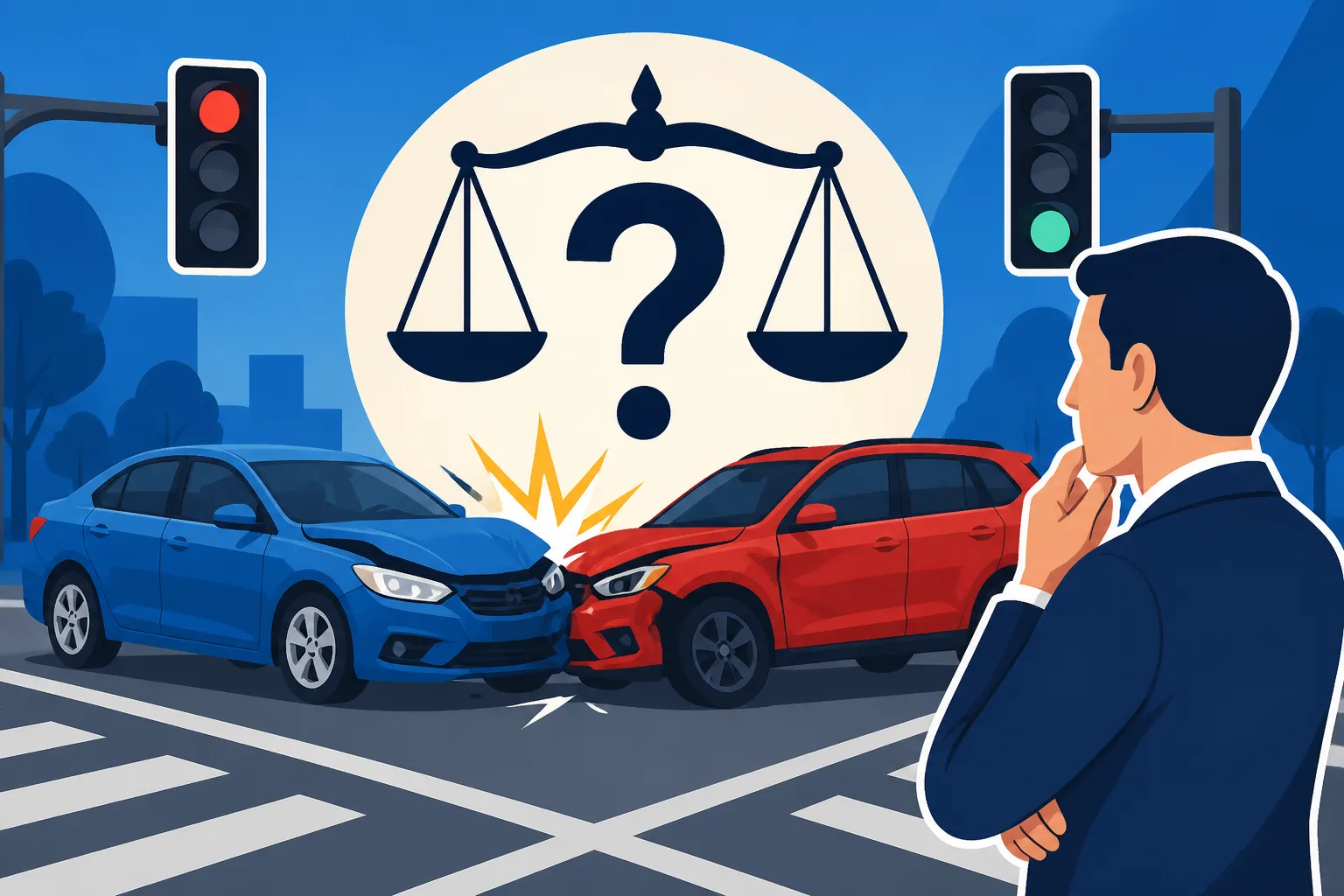
Consider a scenario where a driver blows through a red light at a busy intersection in Dallas, striking a vehicle that had a green light. In such a case, the driver who ran the red light would almost certainly be found at fault. However, things can get trickier. What if the light turned yellow, and one driver sped up to "beat" the red, while another vehicle, assuming a red light was imminent, started to proceed? Even in these grey areas, the core principle remains: who had the legal right to be there? The traffic signal is a primary piece of evidence in such incidents.
Common Scenarios for Intersection Accidents and Fault Determination in Texas
Intersection accidents come in many forms, each with its own set of contributing factors and typical fault determinations. It's rare for an accident to have a single, isolated cause; more often, it's a chain of events or a combination of negligent actions. Knowing the common scenarios can help you understand where fault usually lies, though every situation is unique and subject to investigation.
It's not enough to just point fingers. To effectively prove fault, you need evidence that supports your claim. This could include eyewitness statements, traffic camera footage, police reports, and even the physical damage to the vehicles. If you've been in a collision, remember that What to Do After a Car Accident: Step-by-Step (2027). Taking the right actions immediately after the crash can significantly impact the fault determination process later on.
Running a Red Light or Stop Sign
This is perhaps the most straightforward scenario for determining fault. When a driver fails to stop at a red light or stop sign and causes a collision, they are almost always considered at fault. The traffic signal or sign serves as a clear indicator of who has the right-of-way.
Imagine an accident at the busy intersection of Shepherd Drive and Westheimer Road in Houston. If Driver A proceeds through a clearly red light and collides with Driver B, who had a green light, Driver A is at fault. The same applies to stop signs: if Driver C rolls through a stop sign and hits Driver D, who had the right-of-way, Driver C is typically liable. Evidence like red light camera footage, independent witness testimony, or a police report stating a citation for a traffic signal violation can definitively prove this type of fault. It leaves very little room for ambiguity, which is why these cases often move quickly through the insurance process.
Unsafe Left Turns
Left-turn accidents are notoriously common and can be quite complex. In most situations, including in Texas, a driver making a left turn must yield the right-of-way to any oncoming vehicles that are traveling straight through the intersection. If a left-turning vehicle collides with an oncoming vehicle, the driver making the left turn is usually deemed at fault.
However, there are exceptions. What if the oncoming vehicle was speeding excessively, or ran a red light themselves? What if the left-turning driver had a "green arrow" indicating a protected turn, and an oncoming vehicle proceeded through a red light? These nuances can shift the blame. For example, if a driver attempts a left turn at an intersection with a flashing yellow arrow, they must yield to oncoming traffic. If they misjudge the gap and cause an accident, they will be at fault. This particular scenario is so common that there's an entire discussion around Left-Turn Accident Fault Rules. It's crucial to gather as much information as possible about the traffic signals and the speed of other vehicles involved.
Failure to Yield
Beyond specific signals, many intersections in Texas operate on general failure to yield principles. This often comes into play at intersections with yield signs, or when making a right turn on red. A "failure to yield" accident occurs when a driver does not grant the right-of-way to another vehicle when legally required to do so.
Think of a situation where a driver attempts to make a right turn on red at an intersection in San Antonio without coming to a complete stop and ensuring the path is clear. If they collide with a vehicle that has a green light and is proceeding through the intersection, the turning driver is likely at fault for failing to yield. Similarly, at a four-way stop, if two cars arrive at the same time, the driver on the left should yield to the driver on the right. If the driver on the left proceeds without yielding and an accident occurs, they would be at fault. These scenarios often hinge on who arrived first or who had the statutory right to proceed under the specific circumstances.
What to Do After an Intersection Accident in Texas to Protect Your Claim
The moments immediately following an intersection accident in Texas are critical. What you do and say can significantly impact the determination of fault and the success of any potential car accident claim. Many people are in shock or pain and might not think clearly, but taking a few essential steps can protect your rights and help you build a strong case. Remember, the goal is to gather as much objective information as possible.
It's common for emotions to run high, but try to remain calm and focused. Even seemingly minor details can become important later. If you're physically able, start documenting everything you can. This proactive approach will be invaluable when dealing with insurance companies and potentially even attorneys. Understanding How to File a Car Accident Insurance Claim will also be beneficial down the line.
Documenting the Scene Thoroughly
One of the most powerful things you can do is thoroughly document the accident scene. Modern smartphones make this easier than ever. Start by taking numerous photos and videos from different angles. Capture the positions of all vehicles involved before they are moved, damage to all vehicles, any skid marks, debris on the road, traffic signals (if applicable), and any relevant road signs. Don't forget to photograph the license plates and insurance cards of all drivers involved.
Beyond visual evidence, write down important details: the date, time, and exact location of the accident (e.g., "intersection of Main Street and Elm Avenue in Fort Worth"). Note the weather conditions, road conditions (wet, dry, icy), and any specific traffic patterns. If there were witnesses, get their contact information, including names, phone numbers, and email addresses. Their unbiased account can be crucial in corroborating your version of events and countering any conflicting statements made by the other driver.
Reporting the Accident to Authorities and Insurers
After ensuring everyone's safety, your next step should be to report the accident to the proper authorities. In Texas, if an accident results in injury, death, or property damage exceeding $1,000, you are legally required to report it to the police. Even for minor accidents, a police report can be incredibly beneficial. Officers at the scene will document details, interview drivers and witnesses, and may issue citations. This official record, which you can typically obtain from the Texas Department of Transportation (TxDOT) or the local police department, is a neutral, third-party account of the incident and can carry significant weight in fault determination. Keep in mind that Police Reports and Car Accident Fault often provide an initial assessment of who the officer believes was at fault, but this isn't always the final word.
Following the police report, you should notify your insurance company promptly. Even if you believe the other driver is entirely at fault, your policy often requires you to report any accident. Provide your insurer with the facts, but avoid admitting fault or speculating about what happened. Simply stick to the observable details. Your insurance company will then begin its own investigation, potentially contacting the other driver's insurer to exchange information.
How Texas's Comparative Fault System Impacts Your Case
One of the most critical aspects of understanding fault in Texas is the state's modified comparative negligence rule, sometimes called the "51% bar rule." This legal framework acknowledges that fault isn't always black and white; sometimes, multiple drivers share responsibility for an accident. This system can significantly impact the compensation you might receive, even if you weren't entirely to blame.
It's a common misconception that if you're even slightly at fault, you can't recover any damages. While some states have very strict "contributory negligence" rules that bar recovery if you're even 1% at fault, Texas takes a more nuanced approach. However, there's a limit, and crossing that threshold means you could walk away with nothing.
The Modified Comparative Negligence Rule
In Texas, under the modified comparative negligence rule (Texas Civil Practice and Remedies Code, Chapter 33), you can still recover damages for your injuries and losses even if you are partially at fault for an accident. However, there's a critical caveat: your percentage of fault cannot be greater than 50%. If you are found to be 51% or more at fault for the collision, you are legally barred from recovering any damages from the other parties involved. This is why it's often referred to as the "51% bar."
For instance, consider an accident at an intersection in Austin where you were making a left turn. An oncoming vehicle was speeding, and you misjudged the turn, resulting in a collision. An investigation might determine you were 40% at fault for failing to yield, but the other driver was 60% at fault for excessive speeding. In this scenario, because your fault is less than 51%, you could still recover 60% of your total damages from the other driver's insurance. However, if the fault was reversed, and you were 60% at fault, you would receive nothing. This is a crucial detail that distinguishes Texas from other states and highlights why accurate fault assessment is so important. If you find yourself in a situation where What Happens If You're Partially at Fault?, understanding this rule is paramount.
| Fault Percentage Assigned to You | Ability to Recover Damages in Texas | Impact on Settlement |
|---|---|---|
| 0% | Full recovery of all damages | Highest potential settlement value |
| 1% – 50% | Recover damages reduced by your fault percentage | Settlement reduced proportionally (e.g., 25% fault = 75% settlement) |
| 51% or more | NO recovery of any damages | No settlement from the other party |
How Fault Affects Your Settlement
The percentage of fault assigned to you directly impacts the amount of compensation you can receive in a settlement or judgment. Let's say your total damages (medical bills, lost wages, pain and suffering, property damage) are $50,000. If you are found to be 20% at fault for the intersection accident, you would only be able to recover 80% of your damages, which would be $40,000. The $10,000 representing your 20% share of fault would be deducted from the total.
This reduction happens regardless of whether you settle with the insurance company or go to court. Insurance companies are very keen on assigning as much fault as possible to you because it reduces their payout. This is why having strong evidence to How to Prove the Other Driver Was at Fault is so vital. They will analyze every detail, from witness statements to the police report, to argue their position. It also means that if you are facing a situation where What Happens If the Other Driver Blames You?, it's important to be prepared to defend your actions and present your own evidence. Negotiating a fair settlement under Texas's comparative fault rules can be complex, and often, an experienced attorney can help ensure your rights are protected and that fault is accurately assigned.
Disclaimer
Please remember that this information is for educational purposes only and does not constitute legal advice. Car accident claims are complex, and the specific laws and circumstances of your case can significantly alter the outcome. It is always recommended to consult with a qualified legal professional in Texas for advice pertaining to your individual situation.