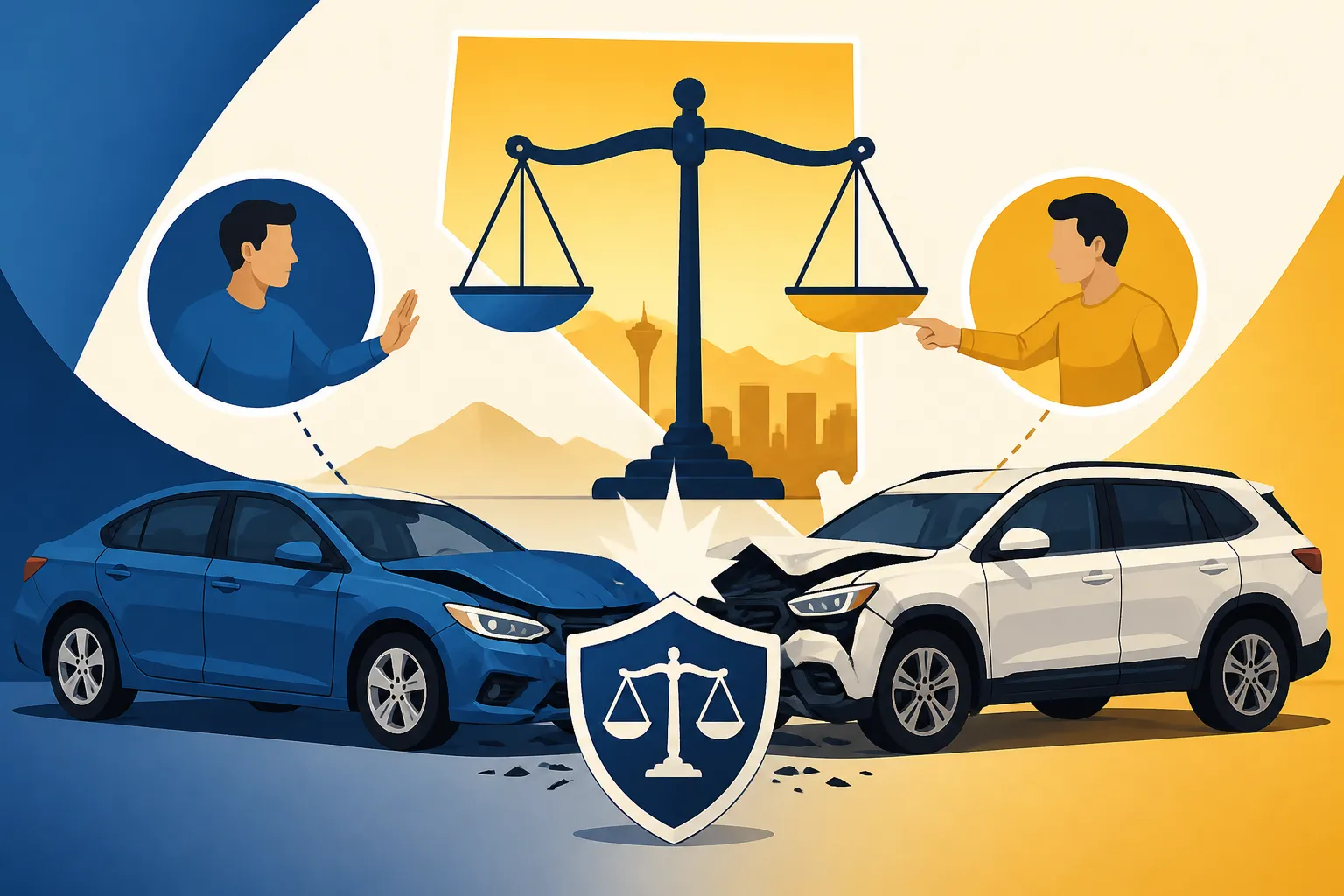
Comparative Negligence Laws in Nevada
Getting into a car accident is stressful enough, but then you're hit with the confusing legal jargon about "fault" and "negligence." It feels like you need a law degree just to understand if you'll be able to recover your damages. This guide will walk you through Nevada's specific comparative negligence laws, explaining exactly how they work and what they mean for your car accident claim, so you can navigate the aftermath with a clearer head.
Understanding Comparative Negligence
The concept of "fault" in a car accident isn't always black and white. It's rarely a simple case of one person being 100% to blame and the other being completely innocent. Often, both drivers might have contributed in some way to the collision. This is where the legal principle of negligence comes into play, and it's something every driver needs to understand, especially when dealing with insurance companies and potential claims.
What is Comparative Negligence?
At its heart, comparative negligence is a legal doctrine designed to assign responsibility when multiple parties contribute to an accident. Instead of saying "it's all your fault" or "it's all their fault," it allows for the sharing of blame. Imagine you're driving along I-15 near Las Vegas, and another driver abruptly changes lanes without signaling, causing a collision. It might seem obvious they're at fault, but what if you were also speeding slightly, even just a little? In a pure "all or nothing" system, that small amount of fault could potentially bar you from recovering any damages at all, which feels incredibly unfair when the other driver was clearly the primary cause.
This is precisely the frustration comparative negligence aims to address. It seeks to provide a more equitable outcome by evaluating each party's level of carelessness or failure to exercise reasonable care, and then adjusting the compensation accordingly. It acknowledges the nuanced reality that accidents are often complex events with multiple contributing factors, rather than simple, clear-cut scenarios. Without a system like this, many innocent victims could be left without compensation just because they had a tiny fraction of responsibility.
The Different Types of Comparative Negligence
While the core idea of sharing blame remains consistent, different states implement comparative negligence in varying ways. It's like different flavors of the same ice cream; they all start with the same base but have distinct characteristics. The three main types you'll typically hear about are pure comparative negligence, modified comparative negligence with a 50% bar, and modified comparative negligence with a 51% bar. Each system dictates how much, if any, compensation an injured party can recover based on their assigned percentage of fault. For a deeper dive into these distinctions, you might want to read our article on Comparative vs Contributory Negligence Explained.
In states with pure comparative negligence, like California, an injured party can recover damages even if they are 99% at fault. Their compensation is simply reduced by their percentage of fault. So, if you're awarded $100,000 but are found 99% at fault, you'd still get $1,000. It's a system designed to ensure some recovery, no matter how negligent you were. Then there are the modified systems, which place a cap on the amount of fault you can bear and still recover damages. These modified rules are crucial because they introduce a threshold that can make or break your claim, and they are what most states, including Nevada, utilize.
Nevada's Specific Comparative Negligence Rules
Now, let's zoom in on what really matters if you're dealing with a car accident here in the Silver State. Nevada doesn't use the pure comparative negligence model, which means there's a specific limit to how much fault you can carry while still being eligible for compensation. Understanding this threshold is absolutely vital for anyone involved in a collision on Nevada roads, from the bustling streets of Reno to the quiet highways leading to Lake Tahoe.
Nevada's Modified Comparative Negligence 51% Bar Rule Explained
Nevada operates under a modified comparative negligence system, specifically known as the "51% bar rule." This means that you can still recover damages even if you are partially at fault for an accident, as long as your percentage of fault is not greater than the fault of the other party or parties involved. In plain language: if you are found to be 50% or less at fault, you can still collect compensation for your injuries and damages. However, if your fault is determined to be 51% or higher, you are completely barred from recovering any compensation from the other party.
This 51% rule is a critical distinction because it sets a hard line. Think about a minor fender bender in a busy Las Vegas parking lot, perhaps outside the Fashion Show Mall. If you're backing out and another driver is also backing out, and you both collide, an investigation might determine you were 40% at fault and they were 60%. Under Nevada's rule, because your fault is 40% (which is less than 51%), you can still recover 60% of your damages. But if that determination flipped, and you were found 60% at fault, you would walk away with nothing, even if the other driver bore some responsibility. This rule really underscores the importance of accurately determining who is at fault in a car accident.
How Your Percentage of Fault Impacts Your Claim
The percentage of fault assigned to you directly dictates how much your car accident settlement will be reduced. It’s a proportional reduction, which means if you’re deemed 25% responsible for an accident, any award you receive will be cut by 25%. Let’s say you sustained $10,000 in medical bills, lost wages, and pain and suffering from an accident on the I-80 heading towards Fernley. If the other driver was 75% at fault and you were 25% at fault, your potential $10,000 in damages would be reduced by $2,500 (25%), meaning you would only recover $7,500. This might seem straightforward, but in reality, determining these percentages can be a fierce battle with insurance companies.
The challenge comes when insurance adjusters, who are trained negotiators, try to push your percentage of fault higher. They know that every percentage point they can pin on you directly reduces their payout. If they can get your fault to 51% or more, they don't have to pay you anything at all, which is their ultimate goal. This is why thorough documentation and understanding how fault is determined is so vital. It’s not just about proving the other driver was wrong; it’s about proving you were not more than 50% wrong. Our guide on How Comparative Fault Reduces Your Settlement goes into more detail about these financial implications.
| Percentage of Your Fault | Eligibility for Compensation (Nevada) | Amount Recovered (Example: $10,000 total damages) |
|---|---|---|
| 0% | Yes (100% of damages) | $10,000 |
| 10% | Yes (90% of damages) | $9,000 |
| 25% | Yes (75% of damages) | $7,500 |
| 49% | Yes (51% of damages) | $5,100 |
| 50% | Yes (50% of damages) | $5,000 |
| 51% or more | No (0% of damages) | $0 |
Practical Implications for Your Nevada Car Accident Claim
Navigating a car accident claim in Nevada means constantly keeping the 51% comparative negligence rule in mind. Every step you take, from the moment of impact to the final settlement negotiation, can influence the percentage of fault assigned to you. It's not just about what happened, but also about how effectively you can prove your version of events and counter any accusations made against you.
Proving Fault and Gathering Evidence
The success of your claim, particularly under Nevada’s 51% rule, hinges on your ability to prove the other driver's fault while minimizing your own. This isn't just a suggestion; it's a necessity. From the scene of the accident, whether it's a minor ding in Summerlin or a more serious crash on US-95, every piece of evidence you collect is crucial. This includes photographs of vehicle damage, the accident scene, skid marks, and any road conditions. It also involves eyewitness statements, contact information for all parties, and a detailed police report. The more evidence you have supporting your side, the stronger your position will be against claims of your own negligence.
Remember, the police report itself, while important, doesn't definitively determine fault for insurance purposes, but it often provides a strong foundation. Even minor details, like the positioning of vehicles or whether turn signals were used, can contribute to how fault is assessed. If you want to dive deeper into gathering robust evidence, our article How to Prove the Other Driver Was at Fault offers practical steps. Neglecting to gather this evidence can leave you vulnerable to the other party or their insurance company assigning a higher percentage of fault to you, potentially pushing you over that critical 51% threshold.
Negotiating with Insurance Companies
Dealing with insurance companies after an accident is often one of the most frustrating parts of the entire process. They are businesses, and their primary goal is to minimize payouts. They are acutely aware of Nevada's comparative negligence laws and will use them to their advantage. Expect them to scrutinize every detail to find any shred of evidence that suggests you contributed to the accident, even in a small way. They might ask for recorded statements, hoping you'll inadvertently say something that can be twisted to imply fault. Learning What Is an Admission of Fault (and How to Avoid It)? is incredibly important here.
During negotiations, the adjuster will likely present their initial assessment of fault, which may already assign you a percentage. It's your job, or your legal representative's, to challenge this if it's unfair or inaccurate. For instance, if you were T-boned at an intersection in Henderson, and the other driver ran a red light, but the insurance company tries to claim you were partially at fault for not reacting fast enough, you need to be prepared to present evidence that refutes that claim. This back-and-forth over fault percentage can be intense, as even a small shift can significantly impact your final settlement amount. Understanding How Insurance Companies Determine Who Is at Fault can give you an edge in these conversations.
What Happens If You're Found Partially at Fault?
It’s a tough pill to swallow, but if you're involved in a car accident and determined to be partially responsible, even just a little, it fundamentally changes the game for your claim. This isn't about shaming or blaming; it's about the cold, hard reality of how Nevada's laws impact your ability to recover financially. Accepting this reality early can help you manage your expectations and strategize your next steps more effectively.
Reduced Compensation and What to Expect
If you are found to be 50% or less at fault in a Nevada car accident, you can still receive compensation for your damages. However, as we discussed, your total recovery will be reduced by your assigned percentage of fault. This reduction applies across the board to all damages you’re claiming, whether they are economic damages like medical bills and lost wages, or non-economic damages like pain and suffering. So, if your total damages are calculated at $50,000, and you are found 20% at fault, you would only be able to recover $40,000 (a $10,000 reduction).
This can be a harsh reality for many accident victims. You might have significant medical expenses, your car might be totaled, and you might be out of work, but your own contribution to the accident, no matter how minor, directly translates to less money in your pocket. This makes every percentage point of fault critically important, emphasizing why disputing unfair fault assignments is so vital. If you find yourself in this situation, it’s worth exploring our article titled Can You Still Get Paid If You're Partly at Fault? to understand your options better.
When to Consider Legal Counsel
Given the complexities of comparative negligence and the 51% bar rule in Nevada, knowing when to involve a legal professional is perhaps the most crucial advice anyone can offer. If your accident involved significant injuries, if fault is disputed, or if the insurance company is already trying to pin a high percentage of blame on you, a car accident lawyer can be an invaluable asset. They understand the nuances of Nevada law and have experience negotiating with insurance companies who will try to minimize their payout.
A good attorney can help you gather robust evidence, analyze police reports, interview witnesses, and even consult with accident reconstruction specialists if necessary. More importantly, they can articulate your case in a way that protects you from being unfairly assigned a high percentage of fault. They can also provide a realistic assessment of your claim's worth, including how your partial fault might affect the final settlement, as detailed in our comprehensive guide How Much Is My Car Accident Settlement Worth? (2026). Deciding whether you need a lawyer for a car accident, especially when comparative negligence is a factor, is a decision that shouldn't be taken lightly, as it can significantly impact the outcome of your financial recovery.
Navigating the Claims Process After a Nevada Car Accident
Dealing with the aftermath of a car accident is a multi-step process, and understanding each phase is essential, especially with Nevada's comparative negligence laws in mind. From the immediate moments after the crash to the resolution of your claim, every action you take (or don't take) can have long-lasting implications.
Immediate Steps After an Accident
The actions you take right after an accident can lay the groundwork for your entire claim, influencing how fault is initially perceived and documented. First and foremost, ensure everyone's safety. Move vehicles out of traffic if possible, and check for injuries. Then, call the police, even for what seems like a minor collision, especially if there's any damage or injury. A police report provides an official, third-party account of the incident, which is invaluable. Documenting the scene with photos and videos, exchanging information with the other driver, and refraining from admitting fault are critical.
Seeking medical attention immediately, even if you feel fine, is also crucial. Some injuries, like whiplash or concussions, might have delayed symptoms that don't appear for hours or even days. Delaying medical care can not only harm your health but also allow the insurance company to argue that your injuries weren't directly caused by the accident. For a comprehensive overview of what to do, refer to our guide What to Do After a Car Accident: Step-by-Step (2027). These initial steps are your first line of defense against potential accusations of high comparative fault later on.
Filing Your Claim and Initial Investigation
Once the immediate aftermath is handled, the next step is to file your insurance claim. In Nevada, because it's an "at-fault" state (as opposed to a no-fault state), you'll typically file a claim with the other driver's insurance company if they are primarily responsible. However, it's often wise to inform your own insurance company as well, especially if you have collision coverage or personal injury protection. This helps ensure all your bases are covered.
During the initial investigation, both insurance companies will start gathering facts, including reviewing police reports, photos, witness statements, and possibly requesting a recorded statement from you. This is where the comparative negligence evaluation truly begins. The adjusters will be looking for any evidence to support their client's position and minimize their liability. Be prepared for them to ask pointed questions about your actions leading up to the accident. Your ability to clearly articulate your side and provide supporting evidence will be vital in challenging any attempts to assign you a higher percentage of fault.
Understanding Your Settlement Potential with Comparative Fault
When you're dealing with injuries, vehicle damage, and the stress of an accident, the question of "how much" you might actually get as a settlement is always on your mind. Nevada's comparative negligence laws directly influence this, and it’s important to have realistic expectations about the financial outcome.
Factors Beyond Fault Affecting Your Settlement
While your percentage of fault is a major determinant in a Nevada car accident settlement, it's not the only factor. The severity of your injuries, the extent of your medical treatment, lost wages, and the impact on your quality of life all contribute to the overall value of your claim. For instance, a claim involving a herniated disc from a car accident will likely command a higher settlement than one with minor whiplash. The more comprehensive and well-documented your damages are, the stronger your negotiating position, even if you bear some percentage of fault.
Additionally, factors like the at-fault driver's insurance policy limits can play a significant role. Even if you have a strong case and minimal fault, if the other driver has very low coverage, there might be a practical cap on how much you can actually recover from their policy. This is why having your own underinsured motorist coverage is so important in Nevada. Our comprehensive guide on How Car Accident Settlements Are Calculated provides an in-depth look at all these elements.
The Role of Negotiation and Legal Representation
Negotiating a fair settlement under comparative negligence laws is rarely a simple task. The initial settlement offer from an insurance company often doesn't fully account for all your damages, especially if they've assigned you a higher fault percentage. This is where skilled negotiation comes into play. If you're confident in your evidence and believe their fault assessment is unfair, you can counter their offer.
However, if you feel overwhelmed, or if the fault assignment is highly contested, bringing in a legal professional can dramatically change the dynamic. An attorney can handle all communications with the insurance companies, present your case effectively, and skillfully negotiate for a higher settlement. They understand the tactics insurance companies use and can advocate fiercely to protect your rights and ensure your fault percentage is not unfairly inflated. This can be particularly helpful if you're dealing with severe injuries or a complex accident scenario, as they can help maximize your recovery even when you are partially at fault. Our article How to Negotiate a Car Accident Settlement offers valuable insights into this process.
Disclaimer
Please remember that this information is for educational purposes only and should not be considered legal advice. Car accident laws are complex and vary by jurisdiction. For advice specific to your situation, it is always recommended to consult with a qualified legal professional in Nevada.