Comparative Negligence Laws in New Mexico
It's incredibly frustrating when you've been involved in a car accident, and suddenly you're facing a mountain of confusing legal jargon, especially when it feels like everyone is trying to figure out who's to blame. You might be nursing injuries, dealing with a damaged vehicle, and all you want is some clear answers on how to get things sorted. This guide is here to cut through the confusion and explain exactly how comparative negligence laws work in New Mexico and what that means for your car accident claim.
Understanding the Concept of Comparative Negligence
When you're dealing with the aftermath of an accident, one of the first questions that comes up is always, "Who's at fault?" And let's be honest, it's rarely as simple as a clear-cut good guy and bad guy scenario, even if we wish it were.
Why Fault Isn't Always Black and White
Picture this: you're driving down a busy street in Albuquerque, and the car in front of you suddenly slams on its brakes because a dog darted out into the road. You react quickly, but not quite quickly enough, and you end up rear-ending them. At first glance, it might seem like you're entirely at fault. However, what if you later found out their brake lights weren't working? Or perhaps they were distracted by their phone just before the sudden stop, even if the dog was the immediate cause?
These kinds of situations highlight why determining fault after a car accident is so complex. It's rare for one single factor or one single driver to be entirely responsible. Often, multiple actions contribute to a collision, and each driver might bear some degree of responsibility. Maybe one driver was speeding slightly, while the other made an unsafe lane change without looking. Both actions played a part. Our legal system recognizes this reality and has developed mechanisms to address shared responsibility rather than an all-or-nothing approach.
What is Comparative Negligence?
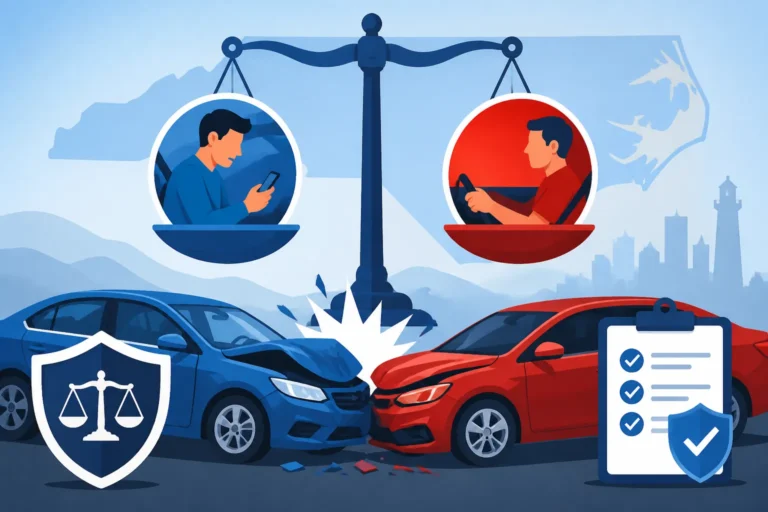
This is where comparative negligence comes into play. Simply put, comparative negligence is a legal principle that allows an injured party to recover damages for their injuries and losses even if they were partly at fault for the accident. Instead of completely barring recovery, as some older laws used to do, this doctrine reduces the amount of compensation the injured party can receive by the percentage of fault assigned to them. It's a way to ensure fairness, acknowledging that accidents often involve shades of gray rather than just black and white.
Imagine you're involved in a collision, and the total damages (medical bills, lost wages, vehicle repair) come out to $10,000. If it's determined that you were 20% at fault for the accident, under comparative negligence, you would only be able to recover 80% of your damages, which is $8,000. It's a proportional system designed to allocate financial responsibility in line with each party's contribution to the accident. This approach is a significant departure from what's known as "contributory negligence," a much stricter system used in a handful of states where if you were even 1% at fault, you couldn't recover anything at all. Thankfully, New Mexico isn't one of those states.
New Mexico's Pure Comparative Negligence System
Navigating the aftermath of a car accident in New Mexico means understanding a crucial legal concept: pure comparative negligence. This isn't just some legalistic phrase; it directly impacts how much compensation you can receive if you're injured in a crash.
The Specifics of New Mexico Law
New Mexico stands out because it follows a pure comparative negligence rule. This is a very claimant-friendly system compared to many other states. What does "pure" mean in this context? It means that an injured person can still recover damages from other at-fault parties, even if they are found to be primarily responsible for the accident. Your ability to recover isn't barred, no matter how high your percentage of fault might be.
Let's say you were involved in a two-car accident in Las Cruces, and after all the investigations, it was determined that you were 80% at fault, and the other driver was 20% at fault. In many states with "modified" comparative negligence, you wouldn't be able to recover anything because your fault exceeded a certain threshold (usually 50% or 51%). But in New Mexico, thanks to the pure comparative negligence rule, you could still recover 20% of your total damages from the other driver. It's about proportionality – your recovery is simply reduced by your own percentage of fault. This principle has been firmly established in New Mexico law, allowing courts and insurance companies to allocate damages fairly among all contributing parties.
How Fault is Determined and Apportioned
So, how do we get to these percentages of fault? It's not a random guess, I promise. After a car accident, a thorough investigation typically begins. This usually involves several key players:
- Law Enforcement: When police officers respond to an accident scene, they'll gather initial evidence, interview drivers and witnesses, and document the scene. Their police report often contains their initial assessment of fault, though it's important to remember that this isn't always the final word on legal liability. For more on this, you might find our article on Police Reports and Car Accident Fault helpful.
- Insurance Adjusters: Both your insurance company and the other driver's insurer will send adjusters to investigate. They'll look at the police report, photos of the scene, damage to the vehicles, statements, and sometimes even reconstruct the accident if it's complex.
- Witnesses: Eyewitness accounts can be incredibly valuable in piecing together what happened. Their objective perspective can often shed light on critical details.
- Physical Evidence: Skid marks, debris fields, traffic camera footage, and even vehicle black box data can provide concrete evidence to help determine how the accident unfolded.
Based on all this information, a percentage of fault is assigned to each driver involved. For example, in a scenario where one driver was speeding and another failed to yield, a judge, jury, or even the insurance companies negotiating a settlement, might determine that the speeding driver was 70% at fault and the driver who failed to yield was 30% at fault. The aim is to understand each party's contribution to the collision. Understanding How Fault Is Determined in a Car Accident is fundamental to any claim.
The Impact on Your Compensation
This is where New Mexico's pure comparative negligence system really shows its colors. Once those fault percentages are established, they directly dictate how much compensation you can realistically expect to receive.
Let's consider a few scenarios to make it clear:
- Scenario 1: You are 10% at fault. Suppose you suffered $50,000 in medical bills, lost wages, and property damage from an accident. If you are found to be 10% at fault, the other driver's insurance company (or the other driver, through a lawsuit) would be responsible for 90% of your damages. This means you could recover $45,000.
- Scenario 2: You are 50% at fault. Using the same $50,000 in damages, if you were equally responsible (50% at fault), you would be able to recover 50% of your damages, or $25,000.
- Scenario 3: You are 75% at fault. Even if you were largely to blame, for instance, 75% at fault for the accident, you could still recover 25% of your damages, which would be $12,500 in this example.
This proportional reduction is the cornerstone of pure comparative negligence. It's a system designed to ensure that even if you bear some responsibility, you're not completely left in the lurch. This is a critical distinction, especially when you're thinking about What Happens If You're Partially at Fault?. You can definitely see how How Comparative Fault Reduces Your Settlement is directly applied here.
Practical Implications for Your New Mexico Car Accident Claim
Dealing with the aftermath of a car accident is never straightforward, and New Mexico's pure comparative negligence system adds another layer of complexity. Understanding these practical implications is vital for protecting your rights and maximizing your potential recovery.
Dealing with Insurance Companies and Negotiations
Let's be real: insurance companies are not looking out for your best interests; they are looking out for their bottom line. When they know New Mexico is a pure comparative negligence state, you can bet they will use that to their advantage. Their goal will be to assign as much fault to you as possible, even if it's unfair, because every percentage point of fault they can pin on you directly reduces the amount they have to pay out.
For example, if you're in an accident on I-40 near Santa Rosa, and the other driver's insurance adjuster calls you, they might try to get you to make statements that could be interpreted as an admission of fault. They might suggest that you were going "a little fast" or "weren't paying full attention." These seemingly innocent statements can be used against you to assign a higher percentage of fault. It's absolutely crucial to be extremely careful about what you say.
The police report, while not a definitive legal ruling, can significantly influence the initial fault assessment by insurance companies. If the report indicates you contributed to the accident, expect the other side to lean heavily on that. However, even if the police report is unfavorable, it’s not the end of the road. Further investigation, witness statements, and expert analysis can often challenge initial findings. Remember that the adjuster's first offer is almost always a lowball offer, and knowing How to Deal With a Lowball Insurance Offer is crucial.
What If You Are Significantly at Fault?
This is where New Mexico's pure comparative negligence really shines for claimants, even in challenging situations. In states with modified comparative negligence, if you're found 50% or 51% (depending on the state) or more at fault, you get nothing. Zero. But in New Mexico, that isn't the case.
Imagine you're driving in Roswell, and you make a slightly risky maneuver, like an aggressive lane change, and cause a side-swipe accident. However, the other driver was also excessively speeding. After reviewing all the evidence, a jury might determine you were 60% at fault and the other driver was 40% at fault. In most states, your claim would be dead in the water. But in New Mexico, you could still recover 40% of your damages from the speeding driver.
This is an incredibly important distinction. It means that even when you know you made a mistake or contributed significantly to an accident, you still have a potential path to recovery for a portion of your losses. This provides a safety net that many other state laws do not. However, it also means that the negotiation process can be incredibly complex, as both sides will fiercely argue over every percentage point.
The Role of Legal Representation
Given the complexities of determining fault, the aggressive tactics of insurance companies, and the nuances of New Mexico's pure comparative negligence system, having skilled legal representation can make a world of difference. Trying to navigate this process on your own, especially while recovering from injuries, can feel overwhelming.
A qualified car accident lawyer understands how insurance companies determine who is at fault and their strategies for minimizing payouts. They can:
- Challenge Fault Assignments: If an insurance company unfairly assigns a high percentage of fault to you, your attorney can gather additional evidence, interview witnesses, and bring in accident reconstruction experts to present a stronger case for a lower fault percentage on your part. This helps to How to Prove the Other Driver Was at Fault and protect your claim.
- Negotiate Effectively: Lawyers are experienced negotiators. They can counter lowball offers, present a comprehensive demand for damages, and argue against unfavorable fault percentages, ensuring that you receive fair compensation based on New Mexico's laws.
- Handle Litigation: If a fair settlement cannot be reached, your attorney can take your case to court, where they will present your case to a judge or jury, who will then make the final determination on fault and damages.
Ultimately, deciding whether you Do You Need a Lawyer for a Car Accident? is a personal one, but in a pure comparative negligence state like New Mexico, where every percentage point matters, a lawyer's expertise can be invaluable in navigating the tricky waters of fault and liability.
Here’s a quick comparison of New Mexico's system versus others:
| System Type | Description | Impact on Recovery (You are 70% at Fault) | States Using It (Examples) |
|---|---|---|---|
| Pure Comparative Negligence (New Mexico) | You can recover damages even if you are mostly at fault, but your compensation is reduced by your exact percentage of fault. No threshold. | You can recover 30% of your total damages. | New Mexico, California, Florida, New York, Washington |
| Modified Comparative Negligence (50% Bar) | You can recover damages only if your fault is 49% or less. If you are 50% or more at fault, you cannot recover anything. | You recover nothing, as your fault (70%) exceeds the 49% threshold. | Colorado, Hawaii, Kansas, Oklahoma, Oregon, Utah, Wisconsin |
| Modified Comparative Negligence (51% Bar) | You can recover damages only if your fault is 50% or less. If you are 51% or more at fault, you cannot recover anything. | You recover nothing, as your fault (70%) exceeds the 50% threshold. | Arkansas, Idaho, Maine, Mississippi, Montana, North Carolina |
| Contributory Negligence | If you are found to be at any fault (even 1%) for the accident, you are completely barred from recovering any damages. This is a very harsh system. | You recover nothing, as you contributed to the accident. | Alabama, Maryland, North Carolina, Virginia, D.C. |
Note: New Mexico is not a "No-Fault" state. What Is a No-Fault State? (And Which States Are No-Fault) applies to how medical expenses are paid, not how fault for an accident is determined for property damage and pain and suffering.
Navigating Common Accident Scenarios Under New Mexico Law
Understanding how comparative negligence generally works in New Mexico is one thing, but seeing how it applies to specific types of accidents can really bring it home. Different collision types often have distinct default fault assignments that can then be adjusted by comparative fault principles.
Rear-End Collisions
Rear-end collisions are often seen as the most straightforward type of accident when it comes to fault, and typically, the driver who rear-ends another vehicle is presumed to be at fault. This is because drivers are expected to maintain a safe following distance and be able to stop in time if the vehicle in front slows down or stops unexpectedly. For an in-depth look, check out our guide on Rear-End Collision Fault Who Is Responsible?.
However, New Mexico's comparative negligence system means this isn't always an open-and-shut case. There are scenarios where the lead driver might bear some percentage of fault. For instance:
- Malfunctioning Brake Lights: If the lead vehicle's brake lights weren't working, the rear driver might have had no visual warning of a stop, contributing to the collision.
- Sudden, Unsafe Stop: While drivers can stop suddenly, if a driver intentionally or negligently slams on their brakes without a legitimate reason (e.g., as a "brake check" maneuver), they could be assigned partial fault.
- Unsafe Lane Change: If the lead driver cut off the rear driver just before stopping, causing an unavoidable collision, they might share some responsibility.
In these situations, even if the rear driver is mostly at fault, the lead driver's contribution could reduce the rear driver's percentage of fault and allow the rear driver to recover a portion of their damages.
Intersection Accidents and Left Turns
Intersection accidents are fertile ground for comparative negligence, as they frequently involve multiple drivers making quick decisions under pressure. They are often complex, with many variables contributing to the outcome.
Consider a left-turn accident in Farmington. Typically, the driver making a left turn is responsible for ensuring the intersection is clear before proceeding. If they turn in front of oncoming traffic, they are often deemed at fault. Our article on Left-Turn Accident Fault Rules delves into this in detail.
However, comparative negligence can shift this. What if:
- Speeding Oncoming Driver: The oncoming vehicle was traveling significantly over the speed limit, making it impossible for the turning driver to accurately judge the distance and time available? The speeding driver might be assigned a percentage of fault.
- Running a Red Light: If the oncoming driver ran a red light, but the turning driver failed to check adequately before turning, fault could be shared.
Similarly, in a T-bone accident at an intersection – where one vehicle's front hits another vehicle's side – the driver who failed to yield the right-of-way is often primarily at fault. Yet, if the other driver was also speeding or distracted, those factors could introduce shared fault. Learning Who Is at Fault in a T-Bone Accident? can help you understand these dynamics.
Multi-Car Pileups
Multi-car pileups, especially those on busy highways like I-25 near Santa Fe, are perhaps the most intricate scenarios for fault determination and are practically guaranteed to involve comparative negligence. When several vehicles are involved, it becomes a painstaking process to determine each driver's contribution.
In a chain-reaction collision, for instance, the initial cause might be one driver's negligence, leading to subsequent impacts. However, drivers further back in the chain might also be found partially at fault for failing to maintain a safe following distance or for not reacting quickly enough. It’s not uncommon to see fault percentages like 20% for Driver A, 35% for Driver B, 15% for Driver C, and 30% for Driver D.
This kind of accident truly highlights why New Mexico's pure comparative negligence system is so important. With multiple parties contributing, each injured party can seek compensation from every other party found to be at fault, with their own recovery reduced only by their specific percentage of fault. Understanding Who Is at Fault in a Multi-Car Pileup? can shed more light on these complex scenarios.
In all these cases, the principle remains the same: New Mexico’s pure comparative negligence system strives to assign financial responsibility proportionally to each party's role in causing the accident. This approach allows for a more nuanced and, arguably, fairer outcome for everyone involved, even if the process of getting there can be challenging.
Disclaimer
Please remember that this article provides general information and is not intended as legal advice. Car accident claims are complex, and the specific facts of your case, combined with the constantly evolving legal landscape, mean that the information here may not apply to your situation. For personalized guidance, it is always recommended to consult with a qualified New Mexico car accident attorney.