What Is Proximate Cause in a Car Accident Claim?
When you’ve been in a car accident, your mind is probably racing through a million things: your injuries, the damage to your car, dealing with insurance companies, and, inevitably, the question of who is at fault. While it might seem straightforward – someone hit someone else, right? – the legal system has a way of complicating things with terms like "proximate cause." This guide is here to untangle that knot, offering a deeply detailed, realistic explanation of what proximate cause means in a car accident claim, why it’s so crucial, and how it can make or break your ability to recover compensation for your damages.
Understanding the Foundation: What is Proximate Cause?
Imagine you’re driving down a busy street, and suddenly, another car cuts you off, causing you to swerve and hit a parked vehicle. It feels pretty clear who's at fault, doesn't it? The other driver. But in the legal world, especially when it comes to car accident claims, simply identifying "who caused the accident" isn't always enough. This is where the concept of proximate cause steps in, acting as a critical filter for liability. It's not just about what did happen, but what should have been reasonably anticipated or expected to happen as a result of someone's actions. Without establishing proximate cause, even a clear-cut incident can become a tangled mess, leaving victims struggling to get the compensation they deserve.
Beyond Simple Causation: The "But For" Test
At its core, proximate cause begins with what's often called the "but for" test, or cause-in-fact. This is the simplest way to think about how one event leads to another. You ask yourself: "But for the defendant's actions, would the injury or damage have occurred?" If the answer is no, then their action is a cause-in-fact. For instance, but for the other driver running the red light, you wouldn't have collided with their vehicle. This initial step helps to draw a direct line between the negligent act and the resulting harm. It's the foundational block, establishing a basic connection without which no claim can even begin to stand. It sounds simple, but as we’ll see, this is just the beginning of the journey into legal causation.
However, the "but for" test alone isn't sufficient. Life, and car accidents, are full of complex chains of events. If a squirrel ran into the road, causing a driver to swerve, and that swerve led to a multi-car pileup, could you argue "but for the squirrel, the accident wouldn't have happened"? Legally, no. The "but for" test needs a companion – the concept of foreseeability – to truly define legal responsibility. Without this next layer, liability could stretch infinitely, encompassing every tiny, distant event that might have indirectly played a role. This is why the law needs a more refined tool to determine actual legal responsibility.
Foreseeability: A Key Component
This is where the idea of foreseeability becomes absolutely central to understanding proximate cause. It asks whether the injury or damage suffered was a reasonably foreseeable consequence of the negligent action. In other words, would a reasonable person, in the same situation, have anticipated that their actions could lead to this particular outcome? Going back to our red-light example, it's highly foreseeable that running a red light could cause a collision with cross-traffic. The driver should have known that their action carried a significant risk of causing an accident and subsequent injuries.
Conversely, if an action leads to an extremely bizarre or unforeseeable outcome, it might break the chain of proximate cause. For example, if a minor fender bender caused by a distracted driver somehow led to a rare, obscure satellite falling out of orbit and crushing a pedestrian blocks away (a truly outlandish scenario!), the distracted driver likely wouldn't be held proximately responsible for that satellite incident. While their distraction caused the fender bender, it's not reasonably foreseeable that it would result in space debris falling from the sky. This element of foreseeability prevents liability from becoming limitless and ensures that responsibility is only assigned for consequences that could realistically be expected.
Why it Matters More Than You Think
Proximate cause isn't just some dusty legal term; it's the bedrock upon which successful car accident claims are built. Without proving proximate cause, you cannot hold another driver legally responsible for your injuries and damages, no matter how clearly their negligence might have initiated the chain of events. Imagine you were involved in a collision, and the other driver clearly violated a traffic law. You have significant medical bills and your car is totaled. If you can't establish that their violation was the proximate cause of your specific harm, the insurance company or the court could argue that your damages resulted from something else, an intervening cause, or were simply too far removed from the original negligent act to warrant compensation.
This concept becomes particularly vital in cases where there are multiple contributing factors, or where the injuries suffered are unusual. For instance, if a minor rear-end collision, which typically causes soft tissue injuries, somehow triggers a rare, pre-existing condition that leads to a catastrophic health event, the other driver's insurer might argue that the severe outcome wasn't a foreseeable consequence of their actions, thus challenging proximate cause. Understanding this principle empowers you to build a stronger case, ensuring you focus on demonstrating not just what happened, but why the other driver should be held accountable for the specific harm you endured.
The Two Sides of Causation: Actual vs. Proximate
When discussing car accidents and legal responsibility, the terms "cause" and "causation" get thrown around a lot. But in the legal realm, these aren't always interchangeable. There's a fundamental distinction between what we call "actual cause" (also known as "cause-in-fact") and "proximate cause" (sometimes referred to as "legal cause"). It’s a bit like looking at a ripple in a pond: the pebble is the actual cause of the first ripple, but the subsequent ripples reaching the shore might not all be considered proximately caused by that original pebble if something else, like a strong gust of wind, influenced them significantly. Grasping this distinction is crucial because insurance adjusters and defense attorneys will often try to separate these two concepts to reduce or deny your claim.
Actual Cause: The "Cause-in-Fact"
Actual cause, or cause-in-fact, is the most straightforward aspect of causation. It answers the question, "Did the defendant's negligent act actually contribute to the plaintiff's injuries?" As we touched upon earlier, this is typically determined using the "but for" test. If we remove the defendant's action from the sequence of events, would the injury still have occurred? If not, then the defendant's action is an actual cause.
Consider a driver who was texting while driving and drifted into the wrong lane, hitting your car head-on. "But for" the driver texting and drifting, the head-on collision would not have happened. Their distracted driving is the actual cause of your accident and subsequent injuries. This seems quite obvious, doesn't it? However, it’s important to remember that multiple actual causes can exist for a single event. For instance, if you were also slightly speeding, your speed could be considered another actual cause, even if the primary fault lies with the texting driver. The law recognizes that an event can have more than one contributing factor, each of which could pass the "but for" test independently.
Proximate Cause: Limiting Liability
While actual cause identifies all the things that physically contributed to an event, proximate cause steps in to limit the scope of legal liability. It asks: "Is it fair to hold the defendant responsible for this particular injury, given the nature of their negligent act?" This is where foreseeability becomes paramount. Proximate cause prevents liability from extending to every remote consequence, no matter how indirectly connected. It draws a line in the sand, determining at what point the chain of causation becomes too attenuated or unforeseeable for legal responsibility to attach.
Think about a small, low-impact fender bender in a parking lot. The actual cause might be one driver backing out without looking. But if, months later, the stress from that minor incident somehow causes the victim to develop a rare, severe anxiety disorder that no reasonable person could have predicted from a parking lot bump, then it might be argued that while the backing-up was the actual cause of the fender bender, it was not the proximate cause of the severe anxiety disorder. The connection is too distant and unforeseeable. This doesn't mean the victim can't recover for other, more direct and foreseeable damages like vehicle repair and whiplash; it just limits the scope of what the negligent driver is held accountable for. This helps to make the legal system practical and fair, ensuring that individuals are responsible for the natural and probable consequences of their actions.
Here's a quick table to help differentiate these two critical concepts:
| Feature | Actual Cause (Cause-in-Fact) | Proximate Cause (Legal Cause) |
|---|---|---|
| Primary Test | "But For" Test (Would the injury have occurred without the defendant's action?) | Foreseeability (Was the injury a natural and probable consequence of the defendant's action?) |
| Scope | Broad; identifies all contributing factors. | Narrower; limits legal liability to foreseeable outcomes. |
| Focus | Direct connection between action and outcome. | Fairness and reasonable expectation of consequences. |
| Role | Establishes a factual link. | Determines legal responsibility. |
| Example | Driver runs red light. | Driver running red light causes collision. |
A Real-World Example: The Domino Effect
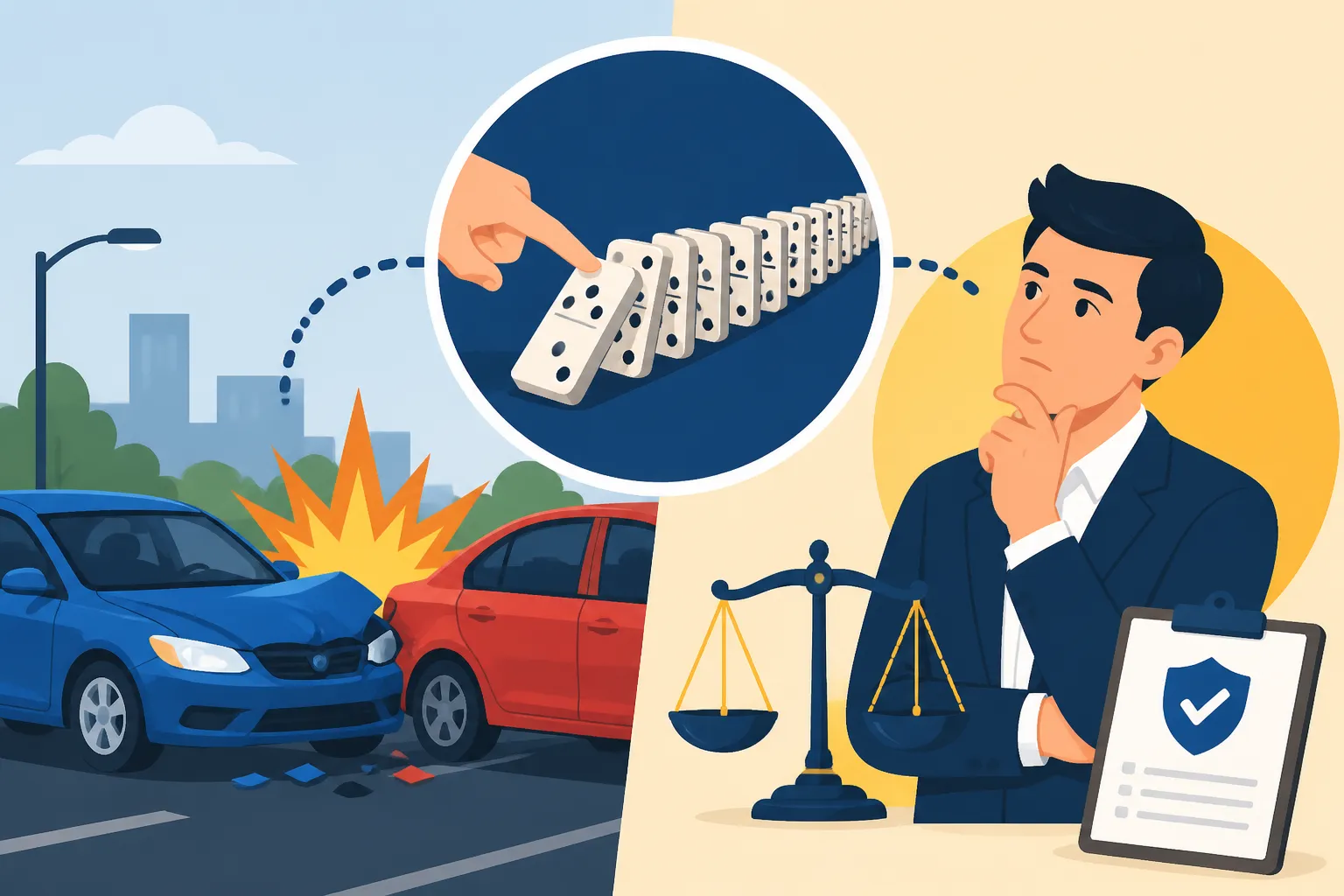
Let's illustrate with a hypothetical but realistic scenario. Imagine a driver, Sarah, is distracted by her phone and rear-ends Mark's car at a stop light in Dallas. The impact is minor, causing a small dent in Mark's bumper. However, the jolt causes a loosely secured ladder on the roof rack of Mark's car to slide forward, striking and damaging the windshield of a third car, driven by Emily, who was stopped directly in front of Mark.
In this "domino effect," Sarah's distracted driving is the actual cause of the initial rear-end collision with Mark. "But for" Sarah's distraction, she wouldn't have hit Mark. The damages to Mark's bumper are clearly proximately caused by Sarah's negligence; it's entirely foreseeable that rear-ending a car will cause bumper damage.
Now, let's consider Emily's damaged windshield. Was Sarah's distracted driving the proximate cause of Emily's damaged windshield? Yes. It is reasonably foreseeable that if you rear-end a vehicle, and that vehicle has something like a loosely secured ladder on its roof, the impact could dislodge it and cause further damage to another car. The chain of events, while involving an intermediary (Mark's car and ladder), remains a foreseeable consequence of Sarah’s initial negligent act. Therefore, Sarah would likely be held both actually and proximately responsible for the damages to Mark's car and Emily's windshield. This intricate chain highlights why a deep understanding of who is at fault in a car accident is critical, especially when multiple vehicles are involved.
Elements Required to Prove Proximate Cause
Proving proximate cause in a car accident claim isn't just about telling a story; it's about systematically demonstrating that certain legal elements have been met. It's a precise process that requires careful attention to detail and evidence. Think of it like building a bridge: each pillar needs to be solid for the entire structure to hold. If any one of these pillars is weak or missing, the defense can easily dismantle your claim. These elements form the basic framework of any negligence claim, and proximate cause is the linchpin that connects the defendant's actions to your specific harm.
Duty of Care: Every Driver's Responsibility
The first and most fundamental element in any negligence claim, including car accident cases, is the "duty of care." Simply put, every driver on the road owes a legal obligation to other drivers, passengers, pedestrians, and property owners to operate their vehicle safely and responsibly. This isn't some abstract concept; it's a concrete expectation rooted in common sense and traffic laws. When you get behind the wheel, you implicitly agree to follow traffic laws, pay attention to the road, avoid driving while impaired, and generally act as a "reasonable person" would under similar circumstances.
This duty of care is universal. It doesn't matter if you're driving a beat-up sedan or a brand new luxury SUV; the expectation of safe driving applies to everyone. For example, a driver in Sacramento has a duty to stop at red lights, yield to pedestrians, maintain a safe following distance, and avoid Distracted Driving (Texting) Accident behaviors. This duty forms the baseline. If no duty of care exists, then there can be no negligence, and thus, no proximate cause. Establishing this duty is usually straightforward in car accident cases, as the mere act of operating a vehicle on public roads automatically creates this obligation.
Breach of Duty: When Safety Rules are Broken
Once the duty of care is established, the next step is to demonstrate that the defendant "breached" that duty. A breach occurs when a driver fails to act as a reasonable and prudent person would have acted under the same circumstances. This is essentially where negligence comes into play. If a driver deviates from their duty of care – by speeding, running a stop sign, driving while intoxicated, or engaging in any other careless behavior – they have breached their duty.
Examples of breaching the duty of care are plentiful in car accidents. A driver who blows through a stop sign at a busy intersection in downtown Los Angeles, causing a T-bone collision, has clearly breached their duty of care. Similarly, a driver who is tailgating and then causes a Rear-End Collision Fault Who Is Responsible has breached their duty to maintain a safe following distance. The breach doesn't have to be intentional; it simply needs to be a failure to exercise reasonable care. This breach is the negligent act that sets the entire chain of events in motion, leading directly to the need to prove proximate cause.
Damages: The Harm Suffered
The final pillar in proving proximate cause, and indeed any personal injury claim, is the existence of "damages." Even if a driver breaches their duty of care, and it was the actual cause of something, if no actual harm or injury results, there's no legal claim for compensation. Damages refer to the measurable harm, losses, and injuries you've suffered as a direct result of the defendant's breach of duty. These can be economic (quantifiable financial losses) or non-economic (subjective, non-monetary losses).
Common types of damages in car accident claims include:
- Medical Expenses: Everything from emergency room visits, ambulance rides, doctor consultations, prescription medications, physical therapy, and even future medical care.
- Lost Wages: Income you've lost because your injuries prevented you from working, including future earning capacity if your injuries are long-term.
- Property Damage: The cost to repair or replace your vehicle, and any other personal property damaged in the crash.
- Pain and Suffering: Compensation for physical pain, emotional distress, mental anguish, loss of enjoyment of life, and other intangible impacts of your injuries.
Without demonstrable damages, even the clearest case of negligence and actual cause will not result in a successful claim. The link between the breach of duty and these specific damages is what proximate cause ultimately seeks to confirm. You must show that the defendant's negligent act led directly and foreseeably to your particular injuries and losses. This is why it's crucial to understand What Are Damages in a Car Accident Claim? and meticulously document all of your losses after an accident.
Foreseeability: The Heart of Proximate Cause
While the "but for" test helps establish a factual link between an action and an outcome, foreseeability is the qualitative filter that determines if that link is strong enough for legal accountability. It's truly the heart of proximate cause, serving as the common-sense yardstick against which a defendant's responsibility is measured. Without foreseeability, the concept of legal liability would stretch into absurdity, holding people accountable for every far-flung, unpredictable consequence of their actions. This concept is all about what a reasonable person would expect, not what could theoretically happen in the most improbable chain of events.
The "Reasonable Person" Standard
When we talk about foreseeability in the context of proximate cause, we're not asking if the specific driver foresaw the exact outcome of their actions. Instead, the law applies an objective standard: the "reasonable person." This hypothetical individual is a composite of society's expectations for how a prudent, careful, and attentive person would act in a given situation. The question becomes: "Would a reasonable person, in the defendant's shoes, have foreseen that their negligent act could lead to the kind of harm suffered by the plaintiff?"
For example, a reasonable person knows that if they drive too fast on a wet road in Seattle, they risk hydroplaning and causing a collision. Therefore, the resulting accident and injuries are a foreseeable consequence of speeding on wet pavement. It doesn't mean they foresaw your specific whiplash injury or the exact dent in your bumper, but they should have foreseen that driving negligently could result in some form of personal injury and property damage. If the harm falls within the general scope of risks that a reasonable person would anticipate from the negligent conduct, then the foreseeability test is likely met. This standard helps to avoid placing an undue burden on individuals for consequences that are truly beyond normal expectation.
Unforeseeable Intervening Acts
Sometimes, after a defendant's initial negligent act, an entirely new and independent event occurs that also contributes to the plaintiff's injuries. These are called "intervening acts." If an intervening act is foreseeable, it generally does not break the chain of proximate cause, and the original defendant remains liable. For instance, if a negligent driver causes a crash, and then paramedics, responding to the scene, cause further minor injury while carefully extracting a victim, the original negligent driver is still likely liable for these additional injuries because medical errors during rescue are a foreseeable risk of causing a serious accident.
However, if an intervening act is unforeseeable and superceding – meaning it's so independent and unexpected that it completely breaks the causal chain – then the original defendant's liability for the subsequent harm may be cut off. Consider a scenario where a negligent driver causes a minor fender bender, and a few minutes later, while the drivers are exchanging information, a meteorite unexpectedly falls from the sky and crushes one of the cars. The meteorite strike is an unforeseeable and superceding intervening act. The negligent driver would be liable for the initial fender bender damage, but not for the damage caused by the meteorite. These situations are rare, but they highlight the power of an unforeseeable event to disrupt the established chain of causation, effectively limiting the original party's responsibility.
Direct Causation vs. Intervening Causation
The distinction between direct and intervening causation further refines the concept of foreseeability. Direct causation refers to a situation where the defendant's negligent act leads directly to the plaintiff's injury without any significant new and independent forces acting between the two. For example, if a drunk driver veers into your lane and hits your car, causing you a broken arm, that's a direct cause. The connection is immediate and unbroken.
Intervening causation, as discussed above, involves an additional force coming into play after the defendant's initial negligence but before the plaintiff's injury. The key question, again, is foreseeability. If the intervening act was a natural and probable consequence of the original negligence, or if it was reasonably foreseeable, it typically does not break the chain of proximate cause. For example, if a negligent driver causes a crash and injures you, and then, while you're being transported to the hospital, an ambulance driver makes a minor error that exacerbates your injury, the initial negligent driver is still likely responsible for the full extent of your injuries. The subsequent ambulance error is a foreseeable risk of emergency medical treatment following a crash. Understanding these nuances is often where an experienced legal professional can make a significant difference in proving your case, tying together the elements of How to Prove the Other Driver Was at Fault effectively.
How Proximate Cause Impacts Your Car Accident Claim
The concept of proximate cause isn't just a theoretical legal discussion; it has very real, tangible impacts on the outcome of your car accident claim. When you're dealing with injuries, mounting medical bills, and lost income, the last thing you want is for the at-fault driver's insurance company to deny or minimize your claim by arguing a lack of proximate cause. This legal principle directly influences how much compensation you can receive, or even if you can receive any at all. It determines the scope of liability, dictating which damages can be attributed to the negligent driver's actions and which cannot.
Establishing Liability: Who Pays What
Proximate cause is fundamental to establishing legal liability. In simple terms, it's the bridge that connects the defendant's negligent actions to your specific injuries and damages. Without this bridge, even if the other driver was clearly negligent (e.g., they were speeding, ran a stop sign, or drove while distracted), their insurance company can argue that their actions were not the direct legal cause of your particular harm. If they succeed in breaking the chain of proximate cause, they might only be held responsible for a portion of your damages, or even none at all.
For instance, if a driver runs a stop sign and causes a collision, and you suffer a broken leg, the running of the stop sign is the actual cause, and it is also the proximate cause of your broken leg because it is entirely foreseeable that ignoring a stop sign could lead to a crash and resulting physical injury. Therefore, the at-fault driver's insurance would be liable for your medical bills, lost wages, and pain and suffering related to the broken leg. However, if you claim that the accident also caused a pre-existing, dormant heart condition to flare up in an extremely rare and unpredictable way, the insurer might challenge the proximate cause for the heart condition. They could argue that such a severe and uncommon reaction was not a foreseeable consequence of a standard intersection collision, thereby attempting to limit their liability to only the broken leg.
Challenging the Other Driver's Arguments
Knowing about proximate cause equips you to anticipate and counter common arguments made by insurance companies and defense attorneys. A frequent tactic is to introduce "intervening" or "superseding" causes to break the chain of proximate cause, thereby shifting blame or reducing the amount they have to pay. They might argue that something you did, or something completely external, was the real cause of your severe injuries or extensive damages, not their policyholder's negligence.
For example, if you were involved in a rear-end collision, and you delayed seeking medical treatment for several weeks, the defense might argue that your delay was an intervening cause that exacerbated your injuries or made them untreatable, thus breaking the proximate cause from their driver's initial negligence. They might claim that "but for your delay," your injuries would have been minor. Another common argument involves pre-existing conditions. If you had a prior back injury, the defense might contend that your current back pain isn't proximately caused by the new accident, but merely a continuation of your old injury. Effectively challenging these arguments often requires strong medical evidence, a clear timeline of events, and potentially expert testimony. This is precisely why building a solid case and understanding How to Prove the Other Driver Was at Fault is paramount.
Dealing with Multiple Contributing Factors
Life isn't always neat, and car accidents are often complex. It's not uncommon for there to be multiple factors contributing to a crash, or for both drivers to share some degree of fault. This is where proximate cause intersects with legal doctrines like comparative negligence or contributory negligence, which vary significantly from state to state. For example, in a state like California, which follows a "pure comparative negligence" rule, if you are found to be 20% at fault for an accident and the other driver 80% at fault, your damages would be reduced by 20%.
In these scenarios, determining proximate cause involves dissecting each party's actions and assessing how their negligence foreseeably led to the accident and its specific damages. If two drivers were both speeding, but one driver also ran a red light, the driver who ran the red light might be found to be the primary proximate cause of the collision, even though the other driver's speeding was also an actual cause. This intricate assessment of shared responsibility impacts the final settlement amount. It requires carefully considering What Happens If You're Partially at Fault? and how different degrees of fault can reduce your recovery. In states with Contributory Negligence States Where 1% Fault Bars Recovery, even minor shared fault can completely derail your claim, making the precise determination of proximate cause incredibly important.
Common Scenarios and Proximate Cause
Understanding proximate cause in theory is one thing, but seeing how it applies to real-world car accident scenarios truly brings its importance to light. Different types of accidents present unique challenges and considerations when establishing the causal link between negligence and harm. Let's look at a few common situations and how the principle of proximate cause typically applies, helping to clarify How Fault Is Determined in a Car Accident.
Rear-End Collisions and Sudden Stops
Rear-end collisions are one of the most common types of car accidents, and often, fault seems clear: the rear driver is usually to blame for following too closely or failing to pay attention. In most cases, if Driver A rear-ends Driver B, Driver A's negligence (e.g., distracted driving, tailgating, failing to stop in time) is both the actual and proximate cause of Driver B's damages. It is entirely foreseeable that if you don't maintain a safe following distance or pay attention, you will hit the car in front of you if it stops suddenly.
However, there are exceptions where proximate cause can become more complex. What if Driver B slammed on their brakes unexpectedly for no apparent reason, or was driving with broken taillights? In such a scenario, Driver B's actions could be considered an intervening cause. If Driver B's sudden, unwarranted stop was unforeseeable by a reasonable driver and directly contributed to the collision, it might break the proximate cause from Driver A's initial negligence (e.g., minor tailgating). Or, in some cases, Driver B could be found partially at fault for the sudden stop, reducing Driver A's liability under comparative negligence rules. Similarly, if Driver A was severely injured after being rear-ended but refused medical treatment for weeks, arguing that their initial whiplash became a chronic problem due to the delay, the defense might argue that the delay in treatment, not the impact itself, was the proximate cause of the chronic pain.
Distracted Driving Incidents
Distracted driving, whether it's texting, talking on the phone, eating, or even just daydreaming, is a pervasive problem and a clear breach of a driver's duty of care. When a distracted driver causes an accident, establishing both actual and proximate cause is usually straightforward. For example, if a driver in Phoenix is looking at their phone and drifts into an adjacent lane, sideswiping another vehicle, their distraction is the actual cause of the collision. It's also the proximate cause of the other vehicle's damage and any resulting injuries, because it's highly foreseeable that taking your eyes off the road will lead to drifting and potential collisions.
The challenge sometimes arises in proving the distraction itself. The at-fault driver isn't likely to admit they were texting. This is where evidence like phone records, witness statements, and even accident reconstruction can be crucial. If you can clearly demonstrate that the driver was distracted, and that distraction led to a specific unsafe maneuver (like swerving or failing to brake), then the proximate cause linking their negligence to your damages is strong. This is why documenting the scene and gathering witness information after an accident is so important for demonstrating Police Reports and Car Accident Fault and negligence.
Accidents in Bad Weather
Driving in bad weather conditions like heavy rain, snow, or ice significantly increases the risk of accidents. While drivers are expected to adjust their driving to suit the conditions (e.g., slow down, increase following distance, use headlights), bad weather itself isn't a "cause" in the legal sense. However, a driver's failure to account for bad weather can certainly be a breach of their duty of care and the proximate cause of an accident.
For instance, if a driver maintains normal highway speed on a road covered in black ice near Flagstaff, loses control, and crashes into another car, their failure to reduce speed and drive cautiously for the conditions is the proximate cause of the accident. It is entirely foreseeable that driving too fast on ice will lead to loss of control and a collision. The bad weather is the condition under which the negligence occurred, but the negligent driving itself is the cause. However, if the bad weather was so extreme and unprecedented that no reasonable driver could have safely navigated it, and the accident was truly unavoidable, then it might be argued that it was an "act of God" rather than a foreseeable consequence of the driver's actions. These situations are rare and highly contested, often requiring expert meteorological and accident reconstruction testimony to determine Who Is at Fault in Bad Weather Rain Snow Ice.
The Role of Legal Professionals and Evidence
Navigating the complexities of proximate cause, especially when dealing with insurance companies and potential litigation, can be incredibly daunting. This is where the expertise of a car accident lawyer becomes invaluable. They are equipped to understand the nuances of causation, gather the necessary evidence, and build a compelling case that clearly links the at-fault driver's negligence to your injuries and losses. Trying to do this alone, especially while recovering from injuries, can lead to critical missteps that jeopardize your entire claim.
Gathering Evidence to Establish Causation
Establishing proximate cause isn't about guesswork; it's about presenting solid, irrefutable evidence. A skilled car accident lawyer knows exactly what evidence to look for and how to present it effectively. This evidence can come in many forms, each playing a crucial role in proving both actual and proximate cause:
- Police Reports: These documents often provide initial assessments of fault, witness statements, and details about traffic violations that can be critical in establishing a breach of duty.
- Witness Statements: Eyewitnesses can provide crucial perspectives on how the accident occurred, details about driver behavior (like distraction), and environmental factors.
- Photographs and Videos: Pictures of the accident scene, vehicle damage, road conditions, and your injuries offer powerful visual proof. Dashcam footage or nearby security camera video can be definitive.
- Medical Records: Detailed medical records are essential to link your injuries directly to the accident. They document the diagnosis, treatment, prognosis, and the causal connection a doctor sees between the incident and your condition. This is how you prove common car accident injuries.
- Accident Reconstruction Reports: For complex collisions, especially those involving significant speed or multiple vehicles, accident reconstruction specialists can use scientific principles to recreate the event and pinpoint the precise cause.
- Traffic Laws and Regulations: Demonstrating that the other driver violated a specific traffic law (e.g., speeding, running a red light) is strong evidence of a breach of duty and, often, proximate cause.
Without a systematic approach to collecting and preserving this evidence, your ability to prove the causal link between the other driver's actions and your damages can be severely hampered. This is a primary reason why following the steps outlined in What to Do After a Car Accident Step-by-Step (2026) is so important from the moment the crash occurs.
Expert Testimony: Accident Reconstructionists
In cases where proximate cause is hotly contested, or the accident mechanics are particularly intricate, expert testimony becomes indispensable. Accident reconstructionists are specialized professionals who can analyze physical evidence (skid marks, vehicle damage, debris fields), witness statements, and vehicle data recorders to determine how an accident occurred, the speeds involved, and the contributing factors. Their scientific analysis can provide compelling, objective evidence that clearly establishes the chain of events and, crucially, the proximate cause.
For example, if a multi-car pileup occurs on a highway in a Fault in a Chain-Reaction Rear-End Crash scenario, it can be difficult to discern who was at fault for the initial impact that set off the chain, and how each subsequent impact contributed to injuries. An accident reconstructionist can create a detailed simulation or diagram showing the sequence of events, demonstrating which driver's initial negligence was the proximate cause of the overall devastation, or which drivers contributed to the subsequent impacts. Their testimony lends significant weight and credibility to your claims, helping a jury or insurance adjuster understand complex dynamics that might not be obvious to the untrained eye.
When to Consult a Car Accident Lawyer
The moment you're involved in an accident where you suspect another party's negligence caused your injuries, it's wise to consider consulting a car accident lawyer. This is especially true if:
- You've sustained injuries: Even seemingly minor injuries like whiplash can have long-term consequences and significant medical bills.
- Fault is disputed: If the other driver or their insurance company is trying to blame you or deny their responsibility.
- There are multiple parties involved: Accidents with more than two vehicles, or those involving commercial trucks, can have complex liability issues.
- The insurance company offers a quick settlement: This often signals that your claim is worth more than they're offering.
- You have questions about your rights or the claims process: An attorney can provide clarity and guidance.
A lawyer can not only help establish proximate cause but also navigate the entire claims process, from initial filing to negotiation and, if necessary, litigation. They understand the legal deadlines (statutes of limitations), how to deal with aggressive insurance adjusters, and how to maximize your settlement by ensuring all your damages, including future medical expenses and pain and suffering, are accounted for. When you’re wondering Do You Need a Lawyer for a Car Accident? (2026), the answer is often yes, especially when complex legal principles like proximate cause are at play.
Proximate Cause in Different State Laws
The general principles of actual and proximate cause are fairly consistent across the United States, as they are fundamental to tort law. However, how these principles interact with comparative fault doctrines can vary significantly from state to state. These differences are critical because they dictate whether and how much compensation you can recover if you are found to share some degree of responsibility for the accident, even if the other driver was the primary proximate cause. Understanding your state's specific laws is paramount to predicting the outcome of your car accident claim.
Pure Comparative Negligence States
In states that follow "pure comparative negligence" rules, a plaintiff can recover damages even if they are largely at fault for the accident, as long as they are not 100% at fault. However, their compensation will be reduced by their percentage of fault. In these states, establishing proximate cause is still essential for both parties. The defendant must prove that their negligence was the proximate cause of the accident, and the plaintiff must prove their damages were proximately caused by the defendant's negligence. But if the defendant can also show that the plaintiff's own negligence was a proximate cause of their injuries, the plaintiff's recovery will be diminished.
For example, if you're in a car accident in California, a pure comparative negligence state, and the other driver ran a stop sign (the proximate cause of the collision), but you were also found to be speeding (a proximate cause contributing to the severity of the impact). A jury might find the other driver 80% at fault and you 20% at fault. If your total damages are $100,000, you would still be able to recover $80,000. This system allows for a flexible assignment of blame and corresponding reduction in payout, emphasizing that each party is responsible for the damages their actions proximately caused. This is a very different landscape than in states with stricter rules, making the discussion around Pure Comparative Negligence States Explained highly relevant.
Modified Comparative Negligence States
Most U.S. states operate under some form of "modified comparative negligence." These states generally allow a plaintiff to recover damages, reduced by their percentage of fault, but only up to a certain threshold. There are two common variations:
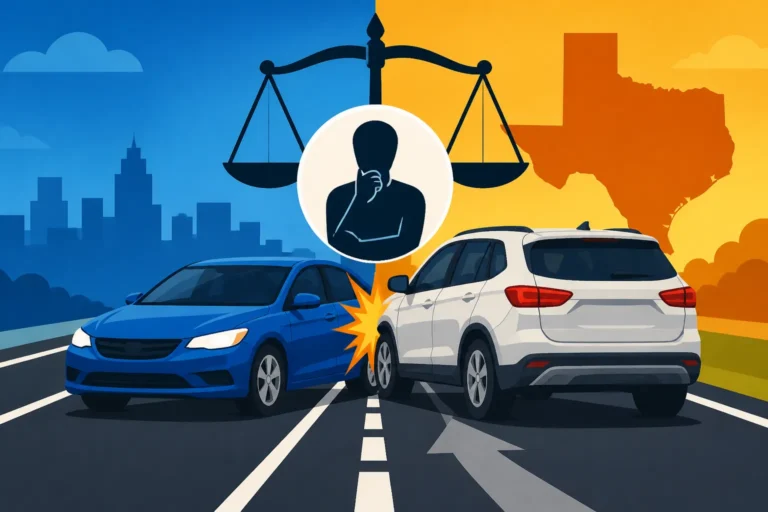
- 50% Bar Rule: In these states (like Texas, Colorado, and Wisconsin), you can recover damages if you are 50% or less at fault. If you are found to be 51% or more at fault, you cannot recover any compensation.
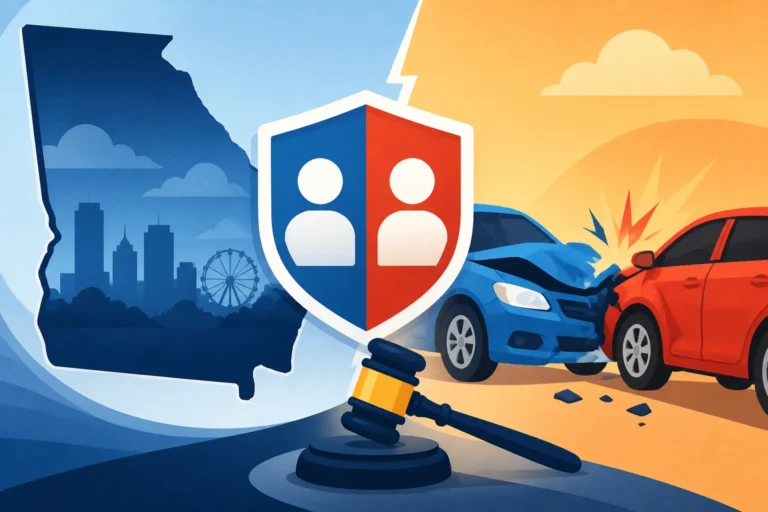
- 51% Bar Rule: In these states (like Georgia, Ohio, and Pennsylvania), you can recover damages if you are 51% or less at fault. If you are found to be 50% or less at fault, you cannot recover any compensation.
In modified comparative negligence states, the determination of proximate cause and the precise percentage of fault are even more critical. If you are found to be just over the threshold (e.g., 51% at fault in a 50% bar state), you walk away with nothing, even if the other driver was also negligent and their actions were a clear proximate cause of the accident. This makes proving the other driver's greater degree of fault, and ensuring your actions are not deemed the primary proximate cause, absolutely paramount. An entire case can hinge on whether your actions are deemed 49% versus 51% responsible, making expertise in Modified Comparative Negligence 50% vs 51% Bar vital.
Contributory Negligence States
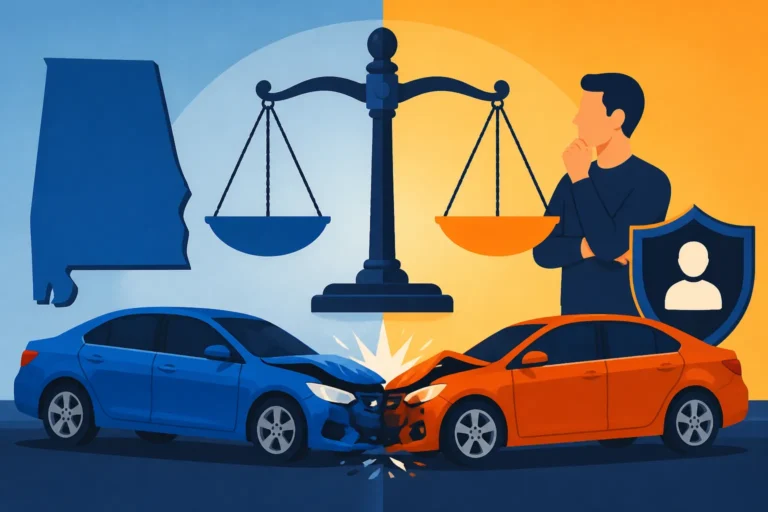
A small number of states, including Alabama, Maryland, North Carolina, and Virginia, still follow the "pure contributory negligence" rule. This is the harshest standard for plaintiffs. In these states, if you are found to be even 1% at fault for the accident – if your own negligence was a proximate cause, however minor, of your injuries – you are completely barred from recovering any damages from the other party. Even if the other driver was 99% at fault, your 1% contribution means you get nothing.
In a contributory negligence state, the defense will vigorously try to prove any degree of proximate cause on your part, no matter how small. For example, if you were hit by a drunk driver in Virginia, but it's discovered you had a minor crack in your windshield that slightly obstructed your vision, the defense might argue that this tiny impairment was a proximate cause of the accident, leading to a complete denial of your claim. This makes proving that the other driver's actions were the sole proximate cause, or that your actions were entirely blameless, incredibly challenging and crucial. Understanding Contributory Negligence States Where 1% Fault Bars Recovery is essential for anyone involved in an accident in these jurisdictions, as the stakes are incredibly high.
Disclaimer
Please remember that the information provided in this article is for general informational purposes only and does not constitute legal advice. Car accident laws, including those related to proximate cause and comparative negligence, vary significantly by state and can be complex. Every accident case is unique, and the outcome depends on specific facts and circumstances. You should always consult with a qualified attorney in your jurisdiction for advice regarding your individual situation. Relying solely on general information without professional legal guidance can be detrimental to your claim.