Comparative Negligence Laws in Kentucky
Getting into a car accident is disorienting enough, but imagine the added stress when you're not sure who's entirely to blame, or if you might even share some responsibility for the crash. It's a frustrating situation that leaves many people wondering if they'll be able to recover any damages at all if they contributed to the accident. This guide is here to clarify how comparative negligence laws in Kentucky specifically address this very common dilemma, helping you understand your rights and what to expect when pursuing a car accident claim.
Understanding Comparative Negligence in Car Accident Claims
When a car accident happens, one of the first and most critical questions that arises is, "Who is at fault in a car accident?" It sounds simple, but often, the answer isn't a straightforward 'yes' or 'no.' Sometimes, both drivers bear some responsibility for the collision. This is where the legal concept of comparative negligence comes into play, and it's a huge deal for your potential recovery. Instead of a winner-take-all approach, comparative negligence systems acknowledge that sometimes, more than one party's actions contribute to an unfortunate outcome.
What "Fault" Really Means
In the context of a car accident, "fault" isn't just about who physically hit whom. It's a legal determination of who acted negligently, meaning they failed to exercise reasonable care, and whose negligence directly caused the accident and subsequent injuries or damages. For example, if someone runs a red light and hits your car, they are clearly at fault. But what if you were speeding at the time, even if they ran the light? Or what if you both swerved unexpectedly into the same lane? These scenarios make fault determination far more complex.
Insurance companies and legal teams spend a lot of time poring over evidence – police reports, witness statements, photographs, even reconstruction analyses – to piece together exactly how a crash occurred and, more importantly, why. Every detail matters when determining how fault is determined in a car accident. This thorough investigation aims to assign a percentage of fault to each party involved, reflecting their contribution to the collision. This percentage is crucial because it directly impacts the amount of compensation an injured party can receive, especially in states that operate under some form of comparative negligence.
The Spectrum of Negligence Systems
Before we dive into Kentucky's specific approach, it's helpful to understand that not all states handle shared fault the same way. There's a spectrum of negligence systems across the U.S., each with different rules governing how partial fault affects a personal injury claim.
At one end, you have contributory negligence states. These are the harshest, stating that if you are found even 1% at fault for an accident, you are completely barred from recovering any damages from the other party. Imagine being hit by a distracted driver, but because you were going 5 mph over the speed limit, you get nothing. It's an all-or-nothing approach that can feel incredibly unfair, which is why most states have moved away from it. To learn more about this, you can read our guide on Comparative vs Contributory Negligence Explained.
Then, there are modified comparative negligence states. These are a bit more forgiving, allowing you to recover damages as long as your percentage of fault doesn't exceed a certain threshold, usually 50% or 51%. For instance, in a 50% bar state, if you're found 50% at fault, you can still recover 50% of your damages. But if you're found 51% at fault, you get nothing. The specific threshold varies, with some states using a 50% bar (meaning you can recover if you are 50% or less at fault), and others using a 51% bar (meaning you can recover if you are 51% or less at fault).
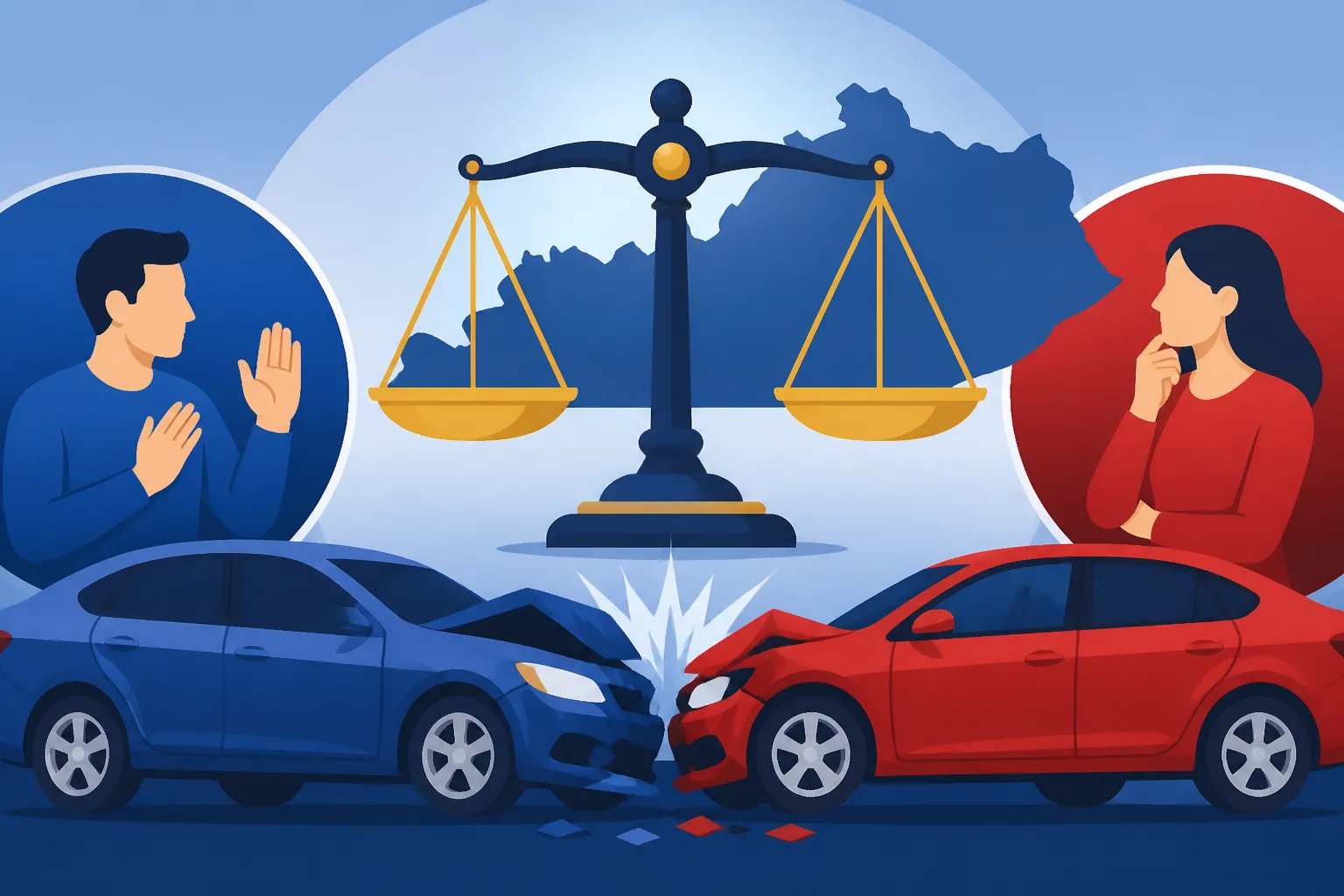
Finally, we arrive at pure comparative negligence states, which is where Kentucky stands. This system is the most lenient towards partially at-fault drivers, allowing them to recover damages regardless of their percentage of fault. This is the system that directly affects car accident claims in the Bluegrass State.
Kentucky's Pure Comparative Negligence System
Kentucky operates under a pure comparative negligence rule, which is excellent news if you find yourself in an accident where you might share some of the blame. This system is designed to ensure that everyone pays for the portion of damages they caused, no more and no less. It's a fair approach that recognizes the complexities of real-world accidents, where sometimes, both parties contribute to the unfortunate event.
How It Works in Practice
In Kentucky, the pure comparative negligence system means that you can still recover compensation for your injuries and damages even if you are significantly at fault for the accident. The crucial point, however, is that your compensation will be reduced by your assigned percentage of fault.
Let's break it down with a scenario. Imagine you're driving through Lexington, perhaps on Harrodsburg Road, and you decide to make a quick lane change without signaling properly. Another driver, who happens to be slightly speeding, doesn't react in time, and a collision occurs. After an investigation, the insurance adjusters or a jury determine that you were 70% at fault for the accident due to your improper lane change, but the other driver was 30% at fault for speeding.
Now, let's say your total damages, including medical bills, lost wages, and pain and suffering, come out to $100,000. Under Kentucky's pure comparative negligence, because you were 70% at fault, your recoverable damages would be reduced by 70%. This means you would be entitled to recover $30,000 (30% of $100,000) from the other driver's insurance. Conversely, if the other driver's damages were $50,000, they would only be able to recover $35,000 (70% of $50,000) from your insurance, since they were only 30% at fault from their perspective.
This system ensures that everyone is held accountable for their share of the blame, allowing those who are partially responsible to still receive some level of compensation for their losses. It’s a distinct difference from states where even minor fault can completely bar recovery. This can feel like a lifeline when you're thinking, "What happens if you're partially at fault?"
Impact on Your Car Accident Claim
The pure comparative negligence rule has a profound impact on how car accident claims are handled and how settlements are ultimately reached in Kentucky. When negotiating with insurance companies, the discussion will inevitably involve each party's degree of fault.
Insurance adjusters will always try to minimize the payout from their end, and if they can assign a higher percentage of fault to you, they will. They might point to factors like your driving behavior, whether you were distracted, or even the initial impact points to argue for your negligence. This is why having strong evidence and a clear understanding of the accident is vital. For more on this, check out our article on How Insurance Companies Determine Who Is at Fault.
This system also means that even if you believe you bear some fault, it doesn't automatically mean your claim is worthless. You still have a right to pursue damages for the portion of the accident that wasn't your fault. This encourages more claims to be pursued, as even drivers with significant, but not total, fault can recover something. It also makes settlement negotiations more nuanced, as both sides will present their arguments for fault percentages. The outcome will largely depend on the strength of the evidence and persuasive arguments from each side.
Proving Fault and Damages Under Kentucky Law
Navigating a car accident claim, especially one involving shared fault, requires meticulous attention to detail and a strategic approach to gathering evidence. Kentucky's pure comparative negligence system means that demonstrating the other driver's fault, and minimizing your own, directly translates to a higher potential settlement. It’s not just about proving they were negligent, but also carefully documenting all your damages to ensure you get full and fair compensation for the portion of the accident that wasn't your fault.
Gathering Evidence to Support Your Claim
The moment an accident happens, your actions can significantly influence the outcome of any future claim. The more detailed and comprehensive the evidence you collect, the better position you'll be in to prove the other driver's negligence and protect yourself from excessive fault assignment.
- Document the Scene Thoroughly: This includes taking numerous photos and videos of the accident scene from various angles, showing vehicle positions, road conditions, traffic signs, skid marks, and any debris. Capture damage to all vehicles involved.
- Obtain a Police Report: While a police report doesn't definitively determine fault, it provides an official account of the accident, often includes officer observations, diagrams, and sometimes even citations issued. This can be a critical piece of evidence in how to prove the other driver was at fault.
- Collect Witness Statements: If there were any bystanders who saw the accident unfold, get their contact information. Their impartial testimony can be incredibly valuable in corroborating your version of events.
- Medical Records: Seek medical attention immediately, even if you feel fine. Some injuries, like whiplash or concussions, have delayed injury symptoms after a car accident. Comprehensive medical records are crucial to proving the extent of your injuries and their direct link to the accident.
- Lost Wage Documentation: Keep detailed records of any time missed from work, including pay stubs, employment verification, and letters from your employer confirming lost earnings.
- Vehicle Damage Estimates: Obtain repair estimates from reputable body shops or, if your vehicle is totaled, documentation of its fair market value before the crash.
Remember, the goal is to build a clear, undeniable picture of what happened and how it has impacted you financially and physically. This detailed documentation will be the backbone of your claim, no matter how complex the fault assignment becomes. For a comprehensive guide, refer to What to Do After a Car Accident: Step-by-Step (2026).
The Role of Insurance Companies and Legal Counsel
Dealing with insurance companies after an accident, especially when fault is disputed, can be incredibly stressful. Their primary goal is to minimize payouts, and they are experts at finding ways to assign more blame to you. This is particularly true if you are in a pure comparative negligence state like Kentucky, where any percentage of fault assigned to you directly reduces their liability.
Insurance adjusters will call you, ask for recorded statements, and might even try to get you to admit fault. It's important to be careful about what you say. It's often beneficial to have legal representation before engaging in extensive conversations with the other party's insurance company. A personal injury lawyer understands Kentucky's specific negligence laws and can act as a buffer, protecting your rights and ensuring you don't inadvertently jeopardize your claim.
A skilled attorney can:
- Investigate the Accident: Independently gather evidence, potentially bringing in accident reconstructionists if necessary.
- Evaluate Your Damages: Accurately calculate all your economic (medical bills, lost wages, property damage) and non-economic damages (pain and suffering, emotional distress).
- Negotiate with Insurers: Present your case robustly, challenging lowball offers and advocating for the highest possible settlement based on the other driver's percentage of fault.
- Represent You in Court: If a fair settlement can't be reached, they can file a lawsuit and represent you throughout the litigation process.
Even if you believe your accident was minor, you might still benefit from consulting with an attorney. Should you get a lawyer for a minor car accident? Often, the answer is yes, as injuries or their long-term effects may not be immediately apparent, and the nuances of comparative negligence can be tricky to navigate alone.
Navigating Your Claim with Partial Fault
Being involved in an accident is tough, and realizing you might share some responsibility can add another layer of anxiety. But in Kentucky, the pure comparative negligence system is designed to provide recourse even when you're partly to blame. Understanding how this plays out in terms of compensation and what strategies you can employ is key to maximizing your recovery.
Expecting a Reduction in Compensation
The most direct consequence of Kentucky's pure comparative negligence rule is that any settlement or jury award you receive will be reduced by your percentage of fault. This is a fundamental concept that you must keep in mind throughout your car accident claim process. For example, if your total damages are $50,000, and you are found to be 20% at fault, you would only be eligible to receive $40,000. If you were 60% at fault, you would get $20,000. The mechanism is straightforward: your total damages minus your percentage of fault equals your recoverable compensation.
It’s a different experience than in states with modified comparative negligence, where exceeding a 50% or 51% fault threshold would mean you get nothing. In Kentucky, even if you are 90% at fault, you can still recover 10% of your total damages. This system truly embodies the principle that everyone should pay for their share of the damage, no more, no less. Therefore, when discussing potential settlement amounts, remember to factor in the potential for a fault reduction. Our article on how comparative fault reduces your settlement can give you more insights.
Strategies for Maximizing Your Recovery
Even with partial fault, there are proactive steps you can take to maximize your potential car accident settlement in Kentucky. It's about building the strongest possible case for the other driver's negligence and thoroughly documenting your own losses.
- Early and Thorough Medical Treatment: Don't delay seeing a doctor. Any gap in treatment can be used by the insurance company to argue that your injuries weren't severe or weren't caused by the accident. Follow all medical advice and attend every appointment. This documentation is crucial for proving the extent of your injuries and their impact on your life, which are key components of how much is my car accident settlement worth? (2026)
- Detailed Documentation of All Losses: Keep meticulous records of everything. This includes medical bills, prescription receipts, therapy invoices, travel expenses to medical appointments, lost income statements, and even receipts for household services you had to pay for because your injuries prevented you from performing them. The more evidence you have of your financial losses, the harder it is for insurance companies to dispute them.
- Avoid Admitting Fault: This is critical. After an accident, it’s natural to apologize or express concern. However, even a simple "I'm so sorry!" can be twisted into an admission of fault by insurance adjusters. Stick to the facts when speaking with anyone, including the police and other drivers. Do not offer opinions about who was responsible. Our article What Is an Admission of Fault (and How to Avoid It)? delves into this important topic.
- Understand Your Damages: Be aware of all the types of damages you can claim. This includes not only economic damages like medical bills and lost wages but also non-economic damages like pain and suffering, emotional distress, and loss of enjoyment of life. These can significantly increase your claim's value.
- Seek Legal Counsel: An experienced Kentucky personal injury attorney will understand the nuances of pure comparative negligence and how to best position your case. They can gather evidence, negotiate with insurance adjusters, and present a compelling argument for the highest possible percentage of fault on the other driver and the full extent of your damages. This significantly improves your chances of receiving fair compensation, even if you bear some of the blame. Can you still get paid if you're partly at fault? Yes, and a lawyer can help ensure it happens.
By being diligent and strategic, you can navigate Kentucky's comparative negligence laws effectively and secure the compensation you deserve, even if you were partially responsible for the collision.
Kentucky Comparative Negligence at a Glance
To help you quickly grasp the key aspects of comparative negligence in Kentucky, here’s a summary:
| Feature | Description |
|---|---|
| Type of System | Pure Comparative Negligence |
| Fault Threshold | None. You can recover damages even if you are largely (e.g., 99%) at fault. |
| Impact on Compensation | Your total damages will be reduced by your assigned percentage of fault. For example, if you are 20% at fault, you receive 80% of your total damages. |
| What to Do | Document everything (photos, police report, witnesses), seek immediate medical attention, keep all records (medical bills, lost wages), and avoid admitting fault. Consult with a personal injury attorney to navigate negotiations and maximize your claim. |
| Benefit | Ensures parties receive compensation proportional to the other driver's fault, even if they bear significant blame, unlike contributory or modified comparative negligence states where a certain level of fault can completely bar recovery. |
Disclaimer
Please remember that this article provides general information and should not be considered legal advice. Car accident claims are complex, and every case is unique. The laws surrounding negligence and personal injury can be intricate and subject to change. It is always recommended to consult with a qualified personal injury attorney in Kentucky to discuss the specifics of your situation and understand your legal rights and options.