Comparative Negligence Laws in Montana
Getting into a car accident is disorienting enough, but the stress really compounds when you're left wondering who's actually responsible and what that means for your ability to recover. Many people assume fault is a simple "he hit me, so it's his fault" situation, but the reality is often much more complex, especially when both drivers might share some blame. This guide will walk you through Montana's specific comparative negligence laws, helping you understand how shared fault can impact your car accident claim and what you can do to protect your rights.
Understanding Comparative Negligence in Car Accidents
When you're involved in a car accident, one of the first questions that comes up, often from frustrated insurance adjusters, is "who was at fault?" It's a question that can feel loaded, and honestly, it's rarely as straightforward as it seems in the heat of the moment. Many drivers feel a surge of panic, wondering if even a minor misstep on their part could completely derail their ability to get compensated for damages. This confusion about fault is a perfectly normal reaction, as the legal nuances can be quite tricky.
What "Fault" Really Means
In the context of a car accident, "fault" isn't just about who physically hit whom. It's about legal responsibility for causing the accident and the injuries or damages that resulted. Sometimes, it's clear-cut: one driver blatantly ran a red light, for instance. But often, multiple factors contribute to a collision, and the actions (or inactions) of more than one driver play a role. For example, imagine a driver making an illegal U-turn, but the other driver involved was also speeding significantly. While the U-turn was certainly a major contributing factor, the speeding could also be seen as increasing the severity of the crash, or even making it unavoidable despite the U-turn.
This idea of shared responsibility is fundamental to how fault is determined in many states. Insurance companies and courts look at the overall circumstances, traffic laws, and each driver's conduct to assign a percentage of blame. It's not about being "perfect" but about exercising reasonable care while driving. If you, as a driver, fail to exercise that reasonable care, you might be deemed partially at fault. This can be incredibly frustrating to hear, especially when you feel like the other person was clearly the main culprit. But understanding this broader definition of fault is the first step in navigating your claim effectively. For a deeper dive into this process, check out our guide on How Fault Is Determined in a Car Accident.
The Core Concept of Comparative Negligence
This brings us to the core concept of comparative negligence. This legal doctrine is essentially a way to fairly distribute financial responsibility when more than one party contributes to an accident. Instead of saying "one person is 100% at fault, the other is 0%," comparative negligence allows for a more nuanced assessment. It acknowledges that sometimes, things aren't black and white; they're shades of gray.
Historically, some states operated under a harsh rule called "contributory negligence." In those states, if you were found even 1% at fault for an accident, you were completely barred from recovering any damages, no matter how severe your injuries or how negligent the other driver was. Can you imagine the frustration of losing everything just because of a minor oversight on your part? Thankfully, most states, including Montana, have moved away from this rigid system and adopted some form of comparative negligence. This shift was largely due to the realization that contributory negligence was often unjust and left truly injured parties without recourse. For a comprehensive comparison, you might find our article on Comparative vs Contributory Negligence Explained very enlightening.
Under a comparative negligence system, your ability to recover compensation is directly tied to your assigned percentage of fault. If you're found partly at fault, your damages (the money you receive for medical bills, lost wages, pain and suffering, etc.) are reduced by your percentage of fault. This means if the total damages are $10,000 and you're found 20% at fault, you would only be able to recover $8,000. It's a system designed to be more equitable, ensuring that those who bear some responsibility for an accident still face a proportional reduction in their recovery, rather than being completely shut out.
Montana's Modified Comparative Negligence Law: The 51% Rule
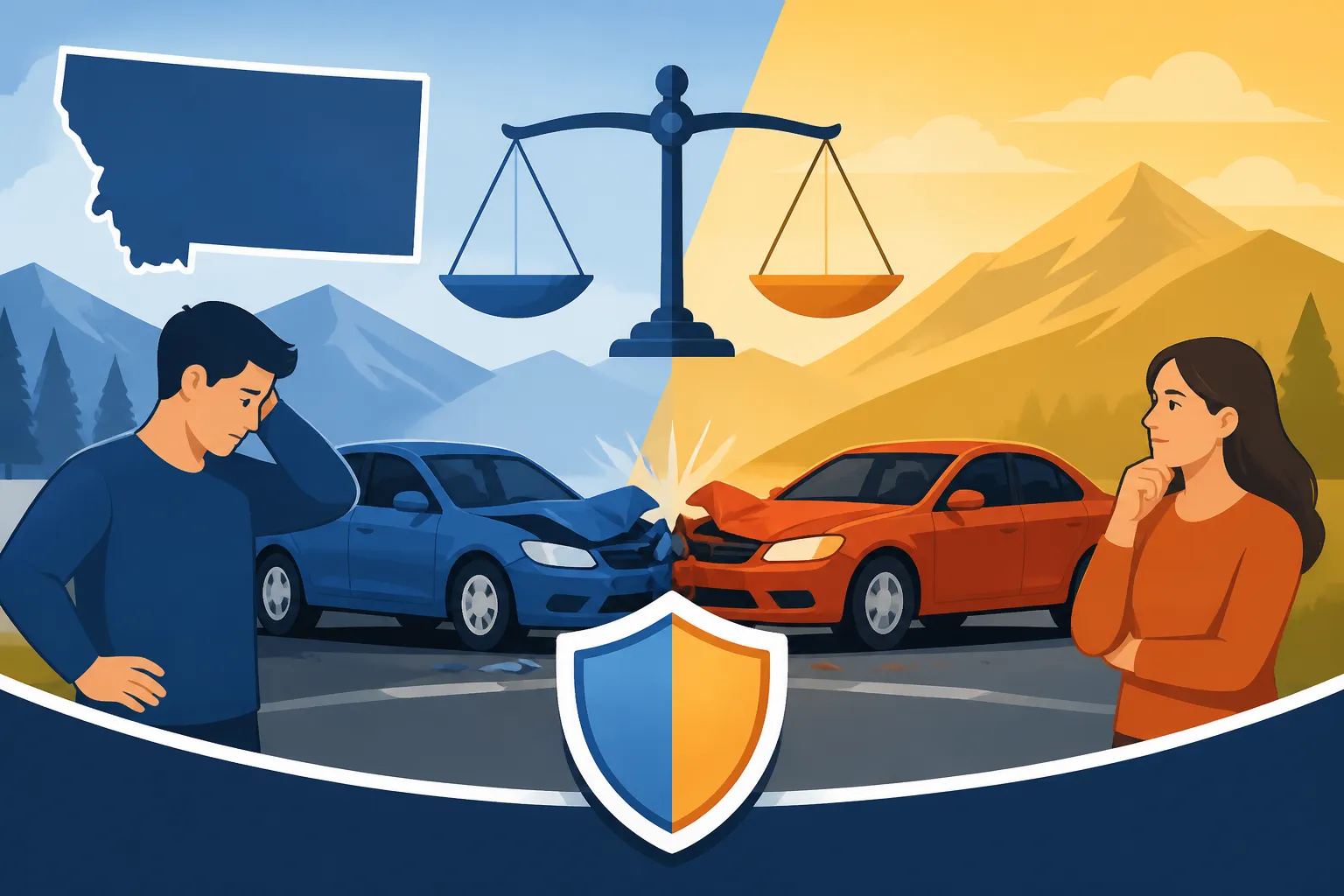
Now that we've covered the general idea of comparative negligence, let's zoom in on how it specifically plays out here in the Big Sky Country. Montana operates under a particular type of comparative negligence known as "modified comparative negligence" with a "51% bar" rule. This distinction is incredibly important and can significantly impact the outcome of your car accident claim. Many people assume that if they're "a little bit" at fault, they'll just get a little less money, but the 51% rule introduces a hard cutoff that you absolutely need to be aware of.
How Montana's Law Works
In Montana, if you are deemed 50% or less at fault for a car accident, you can still recover damages from the other responsible parties. However, your total compensation will be reduced by your assigned percentage of fault. This is the "comparative" part of the law.
Here's where the "51% bar" comes in: If you are found to be 51% or more at fault for the accident, you are completely barred from recovering any damages from the other driver. That means if the jury or the insurance company determines your fault level crosses that 50% threshold, your claim for compensation is effectively gone, regardless of how severe your injuries are or how much the other driver also contributed.
Let's illustrate this with a few clear examples, because seeing the numbers really helps solidify the concept:
-
Example A: You are 20% at fault.
- Suppose your total damages (medical bills, lost wages, pain and suffering, etc.) are determined to be $50,000.
- Since you are 20% at fault, your recoverable damages would be reduced by 20%.
- Calculation: $50,000 – (20% of $50,000) = $50,000 – $10,000 = $40,000.
- In this scenario, you would be able to recover $40,000.
-
Example B: You are 50% at fault.
- Let's use the same total damages of $50,000.
- If you are found 50% at fault, your recoverable damages would be reduced by 50%.
- Calculation: $50,000 – (50% of $50,000) = $50,000 – $25,000 = $25,000.
- Here, you could still recover $25,000. You're right on the edge, but you can still recover.
-
Example C: You are 51% at fault.
- Again, imagine your total damages are $50,000.
- If you are found 51% at fault, because you crossed the 50% threshold, you recover $0.
- This is the critical difference and why that 51% mark is so vital in Montana.
This "51% bar" can feel incredibly unfair if you find yourself just over the limit, even if the other driver was also highly negligent. It emphasizes why fighting for every percentage point of fault can be so important in your claim.
The Impact on Your Car Accident Claim
Understanding Montana's 51% rule isn't just an academic exercise; it has very real, practical implications for anyone pursuing a car accident claim. The moment an accident happens, the other driver's insurance company is going to start working to protect their bottom line. Knowing that if they can push your fault percentage to 51% or higher, they won't have to pay you anything, you can bet they'll try their hardest to do just that.
Insurance adjusters are skilled negotiators and investigators. They'll look for any detail, any statement, or any piece of evidence that could suggest you were more at fault than you believe. This could be anything from a slight deviation from the speed limit, a momentary lapse in attention, or even not having your headlights on at dusk. Their goal is to either reduce the amount they have to pay or, ideally for them, deny your claim entirely by arguing you were primarily responsible. This tactic can be incredibly intimidating and frustrating for individuals who are already dealing with injuries and vehicle damage.
Because of this, collecting solid evidence immediately after an accident is paramount. The more documentation you have to support your version of events and to demonstrate the other driver's negligence, the stronger your position will be. This evidence helps counter any attempts by the insurance company to inflate your share of the blame. Every piece of information, from photos of the scene to witness contact details, plays a role in clearly establishing fault. Our article, How Insurance Companies Determine Who Is at Fault, offers excellent insight into their process.
Proving Fault and Protecting Your Claim in Montana
Given Montana's 51% comparative negligence rule, proving the other driver was primarily at fault (meaning 50% or more) is absolutely critical to the success of your car accident claim. This isn't just about feeling "right"; it's about whether you'll recover any compensation at all. The moments immediately after an accident, and the steps you take in the days and weeks that follow, can make or break your case.
Gathering Evidence at the Scene and Beyond
The accident scene itself is often the most vital source of evidence, but its transient nature means you have a very narrow window to collect crucial information. When you're shaken up, injured, or simply don't know what to do, it's easy to overlook details. This is why having a plan, even a mental one, can be a huge advantage.
First and foremost, if you are able and it's safe to do so, document everything. Use your phone to take photos and videos from multiple angles. Get pictures of:
- The positions of both vehicles after the collision.
- Any visible damage to all vehicles involved.
- Skid marks on the road.
- Traffic signs, signals, or road conditions that might be relevant (e.g., obscured stop signs, potholes, ice).
- Any debris on the road.
- The surrounding area, including landmarks.
Beyond photos, gather contact and insurance information from all drivers involved. If there are any witnesses, get their names and phone numbers. Their unbiased account can be incredibly valuable in proving fault. Remember, in Montana, like any state, traffic laws are paramount. If the other driver violated a specific law—like running a red light in Missoula, making an illegal turn on Reserve Street, or failing to yield in downtown Bozeman—that violation can be strong evidence of their negligence.
It's also absolutely essential to call the police, even for seemingly minor accidents, especially if there are injuries or significant property damage. A police report, while not a definitive statement of fault, provides an official, third-party account of the accident, including diagrams, officer observations, and sometimes even citations issued. This report can carry significant weight with insurance companies and in court. You can learn more about its importance in our article on Police Reports and Car Accident Fault. For a comprehensive guide on what to do, refer to What to Do After a Car Accident: Step-by-Step (2027).
Dealing with Insurance Companies and Fault Disputes
Once the immediate aftermath of the accident subsides, you'll inevitably be dealing with insurance companies. And here's where the rubber meets the road with Montana's comparative negligence laws. The other driver's insurance adjuster's primary job is to pay out as little as possible. Knowing the 51% rule, they will likely try to find any way to assign a higher percentage of fault to you.
This is why your communication with them is so important. Never admit fault at the scene of an accident or when talking to insurance adjusters. Even an innocent-sounding apology like, "Oh gosh, I'm so sorry, I didn't see you there," can be twisted into an admission of fault later on. Stick to the facts. Provide only the information required by law, such as your contact and insurance details. If an adjuster presses you for a recorded statement, it's often best to consult with legal counsel before giving one. They might be trying to trick you into saying something that could undermine your claim. You can also explore our post on What Is an Admission of Fault (and How to Avoid It)? for more guidance.
If the insurance company tries to blame you unfairly, or assigns a fault percentage that you strongly disagree with, you have the right to dispute it. This is where your gathered evidence becomes invaluable. Your photos, witness statements, and police report can serve as powerful tools to challenge their assessment. Sometimes, it becomes a back-and-forth negotiation where each side presents their evidence and arguments to arrive at a mutually agreeable (or at least legally defensible) fault percentage. For advice on how to handle such situations, read What Happens If the Other Driver Blames You?. To understand how you can strengthen your position, our guide on How to Prove the Other Driver Was at Fault provides excellent strategies.
What Happens If You're Found Partially at Fault?
Even if you've done everything right and collected all the evidence, there's always a possibility that you'll be found partially at fault for an accident in Montana. This can be disheartening, but it's crucial to understand that it doesn't necessarily mean your claim is dead in the water, provided you stay below that critical 51% threshold.
Reduction in Damages
As we discussed with Montana's modified comparative negligence rule, if you are found 50% or less at fault, your damages will be reduced proportionally to your assigned fault. This applies to all categories of damages you might be seeking. This includes:
- Economic Damages: These are quantifiable financial losses such as medical bills (past and future), lost wages (from time off work), loss of earning capacity (if your injury prevents you from working at the same level in the future), property damage, and out-of-pocket expenses for things like transportation to medical appointments or necessary home modifications.
- Non-Economic Damages: These are more subjective losses that don't have a direct bill or invoice, but are very real. They include pain and suffering, emotional distress, loss of enjoyment of life, and disfigurement.
Let's revisit an example to clarify: Imagine you suffered significant injuries in a car accident in Billings, and your total damages, including economic and non-economic losses, are calculated to be $100,000. If an investigation or jury determines you were 30% at fault, your recoverable damages would be reduced by that percentage.
- Original total damages: $100,000
- Your fault percentage: 30%
- Reduction: $100,000 * 0.30 = $30,000
- Recoverable amount: $100,000 – $30,000 = $70,000
So, instead of receiving the full $100,000, you would receive $70,000. While a reduction is never ideal, it's certainly better than receiving nothing at all, which would be the case if your fault reached 51% or higher. Understanding How Comparative Fault Reduces Your Settlement and the difference between Economic vs Non-Economic Damages Explained can help you manage your expectations and strategize your claim.
The Role of Legal Representation
Navigating a car accident claim in a comparative negligence state like Montana, especially when fault is being disputed, can feel like trying to solve a puzzle with half the pieces missing. This is precisely why hiring an experienced car accident lawyer can be an invaluable asset. They bring expertise that most individuals simply don't possess, and their presence can significantly impact the outcome of your claim.
A good attorney understands the nuances of Montana's specific modified comparative negligence laws and how they apply to your unique situation. They can:
- Investigate thoroughly: They know what evidence to look for, how to collect it, and how to preserve it. This might involve commissioning accident reconstructionists, consulting with medical experts, or subpoenaing traffic camera footage from local municipalities like the City of Helena or Great Falls.
- Negotiate effectively: Lawyers are seasoned negotiators who can counter the tactics used by insurance adjusters. They can argue for a lower percentage of fault assigned to you, or persuasively present evidence that shifts more blame to the other party, ensuring you stay below that critical 51% bar.
- Handle complex legal procedures: If negotiations fail, and a lawsuit becomes necessary, your attorney will be prepared to navigate the court system, file the correct paperwork, meet deadlines, and represent your interests vigorously in front of a judge or jury.
For instance, if an insurance company is trying to pin 40% fault on you, a skilled lawyer might be able to argue it down to 20% or even 10% based on their investigation and understanding of legal precedents. This seemingly small shift in percentages can translate to thousands, or even tens of thousands, of dollars more in your pocket. Given the high stakes involved in crossing the 51% threshold, having a legal advocate in your corner can make all the difference. For more insight, consider reading Do You Need a Lawyer for a Car Accident? (2026) and When to Hire a Car Accident Lawyer.
Below is a table that summarizes how Montana's 51% Modified Comparative Negligence rule would apply to different scenarios:
| Your Percentage of Fault | Total Proven Damages | Damages Recoverable (%) | Amount You Can Recover |
|---|---|---|---|
| 0% | $50,000 | 100% | $50,000 |
| 10% | $50,000 | 90% | $45,000 |
| 25% | $50,000 | 75% | $37,500 |
| 40% | $50,000 | 60% | $30,000 |
| 50% | $50,000 | 50% | $25,000 |
| 51% | $50,000 | 0% | $0 |
| 75% | $50,000 | 0% | $0 |
Disclaimer
Please remember that this information is intended for educational purposes only and does not constitute legal advice. Car accident claims are complex, and the specific facts of your situation will determine the best course of action. It is highly recommended to consult with a qualified personal injury attorney in Montana to discuss your particular case.