Comparative Negligence Laws in Ohio
Getting into a car accident is disorienting enough, but the stress often compounds when you realize that fault isn't always a simple, black-and-white issue. Many drivers find themselves in situations where both parties might bear some responsibility for a collision, leaving them wondering how on earth their personal injury claim or property damage will be handled. This guide is here to walk you through Ohio's specific laws regarding shared fault, known as comparative negligence, and explain exactly how it impacts your ability to recover compensation after a car crash.
Understanding Comparative Negligence in Car Accidents
When two cars collide, it's rarely just one person's doing. Maybe one driver was speeding, but the other changed lanes without signaling. Or perhaps someone ran a stop sign, but the other driver was distracted by their phone. In these scenarios, assigning 100% of the blame to a single individual just doesn't feel right, and the law agrees. That's where the concept of comparative negligence comes into play, aiming to create a fairer system for distributing responsibility and damages.
What Is Comparative Negligence?
At its core, comparative negligence is a legal principle that allows an injured party to recover damages even if they were partly at fault for the accident. Instead of a strict "all or nothing" approach, it acknowledges that multiple factors and individuals can contribute to a single incident. Most states, including Ohio, have moved away from the older, harsher rule called "contributory negligence," which completely barred a plaintiff from recovering any damages if they were found even 1% at fault. Can you imagine the frustration of having significant injuries but getting nothing because a jury decided you were just a tiny bit careless? Thankfully, comparative negligence offers a much more reasonable path forward for accident victims. It's about proportioning blame and, consequently, proportioning compensation. To understand the broader landscape of how fault is assigned, you might want to read our comprehensive guide on Who Is at Fault in a Car Accident? Complete Guide (2026).
Different Types of Comparative Negligence
While the general idea of comparative negligence is widespread, states apply it in a few different ways, each with its own nuances that can significantly affect your claim. Understanding these distinctions is crucial, especially when you're trying to figure out your rights after an accident.
First, there's pure comparative negligence. In states that follow this rule, you can recover damages no matter how much fault you bear, even if you are 99% responsible for the accident. Your compensation would simply be reduced by your percentage of fault. So, if you caused 90% of a $100,000 accident, you could still recover $10,000. While this might sound incredibly lenient, the logic is that you should still be compensated for the portion of the damages not caused by your own actions.
Then, there's modified comparative negligence, which is the system Ohio uses. This approach sets a specific threshold for fault. If your assigned percentage of fault reaches or exceeds that threshold, you are completely barred from recovering any damages. If your fault is below that threshold, your damages are reduced proportionally. There are two main versions of modified comparative negligence:
- The 50% Bar Rule: In these states, if you are found 50% or more at fault, you cannot recover. If you are 49% or less at fault, you can recover reduced damages.
- The 51% Bar Rule: This is the one that directly applies to car accident claims in Ohio. Here, if you are found 51% or more at fault, you recover nothing. If your fault is 50% or less, you can still recover, but your award will be reduced by your percentage of fault. We'll dive much deeper into this specific rule for Ohio in the next section, but it's important to recognize that this seemingly small difference from the 50% rule can have massive implications for accident victims.
Ohio's Modified Comparative Negligence Rule Explained
For anyone involved in a car accident within the Buckeye State, understanding Ohio's specific application of comparative negligence is paramount. This isn't just legal jargon; it directly affects your ability to get compensation for your injuries and property damage.
The 51% Bar Rule in Ohio
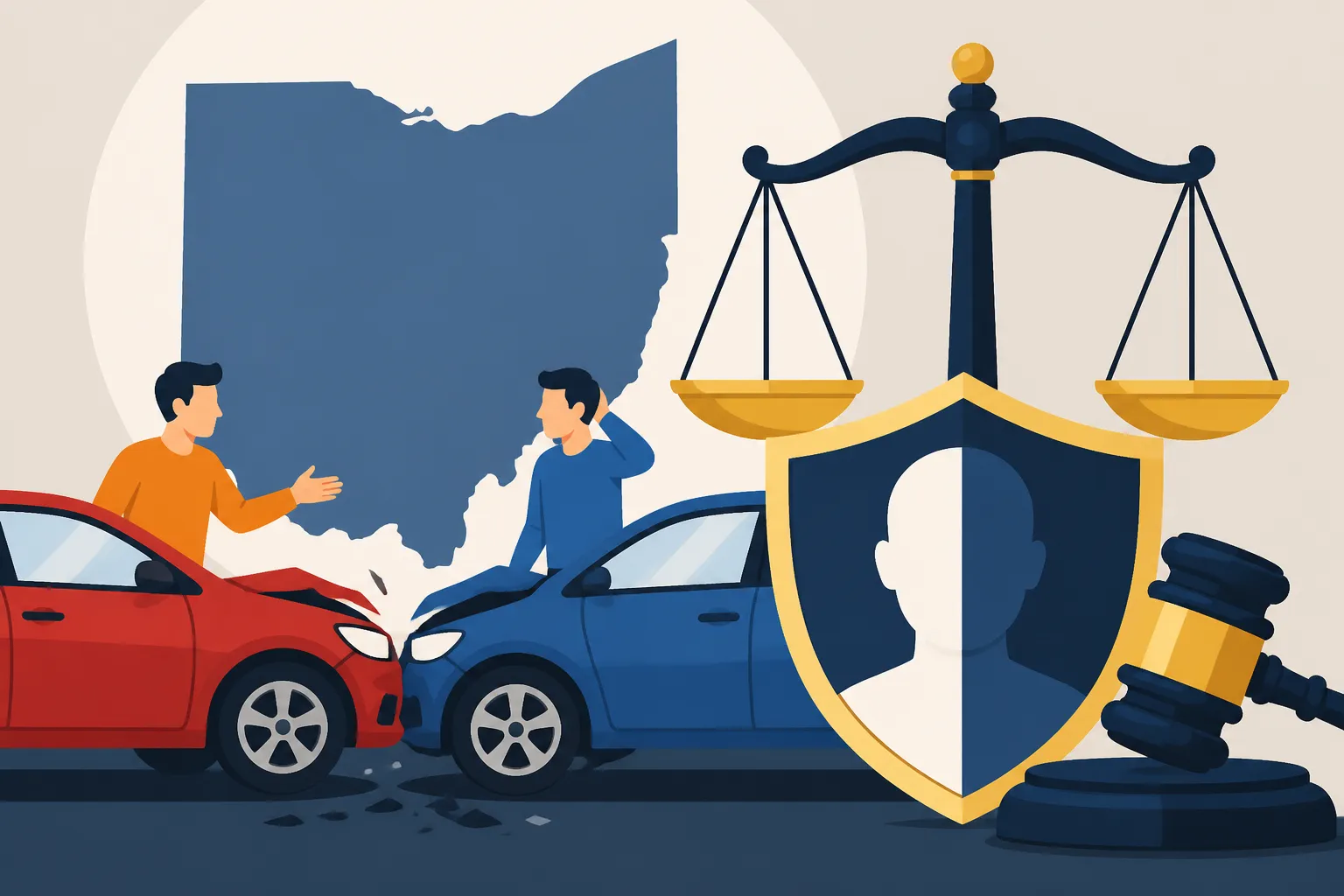
Ohio operates under a modified comparative negligence standard with a 51% bar. What does this truly mean for you after a car crash? Simply put, if you are deemed 51% or more responsible for causing the accident, you will be completely barred from recovering any damages from the other driver or their insurance company. Your claim, in that scenario, effectively goes to zero.
However, if your share of fault is determined to be 50% or less, you can still pursue a claim for damages. The catch? Your total compensation will be reduced by your assigned percentage of fault. Let's look at a concrete example to make this clearer:
Imagine you're involved in a car accident in Cleveland. Your total damages, including medical bills, lost wages, and pain and suffering, come out to $50,000. During the investigation by the insurance companies or, if necessary, in court, it's determined that you were 25% at fault for the collision (perhaps you were slightly speeding). Under Ohio's 51% bar rule, since your fault is 25% (which is 50% or less), you can still recover. Your $50,000 in damages would be reduced by 25%, meaning you would receive $37,500.
Now, consider a different scenario. Let's say the same accident happened, but the investigation concludes you were 60% at fault because you ran a red light, even though the other driver was also 40% at fault for not paying full attention. In this case, because your fault percentage (60%) crosses the 51% bar, you would recover absolutely nothing from the other driver. This is a critical distinction that emphasizes why fighting for a lower fault percentage can be so important in Ohio. Our article on Modified Comparative Negligence (50% vs 51% Bar) delves deeper into the intricacies of these thresholds.
How Fault Is Determined in Ohio Accidents
The big question, then, is who determines this percentage of fault, and how? It's not usually a snap decision made at the scene of the accident. Determining fault is often a complex process involving several parties and various pieces of evidence.
Initially, after an accident, law enforcement officers from the Ohio State Highway Patrol or local police departments like the Cincinnati Police Department or Columbus Division of Police might respond to the scene. They will investigate, interview drivers and witnesses, and document their findings in a police report. While a police report is a valuable piece of evidence, it doesn't always definitively assign fault in a way that is binding on insurance companies or courts. It provides an officer's opinion and factual observations. You can learn more about the role of police reports in our piece on Police Reports and Car Accident Fault.
After the initial scene investigation, the insurance companies for both drivers will launch their own investigations. Their adjusters will gather evidence, including:
- Police reports: As mentioned, these provide a starting point.
- Photographs and videos: Images of vehicle damage, the accident scene, road conditions, and traffic signals can be incredibly telling.
- Witness statements: Independent witnesses can offer unbiased accounts of what happened.
- Driver statements: Your own statement, and that of the other driver, will be taken (though it's crucial to be cautious about what you say, as we'll discuss later).
- Vehicle damage reports: Auto body shops or inspectors will assess the damage to each vehicle, which can sometimes indicate the angle and force of impact.
- Accident reconstruction: In more serious or complex cases, experts might be brought in to analyze the physics of the crash and reconstruct how it occurred.
- Traffic laws: Violations of Ohio Revised Code traffic laws (like speeding, failure to yield, distracted driving, or drunk driving) are strong indicators of fault.
Ultimately, the insurance adjusters will analyze all this information to assign a percentage of fault to each driver. If they can't agree, or if you dispute their findings, the fault determination could eventually fall to a jury in a personal injury lawsuit. Understanding How Fault Is Determined in a Car Accident is key to protecting your rights.
How Comparative Negligence Affects Your Car Accident Claim in Ohio
The practical impact of Ohio's comparative negligence laws on your car accident claim cannot be overstated. It directly influences how much money you might receive, and sometimes, whether you receive anything at all.
Impact on Your Potential Settlement
Let's say you've been in an accident near Dayton, and you've incurred significant expenses and suffered injuries. You've gone through treatment, and now you're trying to figure out what your settlement might look like. This is where comparative negligence bites. If the insurance company, or later a court, assigns you even a small percentage of fault, it directly reduces your potential settlement.
Consider this: your car is totaled, you have $15,000 in medical bills, you missed $5,000 in work, and your pain and suffering are valued at $30,000. Your total damages would be $50,000.
- If you are found 10% at fault, your $50,000 settlement is reduced by 10% ($5,000), meaning you walk away with $45,000.
- If you are found 30% at fault, your $50,000 settlement is reduced by 30% ($15,000), leaving you with $35,000.
- If you are found 50% at fault, your $50,000 settlement is reduced by 50% ($25,000), so you get $25,000.
As you can see, every percentage point of fault assigned to you can lead to a substantial decrease in the money you receive. This also highlights why the other driver's insurance company will often go to great lengths to assign you a higher percentage of fault, even if it seems unfair. They know that by increasing your fault, they decrease their payout. This phenomenon is often discussed in detail in guides such as What Happens If the Other Driver Blames You?. It’s a negotiation tactic, and you need to be prepared for it. Our article on How Comparative Fault Reduces Your Settlement provides a deeper dive into the financial implications.
Here's a quick summary table illustrating how different fault percentages can affect a hypothetical $100,000 claim in Ohio:
| Your Percentage of Fault | Percentage of Damages Recoverable | Total Recoverable from $100,000 Claim |
|---|---|---|
| 0% | 100% | $100,000 |
| 10% | 90% | $90,000 |
| 25% | 75% | $75,000 |
| 50% | 50% | $50,000 |
| 51% | 0% | $0 (Claim Barred) |
| 75% | 0% | $0 (Claim Barred) |
When You Can't Recover Damages
The most severe impact of Ohio's comparative negligence law occurs when your fault crosses that crucial 51% threshold. If you are determined to be 51% or more at fault for the accident, you are legally barred from recovering any compensation from the other driver, no matter how severe your injuries or how extensive your property damage. This rule can feel incredibly harsh, especially if you acknowledge some fault but believe the other driver was primarily responsible.
For example, if you were making an illegal U-turn on a busy street in Akron and another driver, who was slightly over the speed limit, hit you, a jury might decide you were 70% at fault for the U-turn, and the other driver 30% for speeding. In this scenario, despite the other driver's speeding, your 70% fault would mean you recover nothing. This is precisely why early and thorough investigation of the accident, evidence collection, and careful communication with insurance adjusters are so critical in Ohio. If you find yourself in a situation where you believe you might be partially at fault, understanding What Happens If You're Partially at Fault? can provide further clarity.
Navigating a Claim Under Ohio's Comparative Negligence Laws
Knowing Ohio's 51% bar rule is one thing, but actually navigating the aftermath of a car accident to protect your claim is another. It requires diligence, careful decision-making, and often, professional guidance.
Steps to Protect Your Claim
Immediately after an accident, the chaos and shock can make clear thinking difficult. However, the actions you take (or don't take) in the moments, days, and weeks following a collision can profoundly affect your ability to recover damages under Ohio's comparative negligence laws.
- Prioritize Safety and Medical Attention: Your health comes first. Even if you feel fine, some serious injuries, like whiplash or concussions, can have delayed symptoms. Seek medical attention promptly. This not only ensures your well-being but also creates an official record of your injuries, which is vital for any claim.
- Document Everything at the Scene: If you're able, take photos and videos of the accident scene from various angles. Capture vehicle damage, road conditions, traffic signs, skid marks, and any relevant debris. Get contact information for any witnesses. This evidence can be invaluable in proving the other driver's fault and minimizing your own. Our guide on How to Document a Car Accident Scene offers comprehensive advice.
- Report the Accident: File a police report, even for minor accidents, if required by Ohio law or if there are injuries or significant property damage. A formal report documents the incident and the initial findings.
- Be Cautious with Statements: When speaking with the other driver's insurance company, be factual and avoid speculating about fault or minimizing your injuries. Do not give a recorded statement without legal advice. Anything you say can be used to try and increase your percentage of fault. For more on this, check out What Is an Admission of Fault (and How to Avoid It)?.
- Gather Records: Keep meticulous records of all medical appointments, treatments, prescriptions, mileage to and from appointments, lost wages, and any other accident-related expenses.
- Consider Legal Counsel: Given the complexities of Ohio's comparative negligence laws and the aggressive tactics insurance companies often employ, consulting with an experienced Ohio car accident lawyer can be one of the best steps you take. They can help you understand your rights, gather evidence, negotiate with insurance companies, and protect you from unfair fault assignments. To learn if this step is right for you, read Do You Need a Lawyer for a Car Accident? (2026).
Dealing with Insurance Companies and Fault Disputes
Dealing with insurance companies after an accident, especially when fault is a question mark, can feel like you're entering a wrestling match without any training. Remember, the other driver's insurance company's primary goal is to pay out as little as possible, and one of their most effective tools is to assign you a higher percentage of fault.
Insurance adjusters are professionals at this. They might interpret evidence in a way that shifts blame, or they might ask leading questions designed to elicit statements that could be used against you. They understand How Insurance Companies Determine Who Is at Fault and will leverage every bit of information to their advantage.
If the insurance company assigns you a fault percentage that you believe is unfair, you absolutely have the right to dispute it. This is where the evidence you've diligently collected becomes your strongest ally. Your photos, witness statements, and medical records can all support your argument that the other driver bore more responsibility.
Negotiating with insurance companies can be a prolonged and frustrating process. They might offer a lowball settlement based on their fault assessment, hoping you'll accept it quickly to avoid further hassle. An attorney can be invaluable in this stage, acting as your advocate and negotiating on your behalf. They understand the nuances of Ohio law and can effectively challenge unfair fault assignments, potentially improving your outcome significantly. The path to a fair settlement, and understanding How Much Is My Car Accident Settlement Worth? (2026), often hinges on effectively managing these fault disputes. If you're ready to learn more about starting this process, our article on How to File a Car Accident Insurance Claim is a great resource.
Disclaimer
Please note that this article provides general information about comparative negligence laws in Ohio and should not be considered legal advice. Every car accident case is unique, and the outcome depends on specific facts and circumstances. If you have been involved in a car accident, it is strongly recommended that you consult with a qualified Ohio personal injury attorney to discuss your individual situation and legal options.