Comparative Negligence Laws in Pennsylvania
Navigating the aftermath of a car accident is already a dizzying experience, filled with stress about vehicle repairs, medical appointments, and endless paperwork. But then comes the added layer of who's actually responsible for the crash, and how that decision impacts your ability to recover compensation. If you've been in an accident in the Keystone State, understanding Pennsylvania's comparative negligence laws is absolutely critical, as they dictate whether you can collect damages and how much. This guide will meticulously break down these rules, helping you understand your rights and what to expect when it comes to fault in a car accident claim.
Understanding Comparative Negligence in Car Accidents
When two vehicles collide, it's rarely a clear-cut case where one driver is 100% at fault and the other is completely blameless. Life, and the road, are far more nuanced than that. Often, both drivers might have contributed in some way, however small, to the accident. This is where the legal concept of negligence comes into play, and specifically, "comparative negligence." It's a system designed to allocate responsibility when more than one party shares some blame for an incident.
The Core Concept of Comparative Negligence
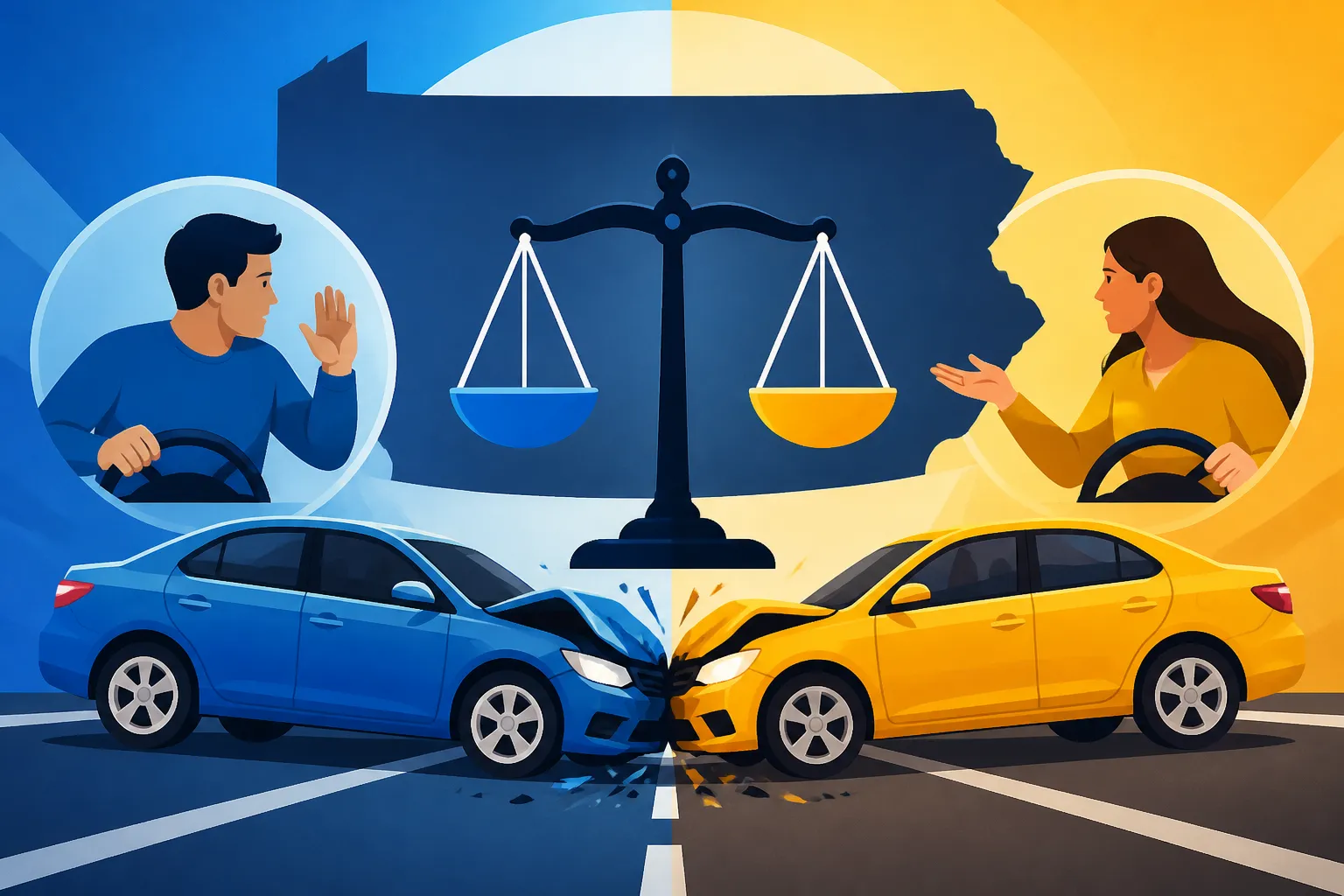
At its heart, comparative negligence acknowledges that fault can be shared. Instead of a black-and-white "all or nothing" approach, it allows courts and insurance companies to assign a percentage of fault to each party involved. Imagine a scenario where Driver A was speeding, but Driver B made an illegal turn. A jury might decide that Driver B was 70% responsible for the collision, while Driver A's speeding contributed 30% to the severity of the impact. This percentage-based system is crucial because it directly influences the amount of compensation an injured party can receive.
This system aims for fairness, attempting to ensure that an injured person isn't completely barred from recovering damages just because they had a minor role in causing the accident. It's a direct contrast to older, harsher legal doctrines that could leave an injured person with zero compensation if they were found even 1% at fault. If you're wondering about the foundational principles, it's worth exploring Comparative vs Contributory Negligence Explained to grasp the historical context and the reasoning behind these different legal frameworks.
Moving Beyond Contributory Negligence
For many years, some states operated under a strict "contributory negligence" rule. Under this doctrine, if an injured party was found to be even slightly at fault—say, 1% responsible—they would be completely barred from recovering any damages from the other party, no matter how negligent the other driver was. This often led to incredibly unfair outcomes, where a person with severe injuries could receive nothing because of a minor misstep on their part. It's a frustrating thought, isn't it? To be severely injured and then told you're completely out of luck because you contributed ever so slightly.
Thankfully, most states have moved away from this rigid system. Comparative negligence was introduced as a more equitable solution. There are generally two types of comparative negligence: "pure" and "modified." Pure comparative negligence allows an injured party to recover damages even if they are largely at fault (e.g., 90% at fault), with their compensation simply reduced by their fault percentage. Modified comparative negligence, which Pennsylvania follows, adds a critical threshold. Understanding this distinction is vital for anyone involved in an accident claim, especially when considering What Happens If You're Partially at Fault?.
Pennsylvania's Modified Comparative Negligence Rule (51% Bar)
Now, let's zero in on Pennsylvania. The Commonwealth operates under a specific version of comparative negligence known as "modified comparative negligence." This isn't just a fancy legal term; it's a rule with very real and significant consequences for your car accident claim. Many people find this particular threshold confusing, so let's break it down thoroughly.
The Crucial 51% Threshold
In Pennsylvania, you can recover damages for your injuries and losses even if you are partially at fault for the accident, as long as your percentage of fault does not equal or exceed 51%. This is often referred to as the "51% bar" rule. What does that mean in practical terms? It means if a jury, or the insurance adjusters, determine you were 50% at fault or less, you can still seek compensation from the other driver. However, the amount you receive will be reduced by your percentage of fault.
For example, if you sustained $100,000 in damages (medical bills, lost wages, pain and suffering), and you were found to be 20% at fault, your recoverable damages would be reduced by 20%. You would then be able to collect $80,000. This system allows for recovery while still holding you accountable for your portion of the negligence. It’s a delicate balance that aims to compensate injured parties fairly without absolving them completely of responsibility. Many people worry about What Does 50/50 Fault Mean for Your Claim?, and in Pennsylvania, 50% fault still allows for recovery.
What Happens if You're 51% at Fault or More?
This is where the "51% bar" truly comes into play and can be a source of immense frustration for accident victims. If you are found to be 51% or more responsible for the accident, Pennsylvania law states that you are completely barred from recovering any damages from the other party. It's an all-or-nothing situation once you cross that critical 50% line. So, if your damages are $100,000 and you're deemed 51% at fault, you get nothing from the other driver's insurance.
This can feel incredibly harsh, especially if you were still significantly injured due to the other driver's actions. It's a stark contrast to states with "pure" comparative negligence, where even 99% fault wouldn't completely shut down your claim. The 51% threshold places a heavy emphasis on arguing and proving the other driver's greater negligence. This is why gathering strong evidence and understanding How to Prove the Other Driver Was at Fault becomes paramount in any Pennsylvania car accident claim. Insurance companies in Pennsylvania are acutely aware of this threshold and will often try to push your fault percentage higher to avoid paying out any compensation.
How Your Fault Percentage Affects Your Claim in Pennsylvania
The assigned percentage of fault isn't just a number on a piece of paper; it's the lynchpin that determines the financial outcome of your car accident claim in Pennsylvania. Every dollar you might be entitled to can be impacted by this figure, making it a central point of contention in many cases.
Reducing Your Recoverable Damages
Let's expand on how this reduction works. Say you were in a multi-car pileup on the Schuylkill Expressway near Philadelphia, and you suffered severe injuries requiring extensive medical treatment. Your total damages, including medical bills, lost wages, pain and suffering, and property damage, might amount to $250,000. If an investigation, through police reports, witness statements, and expert analysis, determines you were 30% at fault for the chain reaction, your maximum recoverable damages from the other at-fault parties would be reduced by 30%. This means you could potentially recover $175,000 (70% of $250,000).
This reduction applies across all categories of damages – both economic (like medical bills and lost wages) and non-economic (like pain and suffering). Understanding this mathematical reality upfront can help manage expectations, although it certainly doesn't make the reduction any less disappointing if you truly believe the other driver was primarily to blame. This system is designed to directly link your financial recovery to your level of responsibility, as detailed in How Comparative Fault Reduces Your Settlement.
Here's a simplified table illustrating how different fault percentages can impact a hypothetical $100,000 total damages claim in Pennsylvania:
| Your Percentage of Fault | Other Driver's Percentage of Fault | Recoverable Damages (from other driver) | Outcome |
|---|---|---|---|
| 0% | 100% | $100,000 | Full Recovery |
| 10% | 90% | $90,000 (10% reduction) | Partial Recovery |
| 25% | 75% | $75,000 (25% reduction) | Partial Recovery |
| 40% | 60% | $60,000 (40% reduction) | Partial Recovery |
| 50% | 50% | $50,000 (50% reduction) | Partial Recovery |
| 51% | 49% | $0 | No Recovery |
| 75% | 25% | $0 | No Recovery |
The Role of Insurance Companies in Assigning Fault
This is where things can get particularly stressful. You've just been in an accident, your car is damaged, and you might be injured. The last thing you want is an insurance adjuster from the other side trying to pin more blame on you. Unfortunately, that's often exactly what happens. Insurance companies have a vested interest in minimizing their payouts, and one of the most effective ways to do that in a modified comparative negligence state like Pennsylvania is to argue that you were 51% or more at fault.
They will meticulously review police reports, witness statements, vehicle damage, and even your medical records, looking for anything that suggests you contributed to the accident. They might interpret a slight hesitation on your part, a minor traffic infraction, or even your statement at the scene as evidence of your negligence. It's a common tactic to attempt to shift blame, and it highlights why it's so important to be careful with what you say to adjusters and to have a clear understanding of How Insurance Companies Determine Who Is at Fault. They are not on your side; their priority is their bottom line.
Proving Fault and Challenging Allegations in Pennsylvania
Given the strict "51% bar" in Pennsylvania, establishing the other driver's fault and minimizing your own becomes a strategic imperative. This isn't just about telling your side of the story; it's about building a robust case with undeniable evidence.
Gathering Crucial Evidence at the Scene and Beyond
The moments immediately following an accident are chaotic, but what you do (or don't do) can profoundly impact your claim down the line. First and foremost, if you're able, thoroughly document the accident scene. This means taking plenty of photos and videos from various angles – show vehicle positions, damage, road conditions, traffic signs, and any skid marks. Get contact information for any witnesses, as their unbiased accounts can be invaluable. It's also critical to call the police, even for seemingly minor accidents, to get an official police report. This document often provides an initial assessment of fault and can carry significant weight. For a comprehensive guide, refer to What to Do After a Car Accident: Step-by-Step (2027).
Beyond the scene, your medical records are paramount. Seeing a doctor immediately after an accident, even if you feel fine, can create a paper trail linking your injuries directly to the incident. Delayed symptoms are common, but delaying medical care can give the insurance company an opening to argue your injuries weren't caused by the crash. Keep detailed records of all your medical appointments, treatments, prescriptions, and any out-of-pocket expenses. This evidence forms the basis of your damages claim and helps prove the extent of the other driver's negligence.
Contesting Unfair Fault Assignments
It's common for an insurance company, particularly the at-fault driver's insurer, to try and shift some or all of the blame onto you. They might argue you were speeding, distracted, or simply didn't react quickly enough. When this happens, it's incredibly frustrating, and it's essential to know you have the right to challenge their assessment. This is not the time to back down. One of the most common frustrations drivers face is being blamed when they feel they were not at fault, a situation explored in What Happens If the Other Driver Blames You?.
Your best bet for challenging these allegations is to present strong counter-evidence. This could involve witness statements that contradict the insurance company's narrative, traffic camera footage, dashcam recordings, or even accident reconstruction expert analysis. If the insurance company is using the police report to assign fault unfairly, remember that police officers don't always have the full picture, and their reports can sometimes be challenged. This is where having a knowledgeable advocate on your side, like an experienced car accident lawyer, becomes invaluable. They can review all the evidence, negotiate with the insurance company, and, if necessary, prepare your case for litigation to fight for a fair fault determination. It may even be worth reading Do You Need a Lawyer for a Car Accident? (2026) to understand the benefits of professional legal guidance.
Disclaimer
Please remember that this information is for educational purposes only and does not constitute legal advice. Car accident claims and negligence laws are complex and vary based on specific circumstances. It is always recommended to consult with a qualified legal professional to discuss your individual situation and rights.