Common Injuries From an Intersection Accident
Being involved in a car accident at an intersection is a uniquely jarring and terrifying experience. One moment you're driving along, perhaps thinking about your day, and the next, a sudden impact throws your world into chaos. The fear isn't just about the crumpled metal of your vehicle; it's the immediate, sickening worry about your body and the well-being of anyone else in the car. This guide will walk you through the most common types of injuries sustained in intersection accidents, helping you understand what to look for and why prompt medical attention is absolutely critical.
The Mechanics of Intersection Accidents and Injury Risk
Intersection accidents are particularly nasty because they often involve vehicles colliding at angles, leading to impacts that can transmit immense force throughout the vehicles and their occupants. Unlike a simple fender bender on the highway, intersection crashes frequently come from the side or are head-on, producing different kinds of forces that affect the body in specific ways. Understanding the physics of these crashes can help you anticipate the types of injuries that might arise.
T-Bone and Sideswipe Collisions
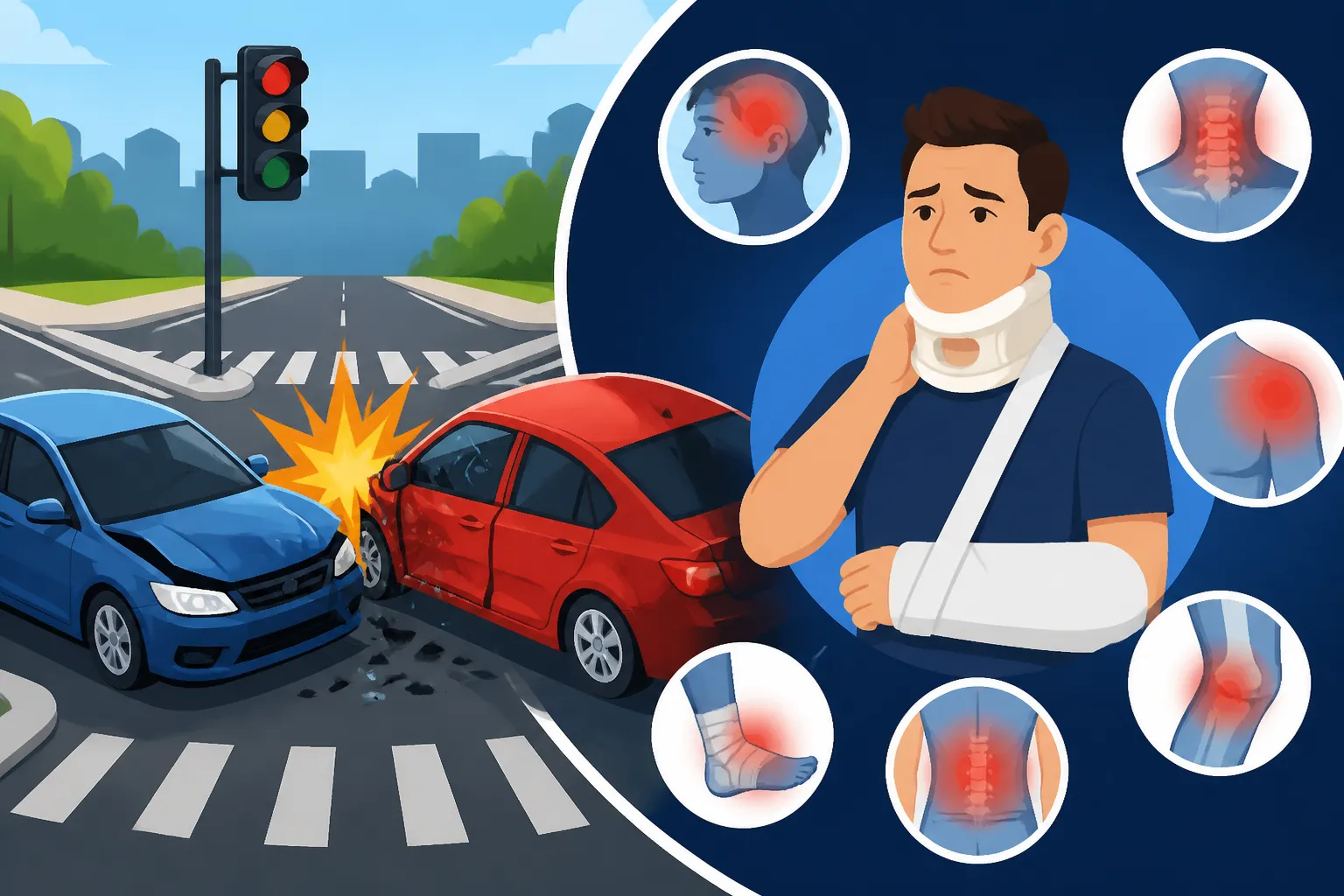
When we talk about intersection accidents, the classic "T-bone" collision is often the first thing that comes to mind. This happens when the front of one vehicle crashes into the side of another, forming a "T" shape. These impacts are notoriously dangerous because the side of a vehicle offers less protection than the front or rear, meaning the occupants on the side of impact are much more vulnerable to direct force. A sideswipe accident, where two vehicles scrape along each other's sides, might seem less severe but can still cause significant rotational forces and jolts.
The forces involved in a T-bone or sideswipe crash are typically lateral, pushing the occupants violently from side to side. Imagine you're sitting in the driver's seat, and another car slams into your driver's side door. Your body will be flung towards the passenger side, potentially hitting the console, the passenger, or even the passenger door. Even with modern airbags, which might deploy from the side (curtain airbags), the initial impact and sudden change in momentum can cause a cascade of injuries. The seatbelt, while critical for safety, can also cause bruising or internal injuries as it restrains your body against such extreme forces.
Consider a scenario in a busy intersection in downtown Los Angeles. A driver runs a red light and broadsides another vehicle attempting a left turn. The occupants in the broadsided car experience a violent lateral acceleration. Their heads may snap sideways, leading to neck and head injuries, while their shoulders, ribs, and hips can absorb direct impact from the vehicle's frame or interior components. Even passengers not directly on the side of impact can be jostled severely, hitting their heads or limbs against various parts of the car's interior, leading to a complex array of potential injuries.
Head-On and Rear-End Impacts at Intersections
While T-bones and sideswipes are common at intersections, head-on and rear-end collisions also frequently occur, often due to misjudgment, distraction, or failure to yield. A head-on collision, where the front ends of two vehicles meet, is one of the most destructive types of crashes. At an intersection, this might happen if a driver makes an illegal turn, veers into oncoming traffic, or loses control. Rear-end collisions, on the other hand, are incredibly common at traffic lights or stop signs where drivers fail to brake in time or are distracted, striking the vehicle in front of them.
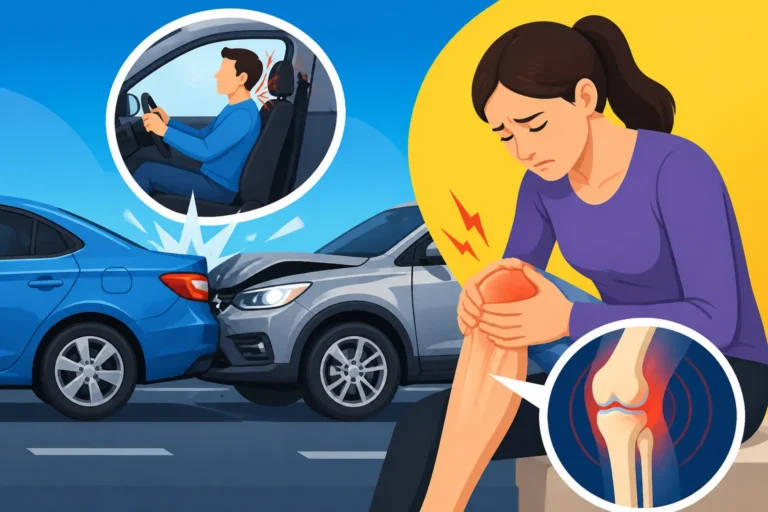
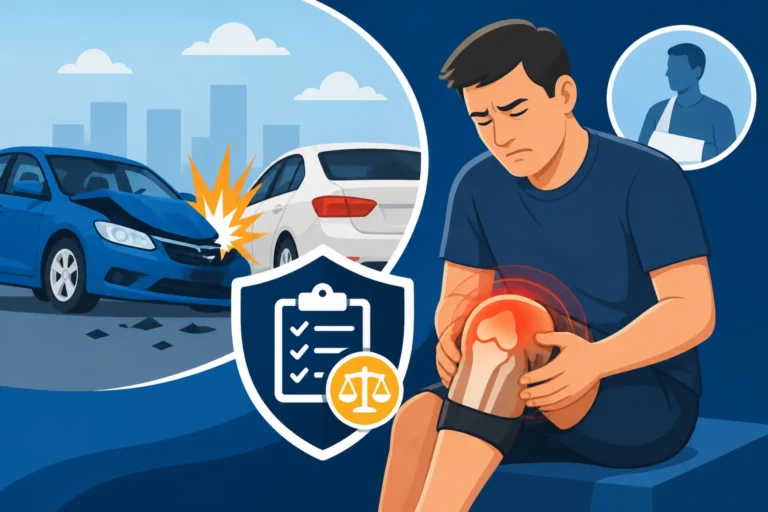
The dynamics of these impacts create distinct injury patterns. In a head-on crash, the primary forces are frontal, causing rapid deceleration. Occupants are thrust forward against their seatbelts, dashboards, or steering wheels. The sheer force can lead to severe chest, facial, and leg injuries. For example, a driver might suffer a "dashboard knee" if their knee slams into the dashboard. In contrast, a rear-end collision primarily involves forward acceleration of your vehicle. This causes your body to be pushed forward while your head lags behind, resulting in the classic whiplash motion.
Think about a driver stopping abruptly at a yellow light on a busy street in Dallas. The car behind them, with a distracted driver, fails to stop and slams into them. The occupants in the front vehicle might experience severe whiplash, as their bodies are suddenly propelled forward. Meanwhile, if two cars collide head-on during a misjudged left turn at a bustling Phoenix intersection, the occupants face extreme frontal impact, risking internal bleeding, broken bones, and severe head trauma. Both types of crashes, though distinct in their initial forces, share the potential for significant, life-altering harm.
Common Soft Tissue Injuries from Intersection Accidents
Soft tissue injuries are incredibly common in car accidents, especially those occurring at intersections. These injuries affect muscles, ligaments, and tendons rather than bones. While they might not be immediately visible like a broken bone, they can be incredibly painful, debilitating, and have long-lasting effects. Often, the symptoms don't even show up right away, making it crucial to be vigilant about your body in the days following a crash.
Whiplash and Neck Strain
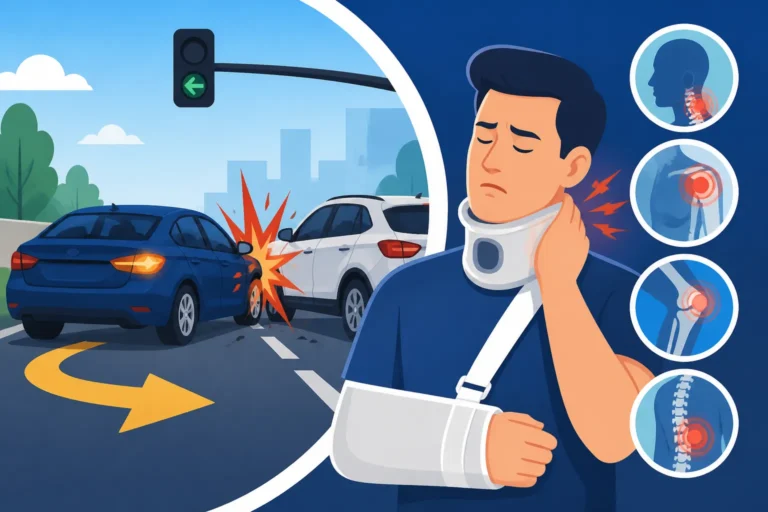
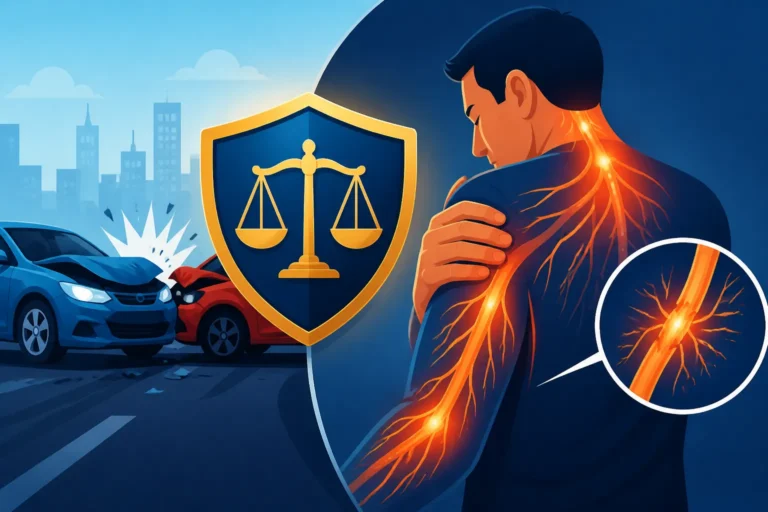
Whiplash is perhaps the most notorious soft tissue injury associated with car accidents, and intersection crashes are prime candidates for causing it. It occurs when your head is suddenly forced backward and then forward, much like the cracking of a whip. This hyperextension and hyperflexion of the neck can strain the muscles and ligaments in your cervical spine, leading to a range of uncomfortable symptoms. It's not just "a stiff neck"; whiplash can involve significant pain, stiffness, reduced range of motion, and even radiating pain into the shoulders and arms.
The tricky thing about whiplash is that symptoms often have a delayed onset. You might feel fine right after the collision, only to wake up the next morning with excruciating neck pain, headaches, and dizziness. This delay can make it harder to connect the injury directly to the accident if you don't seek medical attention promptly. In a rear-end collision at a traffic light, for instance, even at relatively low speeds, the sudden jolt can be enough to cause severe whiplash, because your head and neck absorb the brunt of the inertial forces.
Imagine you're stopped at a red light in San Francisco, admiring the view, and suddenly your car is rear-ended. The initial shock gives way to a dull ache in your neck, which by the next day has escalated into throbbing pain and difficulty turning your head. This classic whiplash scenario can severely impact your daily life, making even simple tasks like driving or working unbearable. It's a prime example of why getting a medical evaluation after a crash, even if you feel okay initially, is essential. For more detailed information, you can read our guide on What Is Whiplash? Symptoms, Treatment & Claims.
Sprains, Strains, and Bruises
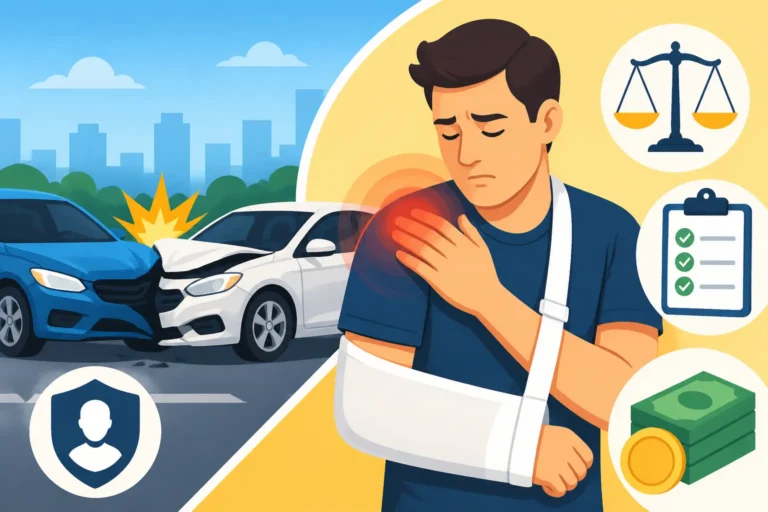
Beyond whiplash, intersection accidents commonly result in other sprains, strains, and contusions (bruises). A sprain occurs when a ligament (which connects bones) is stretched or torn, while a strain involves a muscle or tendon (which connects muscle to bone). These can happen anywhere in the body as it's violently moved or attempts to brace for impact. Bruises, or contusions, are also very common and can range from minor discoloration to deep, painful hematomas.
Drivers and passengers often instinctively brace themselves for an impending impact. This tensing of muscles can lead to strains in the shoulders, back, arms, or legs. For example, if you're holding the steering wheel tightly as another car T-bones your vehicle, the sudden force can strain your wrist, elbow, or shoulder ligaments. Seatbelts, while life-saving, can also cause significant bruising or strain where they cross your chest and hips. This "seatbelt syndrome" can leave a distinctive pattern of contusions and underlying muscle or organ damage.
Consider a person driving through a residential intersection in Sacramento, and another car ignores a stop sign, leading to a violent T-bone collision. The driver’s arm, instinctively reaching for the steering wheel or brace against the door, might suffer a severe shoulder strain or a wrist sprain as the force of the impact wrenches it. Their chest, held tight by the seatbelt, could develop deep bruising and muscle soreness that makes breathing painful for days. While these might not sound as dramatic as a broken bone, the pain and limited mobility from sprains, strains, and deep bruises can be incredibly disruptive and require significant recovery time.
More Serious Injuries to Watch For
While soft tissue injuries are prevalent, intersection accidents also carry a high risk of more severe and potentially life-altering injuries. The sudden, angular forces often involved can lead to significant trauma to critical parts of the body, including the head, spine, and major bones. These injuries often require immediate medical intervention and can have long-term consequences that demand extensive care and rehabilitation.
Head and Brain Injuries
Head injuries are a grave concern in any car accident, but especially in intersection crashes where impacts can be sudden and from unexpected angles. Even if your head doesn't directly hit anything, the rapid acceleration and deceleration can cause your brain to slosh inside your skull, leading to a concussion or even a more severe traumatic brain injury (TBI). Symptoms of a concussion might include headaches, dizziness, confusion, nausea, sensitivity to light or sound, and difficulty concentrating.
The insidious nature of head injuries is that symptoms aren't always immediately apparent. You might feel a bit "off" but dismiss it as shock, only for symptoms to worsen over hours or days. A driver might hit their head on the steering wheel, or a passenger could strike their head against the window or pillar during a T-bone collision. Even without direct impact, the whiplash motion can shake the brain within the skull. These injuries can profoundly affect cognitive function, memory, mood, and overall quality of life.
Imagine a pedestrian crossing a busy street in New York City, and two cars collide in the intersection, sending one vehicle careening onto the sidewalk and striking the pedestrian. Even if they don't lose consciousness, the force of the impact could result in a severe concussion or even a brain bleed. It's critical to understand that any blow to the head or sudden jarring motion warrants immediate medical evaluation. Ignoring symptoms like persistent headaches or confusion could have devastating long-term consequences. Our article on Concussion Symptoms After a Car Accident provides more insight into identifying these crucial signs.
Fractures and Broken Bones
The immense forces generated in intersection collisions frequently lead to fractures and broken bones. Unlike soft tissue injuries, fractures are usually immediately obvious due to severe pain, swelling, and often visible deformity. However, hairline fractures might not be as apparent initially, making X-rays and other diagnostic imaging crucial. These injuries can range from simple breaks that heal with a cast to complex, comminuted fractures requiring surgery and extensive physical therapy.
In a T-bone accident, for instance, a driver's ribs on the side of impact are highly susceptible to fractures as the door or side panel intrudes into the cabin. Their arm or leg, caught between the car's interior and the outside force, can also suffer breaks. Similarly, in a head-on collision, the force can travel through the legs and hips, causing fractures to the femurs, tibias, or even the pelvis. The violent jolt can also cause facial bones to break if the occupant strikes the dashboard or steering wheel.
Consider a high-speed intersection collision in downtown Chicago, where a driver runs a red light and hits a car turning left. The occupants of both vehicles could suffer multiple fractures. The driver of the turning car might sustain a broken arm from gripping the steering wheel, fractured ribs from the side impact, and potentially a broken leg if it was trapped or twisted. These types of injuries often necessitate emergency care, surgical intervention, and a lengthy recovery period, highlighting the severe physical toll of intersection crashes. For more information on identifying and dealing with these injuries, you can check out Broken Bones and Fractures in Car Accidents.
Back and Spinal Cord Injuries
Back and spinal cord injuries are among the most serious and debilitating consequences of intersection accidents. The spine, a complex structure of bones (vertebrae), discs, and nerves, is highly vulnerable to the twisting, compression, and shear forces common in these collisions. Even a seemingly minor crash can lead to a herniated disc, where the soft cushioning between vertebrae bulges or ruptures, pressing on nerves and causing excruciating pain, numbness, or weakness.
More severe impacts can result in vertebral fractures or, terrifyingly, spinal cord injuries. A spinal cord injury, even if incomplete, can lead to paralysis, loss of sensation, or impaired bodily functions below the point of injury. These injuries often occur due to the sudden, violent movements of the torso and head relative to each other, combined with the direct compression or impact forces. Diagnosing these conditions typically requires MRI scans and neurological evaluations.
Imagine a car traveling at speed through a suburban intersection in Houston, suddenly T-boned by another vehicle that failed to yield. The violent rotation and impact could cause a passenger to suffer multiple herniated discs in their lumbar (lower) spine, making it impossible to sit or stand without severe pain. In an even more tragic scenario, the extreme forces could result in a fracture of a cervical (neck) vertebra, leading to a complete spinal cord injury and permanent paralysis. These types of injuries underscore the critical importance of immediate, comprehensive medical assessment after any intersection accident. Our guide on Herniated Disc From a Car Accident offers further details.
Documenting Your Injuries and Seeking Care
After an intersection accident, dealing with the aftermath can feel overwhelming. Beyond the immediate shock and adrenaline, you're faced with vehicle damage, insurance calls, and the uncertainty of your physical condition. However, how you handle the period immediately following the crash, particularly regarding your health, can significantly impact your recovery and any potential car accident claim. Proactive steps are essential to ensure your well-being and protect your rights.
The Importance of Prompt Medical Attention
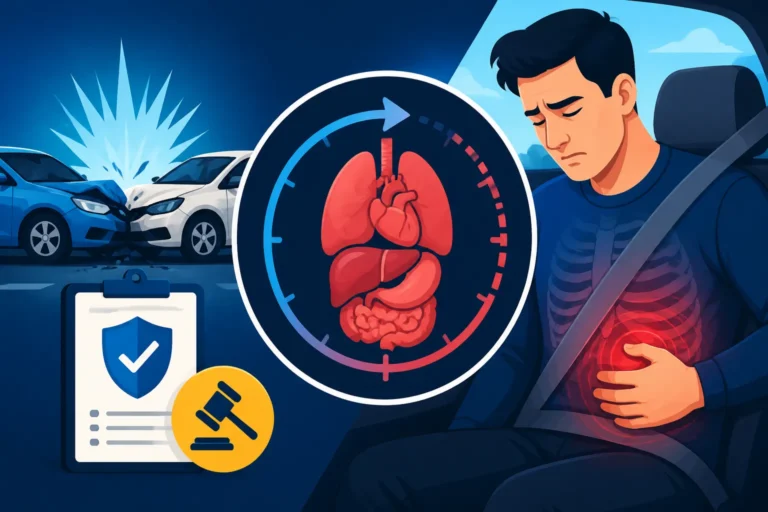
One of the most crucial steps after any car accident, regardless of how minor it seems, is to seek prompt medical attention. This isn't just about your health; it's also vital for establishing a clear record of your injuries. Many common car accident injuries, such as whiplash or concussions, have Delayed Injury Symptoms After a Car Accident. You might feel fine at the scene, only for pain, stiffness, or neurological symptoms to emerge hours or even days later. Delaying medical care can make it challenging to prove that your injuries were directly caused by the accident, as insurance companies might argue that something else caused your condition.
Visiting a doctor immediately creates a formal record linking your physical symptoms to the collision. Even if it's just a check-up, that initial visit forms the baseline for your recovery journey. Your physician can identify injuries that might not be immediately apparent, refer you to specialists, and begin a course of treatment. This proactive approach ensures you receive the care you need and strengthens any future claims you might have for medical expenses or pain and suffering.
Think about a driver in Atlanta who experiences a seemingly minor fender-bender at an intersection. They exchange information and drive away feeling shaken but uninjured. Two days later, they develop a pounding headache and stiff neck. If they had seen a doctor immediately after the crash, even for a quick evaluation, there would be a clear medical record establishing the timeline. Without it, the insurance adjuster might raise questions about the true cause of the delayed symptoms. This is why our advice in Why You Should See a Doctor After a Car Accident is so emphatic – your health and your future depend on it.
Gathering Evidence and Medical Records
Beyond seeking medical treatment, thoroughly documenting everything related to your injuries and the accident itself is paramount. This process begins at the scene of the accident if you are able. Take photos of vehicle damage, the intersection, road conditions, and any visible injuries. Collect contact information from witnesses. If police responded, get a copy of the police report, as it can be instrumental in determining How Fault Is Determined in a Car Accident. This initial evidence lays the groundwork for connecting the crash to your subsequent medical issues.
As you undergo medical treatment, meticulously keep track of all your appointments, diagnoses, prescribed medications, physical therapy sessions, and any out-of-pocket expenses. Every medical record, from initial emergency room reports to specialist notes and billing statements, serves as crucial evidence to How to Prove Injuries in a Car Accident Claim. These documents establish the nature and extent of your injuries, the treatments you've received, and the associated costs. It’s also incredibly helpful to maintain a "pain journal" where you detail your daily symptoms, pain levels, and how your injuries affect your daily life. This personal account can provide powerful insight into your Economic vs Non-Economic Damages in Injury Claims, such as pain and suffering.
For example, imagine a victim in Seattle who suffered severe whiplash and a concussion from an intersection accident. They diligently documented photos of the damaged cars, kept all their ER discharge papers, physical therapy schedules, and prescriptions. They also maintained a detailed journal describing their daily headaches, dizziness, and inability to perform normal activities. When it came time to negotiate a settlement, this comprehensive documentation made it clear to the insurance company that their injuries were significant and directly attributable to the collision. The more detailed your records, the stronger your position will be. Our guide on How Medical Records Prove Your Injuries delves deeper into this essential topic.
| Injury Type | Common Collision Type at Intersections | Symptoms | Potential Severity |
|---|---|---|---|
| Whiplash/Neck Strain | Rear-end, T-bone | Neck pain, stiffness, headaches, dizziness, radiating arm pain | Mild to severe, chronic pain possible |
| Sprains, Strains, Bruises | All types | Swelling, pain, limited movement, discoloration, muscle weakness | Minor to moderate, can linger for weeks |
| Concussion/Mild TBI | All types (especially T-bone, head-on) | Headaches, confusion, memory issues, dizziness, light/sound sensitivity | Mild to severe, long-term cognitive impairment |
| Fractures (Ribs, Arms, Legs) | T-bone, Head-on | Severe pain, swelling, deformity, inability to move limb | Moderate to severe, often requires surgery, lengthy rehab |
| Herniated/Slipped Discs | All types (especially T-bone, rear-end) | Localized back/neck pain, radiating pain, numbness, weakness | Moderate to severe, may require surgery |
| Spinal Cord Injury | High-impact T-bone, Head-on | Paralysis, loss of sensation, severe weakness, loss of bodily control | Extremely severe, often permanent disability |
Disclaimer
Please remember that this article provides general information and should not be considered legal or medical advice. Every car accident case is unique, and the information presented here may not apply to your specific situation. Always consult with a qualified medical professional for diagnosis and treatment of any injuries, and seek advice from an experienced car accident attorney regarding your legal rights and options.