Who Is at Fault in a Multi-Car Accident in California?
Experiencing a multi-car accident on California’s busy freeways or crowded city streets is an incredibly jarring and confusing ordeal. When you’re caught in a pileup, it’s not just about one car hitting another; suddenly, you’re dealing with a complex web of impacts, multiple damaged vehicles, and several drivers, all trying to figure out what just happened and, crucially, who is to blame. This guide is here to walk you through the often overwhelming process of understanding fault in these complicated scenarios, specifically under California’s unique legal system, so you can protect your rights and navigate the aftermath effectively.
Understanding Multi-Car Accidents in California
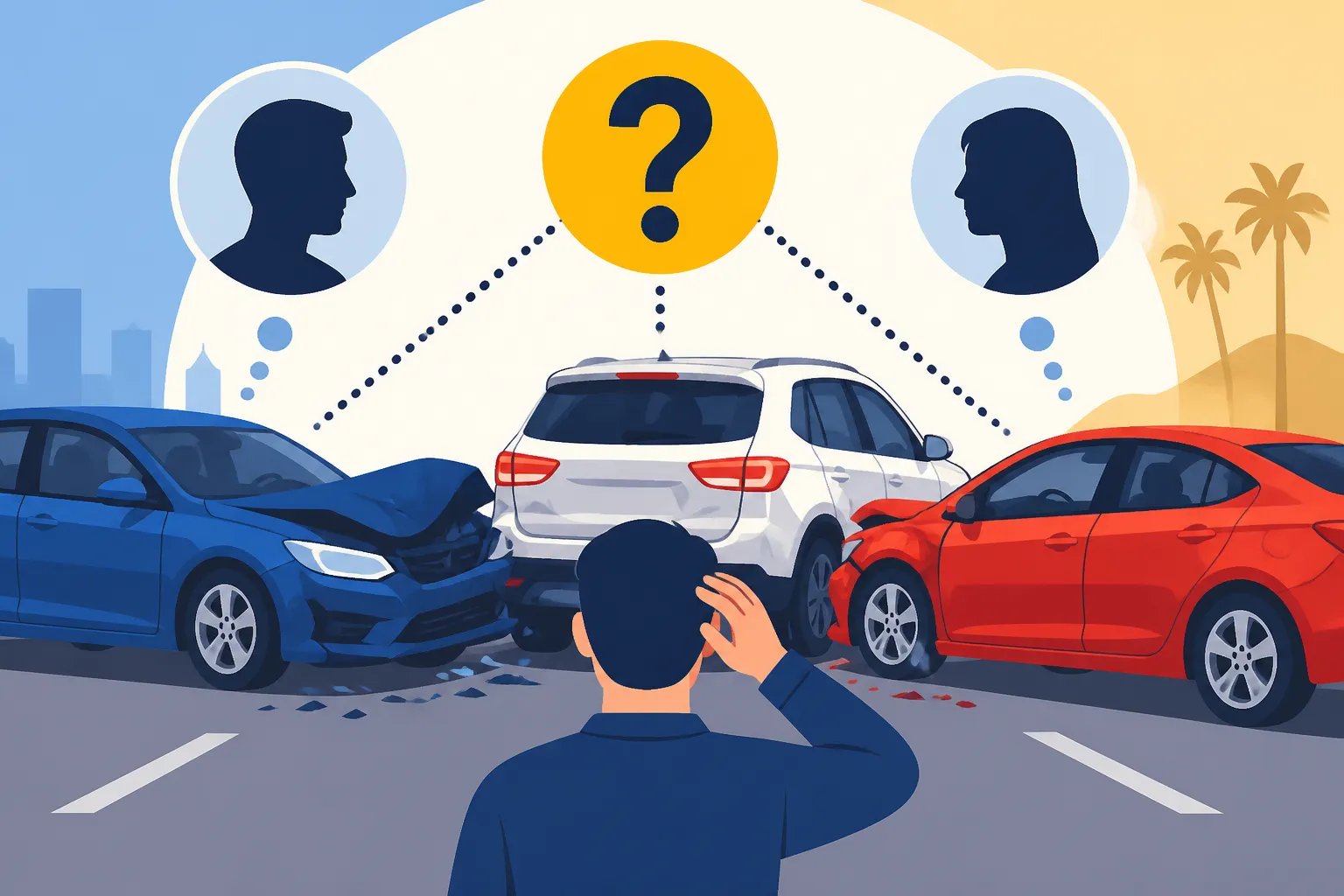
A multi-car accident, often referred to as a pileup or chain-reaction crash, involves three or more vehicles in a single incident. These accidents are unfortunately common in heavily trafficked areas across California, from the 405 in Los Angeles to Highway 101 in the Bay Area. Unlike a simple fender-bender between two cars, the sheer number of vehicles and drivers makes determining fault significantly more complex.
What Makes Multi-Car Accidents So Complex?
Imagine driving down a busy stretch of the I-5 near San Clemente during rush hour. Suddenly, traffic ahead grinds to a halt. You brake, but the car behind you doesn't react in time, hitting your rear bumper and pushing you into the vehicle in front. Now, the car behind the initial impact driver also plows into them, and another car swerves to avoid the whole mess, only to clip a fifth vehicle on the shoulder. This isn't just a two-car crash; it's a cascading event where each impact can have ripple effects, influencing subsequent collisions.
The complexity arises from several factors:
- Multiple Impact Points and Sequences: It’s rarely a single, clean impact. Cars might be hit from the front, rear, and sides, sometimes multiple times. Pinpointing the exact sequence of events, which car struck which first, and how each driver’s actions contributed to the overall incident, is like solving a high-speed puzzle.
- Varying Speeds and Forces: Each vehicle involved might be traveling at a different speed, applying different forces of impact, and causing distinct types of damage. This further complicates the reconstruction of the accident.
- Numerous Driver Actions and Reactions: Did a driver brake hard, swerve, accelerate, or become distracted? With more drivers, there are more individual decisions (or lack thereof) to analyze. One driver's negligence can trigger a chain, but subsequent drivers might also be found negligent for failing to react safely.
- Conflicting Accounts: You can bet that every driver involved will have their own version of events. Trying to reconcile these narratives and find objective truth is a significant challenge for law enforcement and insurance companies.
The Legal Landscape in California
California operates under an "at-fault" insurance system, which means the driver who is determined to be responsible for causing the accident is generally liable for the damages and injuries sustained by others. This is distinct from "no-fault" states, where your own insurance company typically covers your initial medical expenses regardless of who caused the crash. So, if you're ever wondering, "Is California a No-Fault State?", the answer is a clear no when it comes to property damage and bodily injury liability.
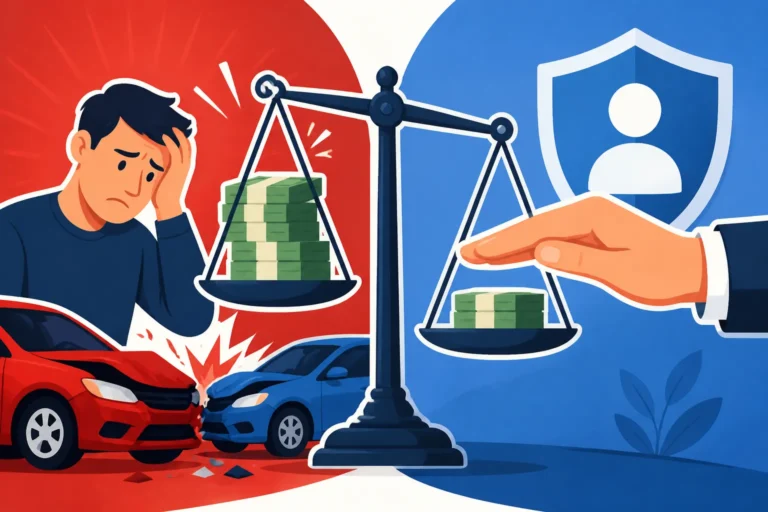
However, simply being an "at-fault" state doesn't simplify multi-car accidents. The crucial element in California is its adherence to pure comparative negligence. This legal principle is absolutely fundamental to understanding how fault is distributed and how it affects your ability to recover damages in a multi-car pileup. It means that fault isn't an all-or-nothing proposition; it can be divided among multiple parties, and your own percentage of fault will directly impact the compensation you can receive. We'll dive deeper into this next.
California's Pure Comparative Negligence Rule and Multi-Car Crashes
Understanding California's pure comparative negligence rule is paramount when you're involved in any car accident, but especially so in a multi-car pileup where blame is rarely assigned to just one person. This system allows for a more nuanced distribution of responsibility, which can be both a blessing and a curse depending on your role in the crash.
How Pure Comparative Negligence Works in Practice
Unlike some states that have a "modified comparative negligence" rule or even "contributory negligence" (which can completely bar you from recovering damages if you're found even 1% at fault), California is a pure comparative negligence state. What does this mean for you? It means that a jury or claims adjuster can assign a percentage of fault to every party involved in an accident, including yourself. Your ability to recover damages is then reduced by your own percentage of fault.
Let's illustrate with a hypothetical: Imagine a three-car pileup on the I-80 heading into San Francisco.
- Car A suddenly slams on its brakes due to a distracted driver ahead, but without warning.
- You (Car B) are following Car A a bit too closely, but you manage to brake just enough to avoid hitting Car A.
- Car C, behind you, is completely distracted by their phone and plows into your rear bumper, pushing your car (Car B) into the back of Car A.
In this scenario, a thorough investigation might find:
- Car C is 70% at fault for distracted driving and rear-ending you.
- You (Car B) are 20% at fault for following too closely, contributing to the chain reaction.
- Car A is 10% at fault for braking suddenly and unexpectedly, even if there was an underlying reason.
Under pure comparative negligence, even though you were found 20% at fault, you can still recover 80% of your damages from Car C and Car A. This is a crucial distinction. In a "50% bar" modified comparative negligence state, if you were 20% at fault, you'd recover 80% of your damages. But if you were found 51% at fault, you would recover nothing. In California, you could be 99% at fault and still recover 1% of your damages. This makes the question of "What Happens If You're Partially at Fault?" particularly relevant and complex in multi-car accidents in California. For a deeper dive into these different systems, you might want to read about Comparative vs Contributory Negligence Explained.
Impact on Damages and Settlements
The direct consequence of California's pure comparative negligence rule is that your assigned percentage of fault will proportionally reduce the amount of compensation you can receive for your injuries and property damage. This impact extends to everything from medical bills and lost wages to pain and suffering.
Consider our previous example where you (Car B) suffered $10,000 in damages and were found 20% at fault. Instead of receiving the full $10,000, you would only be eligible to recover $8,000. The remaining $2,000 would be your responsibility. This is exactly How Comparative Fault Reduces Your Settlement.
This system introduces significant challenges during the settlement negotiation phase. Each insurance company involved will undoubtedly try to minimize their client's fault and maximize the fault of others, including yours. If you're dealing with three or more drivers, each with their own insurance carrier, you can expect a prolonged and often contentious process as adjusters for State Farm, Geico, Progressive, or any other company involved, try to shift blame. They will pore over every detail, looking for any way to assign a higher percentage of fault to other parties, especially if you have significant injuries. It's truly a complex puzzle for How Insurance Companies Determine Who Is at Fault.
Because of this intricate dance of blame, reaching a fair settlement in a multi-car accident in California often requires a strong understanding of accident reconstruction, a meticulous collection of evidence, and robust negotiation skills. Without a clear picture, you might find yourself settling for less than you deserve because the insurance companies successfully pinned a higher percentage of fault on you.
Key Factors in Determining Fault in a Multi-Car Pileup
Determining who is at fault in a multi-car accident is rarely straightforward. It involves a detailed investigation to piece together the sequence of events, often relying on various forms of evidence and expert analysis. In California, where traffic congestion is a constant, and drivers are frequently rushing, these factors become even more critical.
Evidence Collection and Investigation
The foundation of any fault determination rests on the evidence collected from the scene and during the subsequent investigation. This is where the initial actions taken after an accident can dramatically influence the outcome of your claim.
- Police Reports: While a police report doesn't officially determine fault in a legal sense, it's an incredibly influential document. Responding officers will document their observations of the scene, witness statements, vehicle positions, road conditions, and often provide their preliminary assessment of who violated traffic laws. This initial assessment frequently guides insurance adjusters in their own fault determinations. However, police officers are not accident reconstruction experts, and their reports can sometimes contain errors or incomplete information, so it's essential to understand that Police Reports and Car Accident Fault provides a starting point, not the definitive answer. What If There Was No Police Report? can make things even harder.
- Witness Statements: In a multi-car pileup, disinterested third-party witnesses are gold. They can provide an objective account of what they saw, often corroborating or contradicting drivers' statements. Their perspective on the order of impacts, the speed of vehicles, and specific driver behaviors can be invaluable. This is a key part of How to Prove the Other Driver Was at Fault.
- Dashcam Footage and Traffic Cameras: With the increasing popularity of dashcams, video evidence is becoming more common. This footage can provide an undeniable, real-time record of the accident, clarifying disputes about who did what, when, and how. Similarly, traffic cameras (CCTV) from nearby businesses or municipalities might have captured parts of the incident.
- Vehicle Damage and Skid Marks: The type and location of damage on each vehicle can tell a story about the direction and force of impact. Accident reconstruction specialists use this, along with skid marks, debris fields, and vehicle resting positions, to scientifically recreate the accident. They can analyze tire marks to determine speeds, braking points, and even driver intent.
- "Black Box" Data: Many modern vehicles are equipped with Event Data Recorders (EDRs), often called "black boxes." These devices record critical information in the moments leading up to a crash, such as speed, braking, steering input, and seatbelt usage. This data can be incredibly powerful in establishing fault.
Common Scenarios and Fault Assignment
While every multi-car accident has its unique details, certain scenarios are more common than others, and there are general principles that often guide fault assignment in California.
- Chain-Reaction Rear-Ends: This is perhaps the most common multi-car scenario. Typically, the rule is that a driver is responsible for maintaining a safe following distance and being able to stop in time to avoid hitting the vehicle in front. So, if Car C hits Car B, pushing Car B into Car A, Car C is primarily at fault for the initial impact. However, it's not always that simple. If Car A slammed on its brakes suddenly and unreasonably (e.g., no emergency, just an abrupt stop to make an exit), Car A might bear some fault for contributing to the subsequent collisions. If Car B was also following too closely, they might share some fault. It’s a complex dance of responsibility.
- Sudden Lane Changes or Merging Accidents: On California's crowded freeways, drivers often make sudden lane changes without properly checking their blind spots or signaling, leading to side-swipe collisions that can initiate a pileup. The driver who executes an unsafe lane change is almost always deemed at fault for that specific collision. This could then lead to other cars swerving and crashing. Read more about Who Is at Fault in a Lane-Change Accident? or Who Is at Fault in a Merging Accident?.
- Intersection Pileups: These occur when one driver runs a red light or stop sign, causing a collision that then involves other vehicles trying to avoid the initial crash or being struck by the ricocheting vehicles. The driver who violated the traffic signal or right-of-way rules is usually the primary at-fault party.
- Swerving to Avoid a Collision: A driver might swerve to avoid hitting another vehicle, only to strike a third vehicle or a fixed object. The "agony of the moment" doctrine might apply here, where a driver making a reasonable, instantaneous decision to avoid a greater danger might be excused from fault, placing the blame on the original negligent driver who created the hazard. However, if the swerving action was deemed unreasonable or reckless given the circumstances, that driver could still be assigned some fault.
- Contributing Factors: Beyond the immediate actions, other factors frequently contribute to fault. Speeding, distracted driving (like texting), driving under the influence of alcohol or drugs, and even road conditions or visibility can all play a role. For example, a driver speeding in heavy fog on Highway 1 near Big Sur might be assigned a higher percentage of fault for failing to adjust their driving to hazardous conditions, even if another driver initiated the crash. These factors are meticulously examined by insurance adjusters and legal teams to determine liability.
Steps to Take After a Multi-Car Accident in California to Protect Your Claim
Being involved in a multi-car accident is terrifying, and in the chaos, it's easy to overlook crucial steps that can later make or break your claim. Knowing what to do immediately after the crash, and in the days and weeks that follow, is essential to protect your rights under California law.
Immediate Actions at the Scene
Your actions in the immediate aftermath of a multi-car accident can have a significant impact on how fault is determined and the strength of any future claim.
- Safety First: Your top priority is to ensure the safety of yourself and others. If your vehicle is still operational and it's safe to do so, move it to the shoulder or a nearby safe location, away from active traffic. Turn on your hazard lights. If anyone is injured, or if there's significant damage, do not move the vehicles until law enforcement arrives unless they pose an immediate danger.
- Call 911: Always call 911 in a multi-car accident, regardless of how minor you perceive your injuries or property damage to be. You need law enforcement to respond, create an official accident report, and manage the scene. Emergency medical services should also be called if anyone is injured. The police report, even if preliminary, is a vital piece of documentation.
- Document Everything: This step cannot be stressed enough, especially with multiple vehicles involved.
- Take Photos and Videos: Use your smartphone to capture as much as you can. Get wide shots of the entire scene, showing the position of all vehicles, skid marks, road conditions, and any traffic signals. Then, get close-up photos of the damage to all vehicles, license plates, and any visible injuries. Don't forget to capture debris on the road and any relevant landmarks.
- Exchange Information: Get the contact details (name, phone, email, address), insurance information (company name, policy number), driver's license number, and license plate number from every driver involved. You'll also need the make, model, and year of their vehicles.
- Identify Witnesses: This is critical in a multi-car accident. Ask any bystanders if they saw what happened. Get their names and contact information. Their objective accounts can be invaluable when conflicting stories arise.
- Do NOT Admit Fault: This is a golden rule in any accident. Even a simple "I'm so sorry!" can be misconstrued as an admission of fault and used against you later by insurance companies. Stick to the facts when talking to police and other drivers. Do not speculate or apologize. For more guidance on this, see What Is an Admission of Fault (and How to Avoid It)?.
Navigating the Claims Process
The period following the accident can be just as stressful as the crash itself. Dealing with insurance companies and potential legal action requires careful navigation.
-
Seek Medical Attention Immediately: Even if you feel fine, or only have minor aches, see a doctor as soon as possible. Adrenaline can mask pain, and some serious injuries, like whiplash or concussions, might not manifest symptoms for hours or even days. A delay in seeking medical care can hurt your personal injury claim by allowing the opposing insurance company to argue your injuries weren't directly caused by the accident. Your medical records are crucial for proving How to Prove Injuries in a Car Accident Claim.
-
Report the Accident to Your Insurance Company: You should report the accident to your own insurance company promptly, even if you believe you are not at fault. Most policies have clauses requiring timely notification. Providing them with the basic facts will allow them to open a claim. This is part of How to File a Car Accident Insurance Claim. They will then likely initiate their own investigation and contact the other insurance carriers involved.
-
Gather All Documentation: Keep an organized file of everything related to the accident: police report numbers, contact information, photos, videos, medical records, bills, receipts for any expenses incurred (like a rental car), and records of any missed work.
-
Consider Legal Counsel: Given the inherent complexities of Who Is at Fault in a Multi-Car Accident in California? and the pure comparative negligence system, it is highly advisable to consult with an experienced car accident lawyer. A lawyer can:
- Help you understand your rights and the nuances of California law.
- Deal with multiple insurance companies, whose primary goal is to pay out as little as possible.
- Gather additional evidence, such as black box data or accident reconstruction reports.
- Negotiate on your behalf to ensure you receive fair compensation, considering What Happens If You're Partially at Fault?.
- File a lawsuit if a fair settlement cannot be reached.
Determining Do You Need a Lawyer for a Car Accident? (2027) is a decision that can significantly impact the outcome of your case. In multi-car pileups, having an advocate who understands the intricacies of fault assignment and settlement negotiations is often invaluable.
| Action Item | Why It's Crucial in a Multi-Car Accident (California) |
|---|---|
| Secure the Scene | Minimizes further collisions, especially critical with multiple vehicles involved. |
| Call Emergency Services | Establishes official record (police report), ensures injured parties receive immediate care. |
| Document with Photos/Video | Provides objective evidence of vehicle positions, damage, and scene details to refute conflicting accounts. |
| Collect All Driver/Witness Info | Essential for insurance claims; multiple parties mean more potential sources of liability and corroborating statements. |
| Do NOT Admit Fault | Prevents self-incrimination under California's pure comparative negligence system. |
| Seek Immediate Medical Care | Protects your health and creates a documented link between the accident and your injuries, crucial for compensation. |
| Notify Your Insurance | Fulfills policy obligations and initiates your insurer's investigation and support. |
| Consult a Personal Injury Lawyer | Provides expert guidance through complex fault determinations and multi-party negotiations, maximizing your potential recovery. |
Disclaimer
Please remember that this information is intended for educational purposes only and does not constitute legal advice. Every car accident case is unique, and the specific facts and applicable laws can vary. It is highly recommended to consult with a qualified personal injury attorney in California to discuss the specifics of your situation and get personalized legal guidance.