Who Is at Fault in a T-Bone Accident?
Few moments behind the wheel are as terrifying as a T-bone accident. One second you're driving along, and the next, another vehicle broadsides yours, often at an intersection, leaving you disoriented, possibly injured, and certainly wondering, "Who on earth is at fault here?" These collisions can be incredibly complex to untangle, with emotions running high and conflicting accounts. This comprehensive guide will walk you through the nuances of determining fault in a T-bone crash, exploring common scenarios, critical evidence, and the steps you need to take to protect yourself.
Understanding What a T-Bone Accident Truly Is
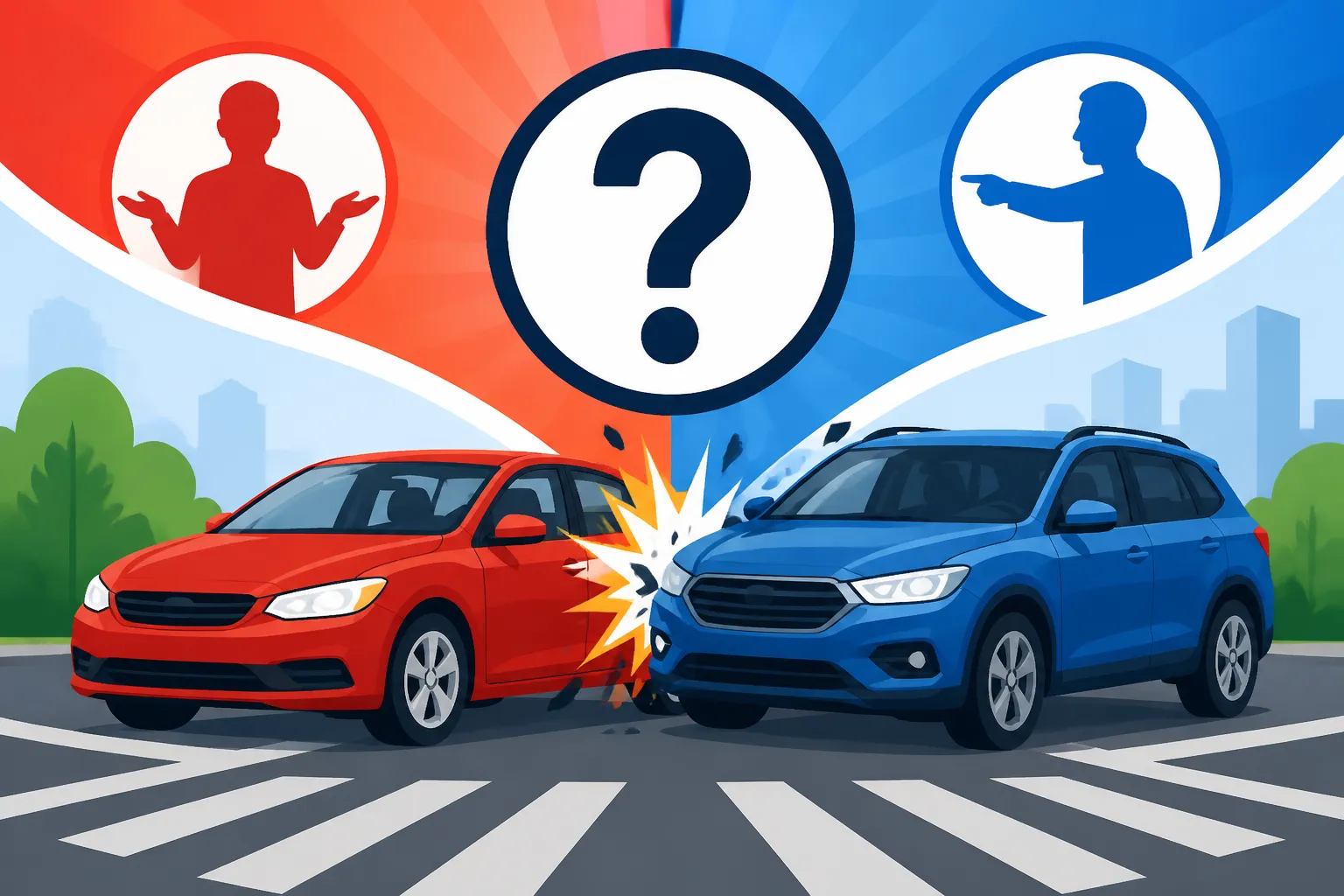
A T-bone accident, also known as a broadside or side-impact collision, gets its name from the shape two vehicles make upon impact. Imagine one car driving straight, and another car hitting it directly on the side, forming a "T." These collisions typically occur when one vehicle's front or rear end strikes the side of another vehicle. They are particularly dangerous because the sides of most vehicles offer far less protection than the front or rear, lacking the robust crumple zones designed to absorb impact energy in head-on or rear-end crashes.
The most common location for a T-bone accident is at an intersection, where multiple vehicles converge and right-of-way rules are paramount. However, they can also happen in parking lots, when pulling out of driveways, or even on multi-lane roads if one driver swerves into another. The suddenness and severity of these impacts often lead to significant vehicle damage and serious injuries, making fault determination a critical aspect of the post-accident process.
Defining the Broadside Collision
A broadside collision is characterized by the impact point: one vehicle's front or rear (the "striking" vehicle) hits the side of another vehicle (the "struck" vehicle). This isn't just a fender bender; these are often high-force impacts that can deform vehicle frames, shatter windows, and deploy airbags. The angle of impact can vary, but the defining characteristic is always the direct side-on strike.
Consider a scenario at a busy city intersection. A driver proceeds through a green light, confident in their right-of-way. Suddenly, from the perpendicular street, another vehicle rushes through a red light, striking the side of the first car with tremendous force. This is a classic T-bone scenario. The sheer force of being hit from the side can cause a vehicle to spin, roll over, or be pushed a considerable distance, complicating the scene and making initial assessments challenging.
Why T-Bone Accidents Are So Serious
The reason T-bone accidents are often so devastating lies in the physics of the impact and the design of passenger vehicles. While modern cars have advanced safety features, the side panels are simply not built to withstand the same level of force as the front or rear. There's less metal, less structural integrity, and often just a door and a thin frame separating occupants from the impact. This lack of protection translates directly to a higher risk of severe injuries.
Common injuries sustained in T-bone crashes include whiplash, traumatic brain injuries (TBI) from head impacts against windows or interiors, broken bones in arms, legs, ribs, and pelvis, and even internal injuries from the force of seatbelts or side airbags. For instance, a driver hit on their side might suffer a severe neck injury or a concussion, while a passenger on the struck side could experience catastrophic damage. These injuries can have long-lasting effects, impacting quality of life and incurring substantial medical costs. The severe nature of these injuries underscores why accurately determining fault is so crucial for any resulting car accident claim. If you're wondering about specific injuries, our guide on Common Car Accident Injuries: Complete Guide (2027) delves into this topic in more detail.
Deciphering Fault Through Right-of-Way Rules
At the heart of determining fault in most T-bone accidents are the fundamental rules of right-of-way. These rules are designed to ensure smooth traffic flow and prevent collisions, particularly at intersections. When a driver violates these rules, they are almost always considered negligent and, therefore, at fault for the resulting broadside collision. Understanding these basic tenets is your first step in understanding who bears responsibility.
Navigating intersections requires vigilance and adherence to traffic controls. Whether it’s a traffic light, a stop sign, or just a yield sign, these controls dictate which driver has the right to proceed. When a T-bone accident occurs, one of the primary questions investigators and insurance adjusters will ask is, "Who had the right-of-way?" The answer often points directly to the at-fault driver.
The Golden Rule of Intersections
The most common scenario for a T-bone crash involves a driver violating a traffic signal or stop sign. If you have a green light or a clear path through an intersection where the other driver had a red light or a stop sign, and they proceeded anyway, they are almost certainly at fault. This seems straightforward, but disputes can still arise. For example, if a driver claims they "beat" a yellow light, or that the other light just turned green, corroborating evidence becomes vital.
Consider a busy intersection in downtown Los Angeles. A driver in a Toyota Corolla proceeds on a solid green light. From the cross street, a Honda Civic, whose driver was distracted, blows through a clearly red light and slams into the side of the Corolla. In this instance, the driver of the Honda Civic is unequivocally at fault because they violated the traffic signal and did not have the right-of-way. This principle applies equally to stop signs: if you have a stop sign, you must come to a complete stop and yield to all cross-traffic before proceeding.
Navigating Uncontrolled Intersections and Four-Way Stops
Not all intersections have traffic lights or stop signs in every direction. Uncontrolled intersections, often found in residential areas, rely on specific right-of-way rules. Generally, the vehicle that arrives at the intersection first has the right-of-way. If two vehicles arrive at approximately the same time, the vehicle on the right typically has the right-of-way. Similarly, at a four-way stop, the first vehicle to arrive and stop has the right-of-way. If two vehicles arrive simultaneously, the driver on the right goes first.
Imagine two cars approaching an uncontrolled intersection in a quiet suburban neighborhood in Portland, Oregon. Both drivers arrive at roughly the same time. The driver of a Subaru Outback is on the left, and the driver of a Ford F-150 is on the right. If the Subaru driver proceeds without yielding to the Ford and a T-bone collision occurs, the Subaru driver would be found at fault. Understanding these nuanced rules is essential, especially when dealing with residential or less trafficked areas where drivers might be less attentive to general right-of-way protocols.
Common T-Bone Scenarios and Presumed Fault
While every T-bone accident has its own unique circumstances, many fall into common patterns where fault is often presumed based on the actions leading up to the crash. These scenarios often involve specific violations of traffic laws or basic safe driving principles. Recognizing these typical situations can help clarify who is likely responsible.
Knowing these common scenarios not only helps in understanding past accidents but also in anticipating potential hazards and driving defensively. When you see a vehicle approach a red light too quickly or attempt a risky left turn, you can adjust your driving to potentially avoid becoming the victim of a T-bone collision.
Red Light and Stop Sign Violations
This is arguably the most clear-cut scenario for determining fault in a T-bone crash. When a driver runs a red light or fails to stop at a stop sign and collides with a vehicle legally proceeding through the intersection, the driver who ran the light or sign is almost always 100% at fault. Their negligent action directly caused the collision by violating a fundamental traffic law designed to prevent such incidents.
Proving this type of fault, however, often requires compelling evidence. While it might seem obvious at the scene, the at-fault driver might deny it or claim the light was yellow, or they stopped briefly. This is where witness statements become invaluable. Imagine a collision at a busy junction in Seattle. A Metro bus driver, with numerous passengers, clearly observed a sedan speed through a red light, crashing into a delivery van. The bus driver's testimony, along with any traffic camera footage from the city, would provide irrefutable evidence of the sedan driver's fault. Dashcam footage from either vehicle is also incredibly helpful in establishing the sequence of events and the color of the traffic signals.
Left Turns Against Oncoming Traffic
Left-turn accidents are notorious for being complex, and when they result in a T-bone, they are often devastating. Generally, a driver making a left turn must yield to oncoming traffic. If a driver turns left and is struck by an oncoming vehicle, the turning driver is usually considered at fault because they failed to yield the right-of-way. This is a crucial distinction that often surprises drivers who assume the other vehicle somehow contributed.
However, there are exceptions that can shift or share fault in these situations. For example, if the oncoming vehicle was excessively speeding, ran a red light, or was driving erratically, the fault could be shared or even entirely shifted. In our guide on Left-Turn Accident Fault Rules, we explore these scenarios in much more detail. Consider a driver making a left turn onto a busy street in Denver. They believe they have enough time but misjudge the speed of an oncoming truck, which then T-bones their passenger side. While the turning driver generally has the burden to yield, if it's later discovered the truck was going 30 mph over the speed limit, the truck driver could bear some, or even significant, responsibility for the accident due to their excessive speed.
Failing to Yield
Beyond specific traffic signals, drivers are often required to yield in various situations. This could be at a designated yield sign, when merging into traffic, or when pulling out of a private drive or parking space. Failure to yield in these contexts, resulting in a T-bone collision, will typically place fault on the driver who failed to yield. These incidents are common in commercial areas or residential zones where drivers might not be as focused on yielding as they would be at a major intersection.
For example, a driver pulling out of a Starbucks parking lot onto a main street in Phoenix, Arizona, must yield to all traffic already on the street. If they misjudge a gap in traffic or simply fail to look, and broadside an oncoming vehicle, they are at fault. Similarly, if a driver attempts to merge onto a highway without yielding to traffic already in the lane and causes a T-bone incident with a vehicle already established in that lane, the merging driver would be found at fault. These situations highlight the constant responsibility drivers have to be aware of their surroundings and respect others' right-of-way.
When Fault Isn't So Clear-Cut: Shifting Liability
While many T-bone scenarios have a clear at-fault party, the reality of car accidents is often far more nuanced. Sometimes, multiple drivers contribute to a collision, or factors beyond simple right-of-way come into play. This is where the concept of shared fault and contributing negligence becomes critical, potentially changing how damages are recovered and liability is assigned. It's not always an all-or-nothing situation, and understanding these complexities is vital for anyone involved in a T-bone crash.
When fault isn't immediately obvious, insurance companies and legal teams will delve deeper into the circumstances, looking at every possible contributing factor. This detailed investigation can often reveal that while one driver might be primarily responsible, another driver's actions (or inactions) also played a role in the accident occurring or in its severity.
Shared Fault and Comparative Negligence
In many states, if more than one driver contributes to an accident, fault can be shared. This is where laws like comparative negligence or contributory negligence come into play. Most states follow some form of comparative negligence, where damages are reduced by the percentage of fault assigned to the injured party. For example, if you are found 20% at fault for a T-bone accident and your total damages are $10,000, you would only be able to recover $8,000 from the other driver's insurance. Some states have a "pure" comparative negligence system, like California, where you can still recover damages even if you're 99% at fault, though your payout would be significantly reduced. Other states have "modified" comparative negligence (50% or 51% bar rules), where if you're found to be 50% or 51% or more at fault, you might recover nothing.
Let's say a driver runs a red light and T-bones another vehicle. On the surface, it seems the red-light runner is 100% at fault. However, what if the driver who was hit was excessively speeding through the intersection? While the red-light runner is still primarily at fault, the speeding driver's actions might be deemed to have contributed to the severity of the accident or their inability to avoid it. A jury or insurance adjuster might assign 75% fault to the red-light runner and 25% to the speeding driver. Our guide on Comparative vs Contributory Negligence Explained offers a deeper dive into how these laws work, and What Happens If You're Partially at Fault? covers the implications for your claim.
Contributing Factors Beyond Right-of-Way
Beyond who had the right-of-way, many other factors can contribute to a T-bone accident and influence fault determination. These often fall under the umbrella of negligent driving behaviors. Speeding is a major one; even if you have the right-of-way, if you are traveling at an excessive speed, you might be found partially at fault for not being able to avoid the collision or for increasing its severity. Distracted driving, such as texting or talking on a cell phone, is another significant factor. A driver looking at their phone might run a stop sign or fail to notice an oncoming vehicle, leading to a T-bone.
Impaired driving due to alcohol or drugs almost always assigns fault to the impaired driver, regardless of other factors. Fault in a Drunk Driving Accident explores this in detail. Mechanical failure, though less common, can also contribute to an accident; for example, if a vehicle's brakes suddenly fail, preventing them from stopping at an intersection. Poor road conditions, such as ice or heavy rain, can make it difficult to stop, but drivers are generally expected to adjust their driving to conditions. Obstructed views, perhaps due to overgrown bushes or parked vehicles, might reduce visibility, though drivers are still expected to proceed with caution. All these elements can complicate the picture of fault and require careful investigation to assign liability fairly. Our Fault in a Distracted Driving (Texting) Accident article provides more context on how specific negligence affects fault.
| Scenario Type | Common Cause | Presumed At-Fault Party | Potential Shifting Factors |
|---|---|---|---|
| Red Light/Stop Sign | Driver runs a traffic signal or stop sign | Driver who ran the light/sign | Other driver excessively speeding; light malfunction |
| Left Turn | Driver turns left without yielding to oncoming | Turning driver (failed to yield) | Oncoming driver speeding, distracted, or running red light |
| Failure to Yield | Driver fails to yield at sign or merging | Driver who failed to yield | Other driver speeding, distracted; obscured view |
| Uncontrolled Inter. | Driver fails to yield to vehicle on the right/first arrival | Driver who failed to yield right-of-way | Other driver speeding, distracted, failing to look |
| Parking Lot/Driveway | Driver pulling out hits vehicle in thoroughfare | Driver pulling out (failed to yield) | Thoroughfare driver speeding, distracted; poor lot design |
The Crucial Role of Evidence in Proving Fault
In the aftermath of a T-bone accident, emotions can run high, and recollections can differ wildly. What one driver swears happened, another might vehemently deny. This is why concrete evidence is absolutely indispensable in determining who is at fault. Without solid proof, it often comes down to a "he said, she said" situation, which can severely complicate your claim and delay your recovery. Gathering and preserving evidence correctly from the start is paramount to protecting your rights and ensuring a fair outcome.
Every detail, no matter how small it seems at the time, can contribute to building a clear picture of what transpired. From tire marks on the asphalt to the exact angle of impact on the vehicles, investigators will meticulously piece together the narrative. Your proactive efforts at the scene can significantly bolster your position when dealing with insurance companies or, if necessary, legal proceedings.
Gathering Evidence at the Scene
The moments immediately following an accident are critical for gathering evidence. First and foremost, check for injuries and ensure everyone's safety. After that, if you are able, documenting the scene is vital. Take numerous photographs and videos from different angles: close-ups of vehicle damage, wider shots showing the vehicles' positions in relation to the intersection, skid marks, traffic signals, road signs, and any debris on the road. These visual records can be incredibly powerful in illustrating how the accident occurred.
Next, identify any witnesses and get their contact information. An impartial witness statement can often be the most compelling piece of evidence. Exchange insurance and contact information with the other driver(s), but do not admit fault or apologize, even out of politeness. Call 911, and ensure a police report is filed, especially if there are injuries or significant property damage. The police report will include initial observations, witness details, and often, an officer's preliminary determination of fault. Our guide What to Do After a Car Accident: Step-by-Step (2027) provides a comprehensive checklist for these critical first moments, and Police Reports and Car Accident Fault delves into the importance of official documentation. However, it's also important to know What If There Was No Police Report? in minor accidents.
How Insurance Companies and Lawyers Determine Fault
Once the immediate aftermath is handled, insurance companies will launch their own investigations to determine fault. This process is rarely quick or simple, as they aim to minimize their payout. Adjusters will review police reports, interview drivers and witnesses, examine photographs, and often inspect the damaged vehicles to analyze the impact points and damage patterns. They may even use accident reconstruction specialists for complex cases, who can use scientific principles to recreate the collision based on physical evidence.
Lawyers, especially those specializing in personal injury, also play a crucial role. They will independently gather evidence, consult experts, subpoena traffic camera footage, and analyze all available data to build a strong case proving the other driver's negligence. They understand How Insurance Companies Determine Who Is at Fault and can anticipate common tactics used to shift blame. A skilled attorney can often uncover details or present evidence in a way that significantly strengthens your position, ensuring you have the best chance to recover fair compensation. For more on proving fault, refer to How to Prove the Other Driver Was at Fault.
What to Do After a T-Bone Accident
Being involved in a T-bone accident is a traumatic experience, and it's easy to feel overwhelmed. However, your actions in the immediate aftermath and the days that follow can significantly impact your physical recovery and your ability to pursue a successful car accident claim. Knowing what steps to take can provide a sense of control in a chaotic situation and safeguard your interests.
Remember, the priority is always safety and well-being. Once you've addressed immediate concerns, shifting your focus to documentation and professional guidance becomes crucial. The more organized and thorough you are, the better positioned you'll be to navigate the complex world of insurance claims and potential legal action.
Immediate Steps for Safety and Documentation
Your health and safety are paramount after any accident. Even if you feel fine, the adrenaline might be masking injuries. Always check yourself and your passengers for injuries. Move your vehicle to a safe location if possible, out of the flow of traffic, to prevent further collisions. Then, immediately call 911 to report the accident to law enforcement and request medical assistance if anyone is injured. It is always wise to be seen by a medical professional, even for seemingly minor aches, as some serious injuries like whiplash or concussions can have Delayed Injury Symptoms After a Car Accident.
While waiting for emergency services, take the opportunity to document the scene thoroughly. Take photos and videos as described earlier, and gather contact and insurance information from all involved parties. If there are witnesses, politely ask for their contact details and a brief account of what they saw. Remember, do not admit fault or discuss the specifics of the accident with anyone other than the police or your attorney. Every word you say can potentially be used against you.
Navigating the Claims Process and Legal Options
Once you've addressed immediate safety and medical needs, the next step is to initiate your car accident claim. Notify your insurance company as soon as reasonably possible, even if you believe the other driver is entirely at fault. Your policy may have specific reporting requirements, and early notification can help streamline the process. Be factual and objective when speaking with your insurance adjuster, but again, avoid making any statements that could be construed as admitting fault.
Dealing with insurance companies can be daunting, and they often seek to minimize payouts. This is where legal counsel becomes invaluable. An experienced car accident attorney can guide you through the complexities of the claims process, handle all communications with insurance adjusters, gather additional evidence, and negotiate on your behalf to ensure you receive fair compensation for your medical bills, lost wages, pain, and suffering. Our guide Do You Need a Lawyer for a Car Accident? (2026) explores when professional legal help is most beneficial. They can explain how fault affects your claim and fight to protect your rights, especially if the other driver's insurance company tries to unfairly blame you. For a complete understanding of the entire process, refer to our comprehensive guide on Who Is at Fault in a Car Accident? Complete Guide (2026).
Disclaimer
Please note that this article provides general information and is not intended as legal advice. Car accident laws vary significantly by state, and the specific circumstances of your accident will determine liability. It is highly recommended to consult with a qualified personal injury attorney to discuss the details of your case and understand your legal options.