Who Is at Fault in Bad Weather (Rain, Snow, Ice)?
It’s a scenario many of us dread: driving in treacherous weather conditions, whether it's a sudden downpour, a slick icy patch, or heavy snow. When an accident happens in these circumstances, the immediate question is always, "Whose fault was it?" The truth is, determining fault in a car accident when bad weather is involved can be incredibly complex, often leading to frustration and confusion. This guide aims to demystify how fault is typically assigned in accidents where rain, snow, or ice play a role, helping you understand your rights and responsibilities.
Understanding the Core Principles of Car Accident Fault
Before we dive into the complexities of weather, it’s crucial to grasp the fundamental concepts that guide fault determination in any car accident. Every driver on the road has a legal obligation to operate their vehicle safely and reasonably. This concept is central to how blame is assigned, regardless of the conditions.
The Universal Duty of Care for Drivers
When you get behind the wheel, you implicitly agree to a "duty of care" to others sharing the road. This isn't just a polite suggestion; it's a legal standard. It means you must drive as a reasonably prudent person would under similar circumstances. This isn't about being perfect, but about being mindful and taking appropriate precautions. For example, a reasonably prudent driver wouldn't speed through a school zone or run a red light. This duty extends to anticipating potential hazards and reacting to them appropriately. Failing to uphold this duty of care is often the bedrock of a negligence claim, which is typically how fault is established in an accident. It’s not just about obeying traffic laws, but also about exercising good judgment to prevent harm to others.
Defining Negligence in Driving
Negligence is the legal term for failing to exercise the standard of care that a reasonably prudent person would have exercised in a similar situation. In simpler terms, it means someone wasn't careful enough, and their carelessness caused an accident. For example, if a driver is distracted by their phone and rear-ends another car, that's clear negligence. The tricky part with bad weather is that what constitutes "reasonable care" changes dramatically with the conditions. Driving 60 mph on a dry highway might be reasonable, but doing so in a blizzard would be considered reckless negligence. Insurance companies and courts look for evidence that a driver failed to adjust their behavior to the prevailing conditions, thereby breaching their duty of care and causing the crash. This principle is vital when considering How Fault Is Determined in a Car Accident.
The Impact of Weather Conditions on Fault Determination
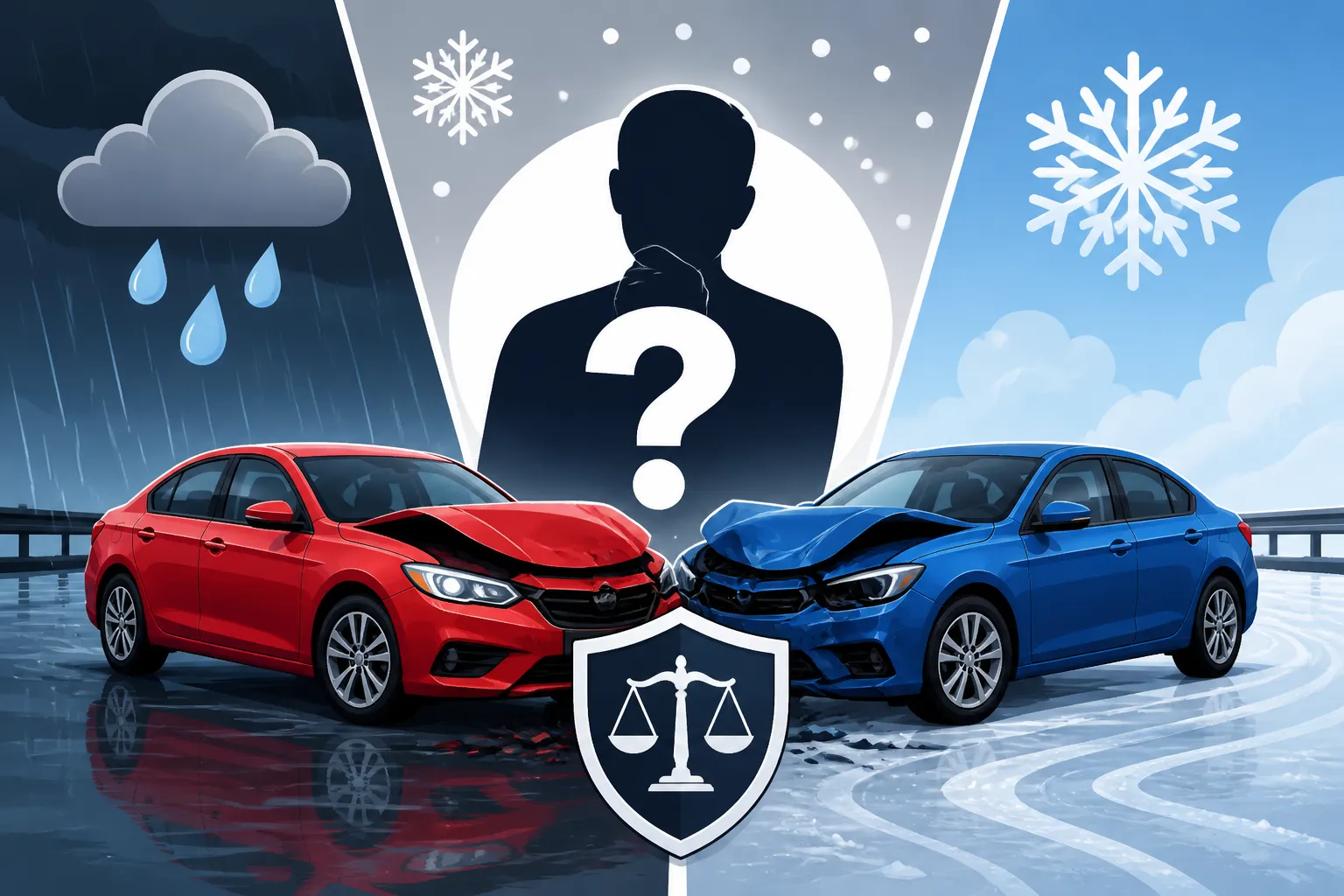
It's a common misconception that if an accident happens because of bad weather, no one is really at fault. While weather can certainly contribute to dangerous driving conditions, it rarely acts as a get-out-of-jail-free card for drivers. Instead, it alters what is considered "reasonable" driving.
Weather as a Contributing Factor, Not an Excuse
Think about it this way: a sudden downpour makes roads slick, but does it force you to hydroplane? Not necessarily. It requires you to slow down, increase your following distance, and drive more cautiously. If you fail to do so and lose control, the weather might have contributed to the hazardous conditions, but your failure to adjust your driving is what ultimately caused the accident. Insurance adjusters and legal professionals don't typically view "it was raining" or "it was icy" as a complete defense. Instead, they’ll investigate whether a driver took appropriate precautions for the conditions. Were they speeding for the weather? Did they have bald tires? Were their headlights on? These are the questions that determine culpability, making the distinction between a factor and an excuse critical. This also ties into understanding What Is Proximate Cause in a Car Accident Claim?.
Driver Responsibility Versus an "Act of God"
The legal concept of an "Act of God" refers to an unforeseeable natural event that no human foresight or care could have prevented. Things like a sudden earthquake or a tornado ripping through a highway might fit this description. However, rain, snow, and ice, while natural, are generally foreseeable and require drivers to exercise greater caution. You can't claim an "Act of God" just because it started snowing. Drivers are expected to check weather forecasts, be aware of current conditions, and adjust their driving accordingly. For instance, if you knowingly drive into a severe blizzard despite warnings, and then get into an accident, it’s highly unlikely a court or insurer would deem that an "Act of God." Your decision to drive in dangerous conditions, and your subsequent failure to drive safely within them, would likely be seen as negligence.
Specific Bad Weather Scenarios and Fault Assignment
Each type of adverse weather presents its own unique challenges and influences how fault might be determined. While the underlying principles of negligence remain, the specific actions expected of a reasonable driver can vary greatly.
Rain and Wet Roads
Rain, even a light drizzle, drastically reduces tire traction and visibility. Wet roads often lead to hydroplaning, where tires lose contact with the road surface due to a layer of water. When an accident occurs in the rain, investigators will look at several factors beyond just the rain itself. Was the driver following too closely? Did they brake suddenly and aggressively? Were their tires properly inflated and did they have adequate tread depth? For example, if Driver A rear-ends Driver B on a wet highway in Seattle, even if Driver A claims "the rain made me slide," they will likely be found at fault for Rear-End Collision Fault: Who Is Responsible?, as a reasonable driver would have increased their following distance and reduced speed to account for the conditions. Speed limits are set for ideal conditions, not for a torrential downpour. Failing to adjust your speed and distance is a common reason for fault assignment in rainy conditions.
Snow and Ice Conditions
Snow and ice are perhaps the most challenging conditions for drivers. Black ice, in particular, is insidious because it's nearly invisible. In these scenarios, the "reasonable driver" standard becomes even more stringent. Drivers are expected to travel at significantly reduced speeds, allow for much greater stopping distances, and avoid sudden maneuvers. If a driver loses control on an icy patch in Denver and collides with another vehicle, the question isn't usually "Was it icy?" but "Did the driver take reasonable precautions for known icy conditions?" This includes having appropriate tires (e.g., winter tires in snowy regions), clearing all snow and ice from their vehicle before driving, and accelerating/braking gently. A common example: a driver sliding through a stop sign on an icy road and hitting another car will almost certainly be found at fault, as they failed to account for the hazardous conditions and stop safely.
Fog and Low Visibility
Fog, heavy mist, or even dense smoke can dramatically reduce visibility to mere feet, creating extremely dangerous driving conditions. In these situations, drivers are expected to use their low-beam headlights (high beams can actually reflect off fog and worsen visibility), reduce their speed significantly, and use fog lights if equipped. The expectation is to drive at a speed that allows you to stop within the distance you can see. If a driver barrels through dense fog on a California highway at 65 mph and causes a multi-car pileup, their failure to reduce speed and enhance visibility would make them primarily at fault. Even in scenarios where one driver slows down appropriately and another rear-ends them, the second driver is typically at fault for failing to maintain a safe following distance and adjust to the reduced visibility. This is a classic case where How Insurance Companies Determine Who Is at Fault will focus heavily on driver actions and adherence to safe driving practices in adverse conditions.
Strategies for Proving Fault in Weather-Related Accidents
When an accident happens in bad weather, proving who was at fault can feel like an uphill battle. The other driver might try to blame the weather, making it challenging to secure fair compensation. However, a meticulous approach to gathering evidence is key.
Gathering Critical Evidence at the Scene
The moments immediately following an accident, especially in bad weather, are crucial for collecting evidence. If it's safe to do so, document everything:
- Photographs and Videos: Capture the scene from multiple angles. Show the damage to both vehicles, the positions of the cars, and crucially, the weather conditions themselves. Take pictures of snow on the road, puddles, ice patches, fog density, or heavy rain. Document any skid marks (or lack thereof), road signs, traffic signals, and any obstructions.
- Witness Information: If anyone saw the accident, get their contact details. Their testimony about how each driver was operating their vehicle before the crash can be invaluable, especially if they can speak to reckless driving in the conditions.
- Police Report: Always call the police, even if it seems minor. A police report documents their observations of the scene, statements from drivers and witnesses, and may include preliminary fault assessments. While not always definitive, Police Reports and Car Accident Fault often play a significant role.
- Driver Statements: Note down what the other driver says. Did they admit to speeding? Did they complain about their bald tires? Any admission of fault or statement indicating negligence can be highly beneficial.
The Role of Expert Testimony
Sometimes, determining fault in complex weather-related accidents requires more than just eyewitness accounts and photos. Accident reconstruction specialists or meteorologists can provide expert testimony. An accident reconstructionist can analyze skid marks, vehicle damage, and other physical evidence to determine vehicle speeds, braking distances, and impact angles, even accounting for reduced traction due to weather. A forensic meteorologist can provide official weather data for the exact time and location of the accident, clarifying visibility, precipitation levels, wind speeds, and temperature, which can support or refute claims about unforeseen conditions. These experts can help bridge the gap between anecdotal accounts and scientific fact, presenting a clearer picture of events for insurance adjusters or a court.
Leveraging Police Reports and Traffic Laws
As mentioned, a police report is a vital piece of evidence. It often includes an officer's assessment of fault, citations issued (e.g., for speeding, failure to maintain control), and details about the road conditions. Officers are trained to observe and document critical facts, and their impartial observations carry weight. Furthermore, traffic laws themselves often contain provisions related to driving in adverse conditions. Many states have "basic speed laws" that require drivers to operate at a speed that is reasonable and prudent for existing conditions, even if it is below the posted speed limit. For example, in California, Vehicle Code 22350 states no person shall drive at a speed greater than is reasonable or prudent having due regard for weather, visibility, traffic, and surface conditions. Citing specific laws violated by the other driver, coupled with the police report, can be very effective in proving their negligence.
Common Misconceptions About Bad Weather and Accident Fault
The unique challenges of driving in adverse conditions often lead to widespread misunderstandings about how fault is determined. Clearing up these myths can empower you to better navigate the aftermath of an accident.
"The Weather is Always to Blame"
This is perhaps the biggest misconception out there. As we've discussed, severe weather conditions like heavy rain, snow, or dense fog are rarely seen as the sole cause of an accident in the eyes of the law or insurance companies. Instead, they are considered contributing factors that demand a higher level of caution and defensive driving from motorists. If a driver fails to adapt their behavior to these known conditions—for instance, by driving too fast for slick roads or not properly clearing their windshield of snow—then their actions, or lack thereof, are what caused the accident, not the weather itself. A driver might say, "I hydroplaned, it wasn't my fault," but an adjuster will ask, "Were you driving at a reduced speed appropriate for the rain? Were your tires in good condition?" The responsibility nearly always circles back to the driver's actions.
"If I Reduced My Speed, I Can't Be at Fault"
While reducing your speed is absolutely the right thing to do in bad weather, simply slowing down doesn't automatically absolve you of all fault. The key is whether your reduced speed was sufficiently reduced for the conditions, and if you continued to exercise reasonable care in other aspects of your driving. For example, if you reduce your speed to 40 mph on an icy highway in Pennsylvania where 20 mph would have been prudent, and you still slide into another vehicle, you could still be found negligent. Similarly, if you reduced your speed but then made sudden braking maneuvers or lane changes that a reasonable person wouldn't attempt in slippery conditions, your actions could still be considered negligent. It's about the totality of your driving behavior, not just one factor. If you were driving cautiously but still got into a wreck, you might be wondering, What Happens If the Other Driver Blames You?, which can be incredibly frustrating.
Navigating Insurance Claims After a Weather-Related Accident
Dealing with insurance companies can be daunting at the best of times, but after an accident in bad weather, it can feel even more complicated. Knowing what to expect and how to prepare can make a significant difference.
Communicating Effectively with Insurance Adjusters
When you report the accident, be factual and avoid speculation. Stick to what you know happened. Describe the weather conditions accurately, but don't overemphasize them to the point where it sounds like you're trying to shift blame entirely to nature. Focus on your actions and the other driver's actions. For example, instead of saying, "The snow caused me to slide into them," say, "The roads were extremely snowy, and I was driving at 25 mph. The other vehicle suddenly swerved into my lane, and despite my reduced speed, I couldn't avoid them." Be prepared for the adjuster to ask detailed questions about your speed, visibility, tire condition, and any actions you took to avoid the crash. Remember, adjusters are looking for facts to support their How Insurance Companies Determine Who Is at Fault assessment. Be polite but firm, and never admit fault.
Understanding Your Rights If You're Partially at Fault
In many states, if you are found partially at fault for an accident, you can still recover damages, though your compensation might be reduced. This is known as comparative negligence. For instance, if you were deemed 20% at fault for driving slightly too fast for icy conditions, but the other driver was 80% at fault for running a red light, you could still recover 80% of your damages. States like California follow a "pure comparative negligence" rule, meaning you can recover even if you're 99% at fault, though your payout would be minimal. Other states have "modified comparative negligence" rules, where you might be barred from recovery if you're 50% or 51% or more at fault. Understanding your state's specific laws on What Happens If You're Partially at Fault? is crucial, as it directly impacts your potential settlement. Don't assume that because the weather was bad, and you might have some contributing factor, you are automatically out of luck.
When to Seek Legal Counsel for Complex Cases
Sometimes, despite your best efforts, the insurance companies might still try to place an unfair amount of blame on you, or the case simply becomes too complex to handle on your own. This is particularly true in accidents involving significant injuries or substantial property damage, or when there are disputes over who did what in challenging conditions. An experienced car accident attorney can help you gather evidence, consult with experts, negotiate with insurance companies, and if necessary, represent you in court. They understand the nuances of negligence laws, especially how they apply in adverse weather. Consulting with a lawyer, even for a free initial consultation, can provide clarity on your options and help ensure your rights are protected. They can evaluate if Can You Still Get Paid If You're Partly at Fault? is a viable path for you.
| Weather Condition | Common Driver Failures Leading to Fault | Proactive Steps for Safe Driving | Key Evidence to Collect Post-Accident |
|---|---|---|---|
| Rain/Wet Roads | Speeding for conditions, tailgating, sudden braking, worn tires | Reduce speed, increase following distance, gentle maneuvers, check tire tread | Photos of puddles/wetness, skid marks, tire condition, witness statements |
| Snow/Ice | Speeding, sudden turns/brakes, not clearing vehicle, inappropriate tires | Significantly reduce speed, gentle inputs, ample stopping distance, winter tires | Photos of snow/ice, uncleaned vehicle, official weather reports, dashcam footage |
| Fog/Low Visibility | Speeding, using high beams, no headlights/fog lights, sudden stops | Use low beams (and fog lights), slow down significantly, increase following distance | Photos showing visibility, witness accounts, police report observations, official weather data |
| High Winds | Not bracing for gusts, driving large vehicles without care, worn tires | Grip wheel firmly, reduce speed, anticipate gusts, check tire pressure | Official weather reports (wind speed), vehicle type, witness statements of impact |
Disclaimer
Please remember, this information is for educational purposes only and does not constitute legal advice. Every car accident case is unique, and the outcome depends heavily on the specific facts, applicable laws in your jurisdiction, and the evidence presented. If you've been involved in an accident, it's always best to consult with a qualified legal professional to discuss your individual situation.