Who Is at Fault in a Chain-Reaction Accident in California?
Getting caught in a chain-reaction car accident is incredibly frustrating and often confusing. One moment you're driving along, and the next, your world is shaking, vehicles are colliding around you, and you're left wondering not only about your safety but also who on earth is going to pay for all this damage. Figuring out fault in these complex multi-car pileups, especially here in California, can feel like a tangled mess. This guide aims to untangle that mess, explaining exactly how fault is determined in a chain-reaction accident within the Golden State.
Understanding Chain-Reaction Accidents
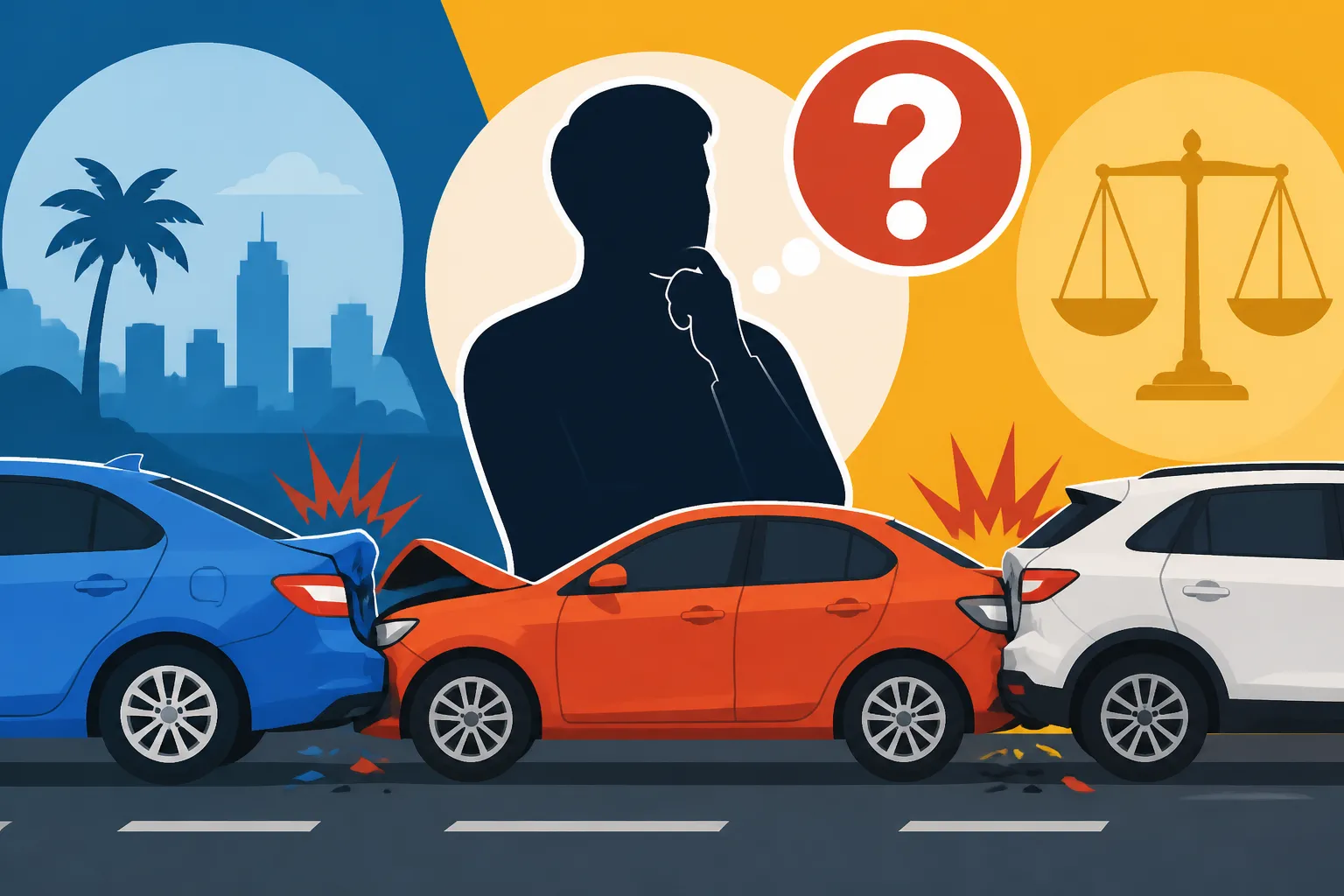
A chain-reaction accident, often referred to as a multi-car pileup, occurs when more than two vehicles collide in a series of impacts. Think of it like a domino effect: one car hits another, which then pushes that car into a third, and so on. These accidents are particularly common on busy freeways and highways, especially during rush hour or in adverse weather conditions like heavy fog or sudden rain, which can significantly reduce visibility and stopping distances.
What Defines a Chain Reaction?
The key characteristic of a chain-reaction accident is the sequential nature of the collisions. It’s not just two cars crashing; it’s a domino effect where the initial impact triggers subsequent ones. For example, if Driver A rear-ends Driver B, pushing Driver B into Driver C, and Driver C then hits Driver D, that’s a classic chain reaction. The complexity arises because while one initial impact might set everything in motion, other factors can contribute to the severity and number of subsequent collisions, such as drivers following too closely, distracted driving, or even sudden braking by a lead vehicle without proper warning.
The legal system and insurance companies look at these events with a fine-tooth comb because each individual impact can have its own contributing factors, even if they all stem from an initial incident. This means that assigning fault isn't always as simple as blaming the very first car to cause a collision, as other drivers might have also been negligent in their actions or inactions.
Common Causes of Multi-Car Pileups
While any accident is unfortunate, chain-reaction collisions often stem from a few critical errors that quickly cascade. One of the most common culprits is distracted driving, where someone isn't paying full attention and fails to react in time to slowing traffic or an incident ahead. For instance, someone glancing down at their phone might not notice the car in front of them braking suddenly, leading to an initial rear-end collision that quickly escalates.
Another major cause is following too closely, also known as tailgating. When vehicles are driving too close together, there isn't enough time or space to stop safely if the car ahead suddenly decelerates or stops. In California, with our often-congested highways, this is an all-too-frequent occurrence. Poor weather conditions, such as heavy rain, dense fog, or even the glare of the sun, can also significantly reduce visibility and traction, making it nearly impossible for drivers to react swiftly enough to avoid a pileup. Combine these factors, and you have a recipe for disaster on the road, where even a minor mistake can trigger a devastating series of events.
Determining Fault in California
California is a "fault" state, which means that the person who causes the accident is generally responsible for the damages. However, it also follows a "pure comparative negligence" rule, which is particularly important in multi-car incidents like chain reactions. This system allows for shared fault among multiple parties involved, meaning that even if you bear some responsibility for the accident, you can still recover damages from other at-fault parties, albeit reduced by your percentage of fault. This is quite different from some other states, and understanding Comparative vs Contributory Negligence Explained is crucial for any California driver.
The Role of Comparative Negligence
In a chain-reaction accident in California, it's very rare for only one driver to be found 100% at fault. This is where comparative negligence truly comes into play. Under this rule, a court or insurance company will assign a percentage of fault to each driver involved. For example, if you were deemed 20% at fault for following too closely, but another driver was 80% at fault for stopping suddenly without warning, you could still recover 80% of your damages. This system acknowledges that multiple parties can contribute to an accident, and it aims to fairly distribute financial responsibility based on each party's degree of negligence.
This can get incredibly intricate, especially when there are many vehicles involved, all with their own claims about what happened. Each driver's actions leading up to their specific impact within the chain are scrutinized. Were they speeding? Were they distracted? Did they have working brake lights? All these details help build a picture of each driver's contribution to the overall sequence of events. Understanding What Happens If You're Partially at Fault? is vital, as your actions could impact your ability to recover full compensation.
The "Presumption of Fault" in Rear-End Collisions
In many chain-reaction accidents, the first collision is often a rear-end impact. While California’s comparative negligence rule applies broadly, there's a common legal "presumption" that the driver who rear-ends another vehicle is usually at fault. This is because drivers are generally expected to maintain a safe following distance and be able to stop in time if the vehicle ahead slows or stops. This presumption, however, is not absolute and can be challenged.
For instance, if the lead driver slammed on their brakes without warning, experienced a mechanical failure, or was intentionally trying to cause a collision, the rear-ending driver might be able to demonstrate that they were not entirely at fault. Similarly, if a car was stopped unlawfully in a traffic lane, or if their brake lights were out, these factors could shift some blame. In a multi-car scenario, this initial rear-end presumption might apply to the very first collision, but then the subsequent impacts in the chain would be evaluated individually, with the comparative negligence rule always in mind. This is why getting specific legal advice regarding Who Is at Fault in a Rear-End Accident in California? is often recommended.
Unraveling the Chain of Events
Investigating a chain-reaction accident requires a meticulous look at every single detail. It’s not just about who hit whom, but the conditions, the timing, and the actions of all drivers involved. Collecting comprehensive evidence immediately after the accident is paramount to accurately determining fault.
The Importance of Evidence Collection
Right after a chain-reaction accident, your priority is safety and calling for emergency services. Once that's handled, if you're able, collecting evidence at the scene is critical. This includes taking photos and videos of all vehicles involved, their final resting positions, road conditions, traffic signs, and any visible damage. Be sure to get contact and insurance information from every driver and any witnesses. Detailed notes about the sequence of events as you perceived them, including the time and weather conditions, can also be invaluable.
Consider if there were any dashcam recordings from your vehicle or others, or if nearby businesses had surveillance cameras. These visual records can provide irrefutable proof of who did what and when. The more information you can gather, the stronger your position will be when dealing with insurance companies and potential legal claims. Without solid evidence, it can quickly become a "he said, she said" situation, making it much harder to prove your side of the story.
The Role of Police Reports and Witness Statements
When police respond to a multi-car accident, their report is a crucial document. The police report will often include diagrams of the accident scene, statements from drivers and witnesses, citations issued (if any), and the investigating officer's preliminary assessment of fault. While a police report is not a definitive legal finding of fault, it carries significant weight with insurance companies. Understanding Police Reports and Car Accident Fault is key to knowing how this document can influence your claim.
Witness statements are equally important. An objective third party's account of the accident can corroborate your story or shed light on details you might have missed in the chaos. Sometimes, a witness might have seen the initial cause of the pileup, or noticed a driver behaving erratically just before the collision. Their observations can be vital in establishing the sequence of events and the actions of the various drivers involved.
Factors Influencing Fault Assignments
Assigning fault in a chain-reaction accident in California is a complex process that involves analyzing numerous factors beyond just who hit whom. It’s about understanding the complete picture of negligence and contribution.
Breaking Down Each Impact
Instead of viewing a chain-reaction accident as one single event, insurance adjusters and legal professionals will often break it down into individual mini-accidents. Each collision within the chain is evaluated to determine the fault of the immediate drivers involved in that specific impact.
For example, if Driver A rear-ends Driver B, pushing B into C, and C then hits D:
- Impact 1 (A hits B): Driver A is likely primarily at fault for failing to maintain a safe distance. However, if Driver B stopped suddenly and unexpectedly, or had non-functioning brake lights, B might bear some comparative fault for that initial collision.
- Impact 2 (B hits C): If Driver B was pushed into C by Driver A, Driver A would likely be responsible for the damage to C caused by B. But if B had enough time to stop before hitting C, but failed to do so due to distraction or speed, then B might also bear some fault for hitting C.
- Impact 3 (C hits D): Similarly, if C was pushed into D by B (who was pushed by A), then A is ultimately responsible for the damage to D. But if C had time to react and avoid hitting D, C could also be found partially at fault.
This detailed breakdown ensures that each driver's negligence, or lack thereof, is properly accounted for. The whole process is designed to unravel How Fault Is Determined in a Car Accident in such intricate scenarios.
How Insurance Companies Determine Who Is at Fault
When you file a claim after a chain-reaction accident, your insurance company, and potentially the other drivers' insurers, will launch their own investigations. They'll collect evidence, review police reports, interview drivers and witnesses, and examine vehicle damage. Each insurance company will, naturally, try to minimize their own payout, so they will be looking for any evidence that shifts blame to another party or reduces their insured's percentage of fault. This can lead to lengthy negotiations and disagreements between insurance carriers.
They’ll apply the principles of comparative negligence to assign percentages of fault. For instance, if an adjuster determines that Driver A was 70% at fault for the initial impact that triggered the chain, Driver B was 20% at fault for following too closely and not reacting quickly enough, and Driver C was 10% at fault for having bald tires that reduced braking ability, those percentages will then dictate how much each insurance company is liable for. This entire process is a prime example of How Insurance Companies Determine Who Is at Fault.
| Driver | Action/Condition Contributing to Accident | Estimated Percentage of Fault (Example) |
|---|---|---|
| Driver A | Rear-ended lead vehicle, initiating chain | 70% |
| Driver B | Following too closely, limited reaction time | 20% |
| Driver C | Distracted driving, slow reaction | 10% |
| Driver D | No fault (hit from behind while stopped) | 0% |
This table is a hypothetical example. Actual fault percentages vary widely based on specific accident details.
It's common for insurance companies to disagree, which is why having thorough documentation and potentially legal representation can be so beneficial.
What to Do After a Chain-Reaction Accident in California
Being involved in a multi-car pileup is terrifying. Knowing the right steps to take immediately afterward can significantly protect your rights and improve your chances of a fair fault determination.
Immediate Steps at the Scene
Your absolute first priority after any accident, especially a chain reaction, is safety. Move your vehicle out of the flow of traffic if possible and safe to do so. Check on yourself and your passengers for injuries, and then check on others involved. Call 911 immediately to report the accident to the police and request medical assistance if anyone is injured. Even if injuries seem minor, it’s always better to get checked out by a medical professional. Many injuries, like whiplash or concussions, have delayed symptoms.
Once the immediate danger is addressed, begin gathering information. Exchange contact and insurance details with all drivers involved. Take photographs and videos from multiple angles, capturing vehicle damage, license plates, road conditions, and any relevant surroundings. Look for potential witnesses and ask for their contact information. However, be careful not to admit fault or apologize for anything, as these statements can be used against you later. Just stick to factual exchanges. For a more comprehensive checklist, refer to What to Do After a Car Accident: Step-by-Step (2027).
Navigating the Claims Process
After you've dealt with the immediate aftermath, the next big step is to file a claim. In a chain-reaction accident, you'll likely be dealing with multiple insurance companies. You should report the accident to your own insurance company as soon as possible, even if you believe another driver is entirely at fault. Your policy might have specific requirements for timely reporting, and they can also guide you through the process, especially if you have uninsured motorist coverage or personal injury protection.
Be prepared for a potentially lengthy investigation by the insurance companies. They will review all the evidence to assign fault and determine liability for damages. This is where your diligently collected evidence becomes invaluable. If the other driver's insurance company tries to assign you more fault than you believe is fair, or if they offer a settlement that seems too low, you might need to negotiate. Sometimes, especially with complex multi-car crashes, having an experienced car accident lawyer can be extremely beneficial to advocate on your behalf and ensure your rights are protected throughout the process. Understanding How to File a Car Accident Insurance Claim can help you prepare for this stage.
When to Consider Legal Counsel
Given the complexity of fault determination in multi-car pileups, especially under California's comparative negligence laws, deciding whether to involve a legal professional can be a critical choice.
Complexities of Multiple Parties and Injuries
Chain-reaction accidents inherently involve multiple vehicles and, often, multiple injured parties. Each driver has their own perspective, and their insurance company will be working to protect their interests. This often creates a situation where blame is shifted around, and it becomes difficult for an individual to navigate the various claims and counter-claims on their own. If you're dealing with significant injuries, extensive property damage, or if there's any dispute over fault, the complexities can quickly become overwhelming.
An attorney specializing in car accidents in California can help cut through this red tape. They can gather additional evidence, interview witnesses, work with accident reconstruction experts if necessary, and communicate directly with all the insurance companies involved. This allows you to focus on your recovery rather than the stress of legal and insurance wrangling. A good lawyer will understand how to build a strong case to prove the negligence of the other parties and protect your right to fair compensation, ensuring that your percentage of fault, if any, is accurately and fairly assessed. This is often the case when trying to determine Who Is at Fault in a Multi-Car Pileup.
Maximizing Your Claim in a Comparative Negligence State
In a pure comparative negligence state like California, every percentage point of fault assigned to you can directly reduce the compensation you receive. For example, if your total damages are $100,000, but you are found 25% at fault, your recoverable damages would be reduced to $75,000. Insurance companies know this and will often try to assign a higher percentage of fault to you to reduce their payout.
A lawyer’s expertise is invaluable here. They can challenge unfair fault assessments, present evidence to minimize your liability, and strategically negotiate with all parties to ensure you receive the maximum compensation possible for your injuries, medical bills, lost wages, and pain and suffering. They understand the nuances of California law and how to leverage it to your advantage, especially when it comes to demonstrating that other drivers' negligence was the primary cause of the chain reaction. If you're wondering, Do You Need a Lawyer for a Car Accident? (2027), a multi-car accident is often a strong indicator that legal help would be beneficial.
Disclaimer
Please remember that this article provides general information and is not legal advice. Every car accident case is unique, and the specific facts and circumstances of your incident will dictate the outcome. It is always recommended to consult with a qualified legal professional for advice tailored to your specific situation.